





Kaizen Teams

Dropdown

Table of Contents

Time to read

·

12

Published on

·

March 26, 2025

Last updated on

·

August 18, 2026

Bruno Bologna, CEO at Kaizen Softworks

Bruno Bologna

Chia seed alchemist

CEO

AI

AI

Explore the Adoption of GenAI with Kaizen

Published on

·

August 18, 2026

Last updated on

·

August 18, 2026

Time to read

·

12

Bruno Bologna, CEO at Kaizen Softworks

Bruno Bologna

CEO

Seeing the benefits of GenAI in software development without actively exploring how to implement them in our processes feels like ignoring the obvious.

For this reason, starting this year, Kaizen is investing in developing this competency and understanding how we can apply GenAI in our day-to-day operations and leverage its benefits within software development.

We see two key ways GenAI impacts our discipline:

  • Create systems with GenAI-powered features.
  • Use GenAI to accelerate development.

In short we want to:

  • Speed up AI adoption in software dev.
  • Level up our capabilities.
  • Share what we learn

To be clear: This exploration focuses specifically on GenAI, excluding other areas like Machine Learning, Computer Vision, Natural Language Processing, and Robotics.

The Tip of the Iceberg

This is not a post about the benefits of GenAI applied to software development, so I won't delve into that. I'll take it as obvious that the impact is expected to be massive and inevitable.

Faced with this large-scale transformation, it's natural that both the people who make up our teams and our clients feel curious, question its scope, and actively seek ways to incorporate this technology into their daily work.

This drive has two key engines: on one hand, the sheer magnitude of the technological disruption we are witnessing and, on the other, people's innate curiosity to explore its potential. We want to channel this energy in a structured way, ensuring that the adoption of generative AI is carried out with an organized and sustainable long-term approach within Kaizen.

Our commitment is to guide this revolution responsibly, protecting the privacy of data and the security of our clients and collaborators. The key is not just to integrate the technology, but to do so in a way that enhances human capabilities and generates a real and positive impact in our industry.

The Complex Nature of GenAI Adoption

One challenge in adopting this technology is that its process is completely different from cloud solutions, specific frameworks, or programming paradigm changes that we are already familiar with. 

A priori, the difference mainly lies in that:

  • The applicability of this technology is constantly evolving.
  • The value that GenAI offers depends both on the user's ability to interact with the tool and on the iterative process of constant testing and adjustment.
  • New tools emerge daily but haven't yet consolidated in the market.
  • It's still difficult to define what AI adoption means in more concrete terms.

Therefore, we understand that adopting GenAI cannot be done in a deterministic way. Instead, it's better to see it as a wicked problem (complex problem, without a clear or definitive solution), because there is no clear process for achieving adoption and we don't know what needs to happen or should have happened to affirm that we have adopted GenAI and that we are using it in an appropriate and productive way.

Structure and Adoption Methodology

To carry out this adoption process in an organized and effective way, we are leveraging a company area called Innovation Hub. In this space, projects are developed and teams are formed to work on different initiatives. The goal of this group is to help us expand our offerings, support the technical pre-sales team, take advantage of opportunities to improve the company's administrative and operational efficiency, and simultaneously acquire knowledge about new technologies.

This group seeks elasticity, where different people from various teams can work on a common project. It proactively encourages participation from different people, which promotes cross-pollination and a culture of innovation.

Additionally, to address the AI adoption project given the characteristics of this technology, inspiration was drawn from Henrik Kniberg's book "Generative AI in a Nutshell", especially the chapter referring to "Leading the Change."

We found in this approach a mechanism that tackles the complexity of adopting something as disruptive as AI, promotes experimentation, responsible use, and is quite compatible with our culture and organizational structure. A key characteristic is that it is bottom-up and top-down approach, seeking to viralize adoption through demonstrations of what can be done while making formal mechanisms available to make time and tools available to learn how to use it.

What's Next?

Generative artificial intelligence is transforming the software industry, and at Kaizen we are not passive spectators: we are actively exploring how to apply it in concrete, useful, and responsible ways.

As a client, this means that:

  • We won't make false promises or create expectations we can't meet.
  • We will test, validate, and transparently share our successes and failures.
  • You'll be able to benefit from greater efficiency and new capabilities in projects, always with a pragmatic approach.

We will create spaces for dialogue to discover together how GenAI can bring real value to your business. The future is inevitable, but we can choose how to build it. And at Kaizen, we want to build it together with you.

Seeing the benefits of GenAI in software development without actively exploring how to implement them in our processes feels like ignoring the obvious.

For this reason, starting this year, Kaizen is investing in developing this competency and understanding how we can apply GenAI in our day-to-day operations and leverage its benefits within software development.

We see two key ways GenAI impacts our discipline:

  • Create systems with GenAI-powered features.
  • Use GenAI to accelerate development.

In short we want to:

  • Speed up AI adoption in software dev.
  • Level up our capabilities.
  • Share what we learn

To be clear: This exploration focuses specifically on GenAI, excluding other areas like Machine Learning, Computer Vision, Natural Language Processing, and Robotics.

The Tip of the Iceberg

This is not a post about the benefits of GenAI applied to software development, so I won't delve into that. I'll take it as obvious that the impact is expected to be massive and inevitable.

Faced with this large-scale transformation, it's natural that both the people who make up our teams and our clients feel curious, question its scope, and actively seek ways to incorporate this technology into their daily work.

This drive has two key engines: on one hand, the sheer magnitude of the technological disruption we are witnessing and, on the other, people's innate curiosity to explore its potential. We want to channel this energy in a structured way, ensuring that the adoption of generative AI is carried out with an organized and sustainable long-term approach within Kaizen.

Our commitment is to guide this revolution responsibly, protecting the privacy of data and the security of our clients and collaborators. The key is not just to integrate the technology, but to do so in a way that enhances human capabilities and generates a real and positive impact in our industry.

The Complex Nature of GenAI Adoption

One challenge in adopting this technology is that its process is completely different from cloud solutions, specific frameworks, or programming paradigm changes that we are already familiar with. 

A priori, the difference mainly lies in that:

  • The applicability of this technology is constantly evolving.
  • The value that GenAI offers depends both on the user's ability to interact with the tool and on the iterative process of constant testing and adjustment.
  • New tools emerge daily but haven't yet consolidated in the market.
  • It's still difficult to define what AI adoption means in more concrete terms.

Therefore, we understand that adopting GenAI cannot be done in a deterministic way. Instead, it's better to see it as a wicked problem (complex problem, without a clear or definitive solution), because there is no clear process for achieving adoption and we don't know what needs to happen or should have happened to affirm that we have adopted GenAI and that we are using it in an appropriate and productive way.

Structure and Adoption Methodology

To carry out this adoption process in an organized and effective way, we are leveraging a company area called Innovation Hub. In this space, projects are developed and teams are formed to work on different initiatives. The goal of this group is to help us expand our offerings, support the technical pre-sales team, take advantage of opportunities to improve the company's administrative and operational efficiency, and simultaneously acquire knowledge about new technologies.

This group seeks elasticity, where different people from various teams can work on a common project. It proactively encourages participation from different people, which promotes cross-pollination and a culture of innovation.

Additionally, to address the AI adoption project given the characteristics of this technology, inspiration was drawn from Henrik Kniberg's book "Generative AI in a Nutshell", especially the chapter referring to "Leading the Change."

We found in this approach a mechanism that tackles the complexity of adopting something as disruptive as AI, promotes experimentation, responsible use, and is quite compatible with our culture and organizational structure. A key characteristic is that it is bottom-up and top-down approach, seeking to viralize adoption through demonstrations of what can be done while making formal mechanisms available to make time and tools available to learn how to use it.

What's Next?

Generative artificial intelligence is transforming the software industry, and at Kaizen we are not passive spectators: we are actively exploring how to apply it in concrete, useful, and responsible ways.

As a client, this means that:

  • We won't make false promises or create expectations we can't meet.
  • We will test, validate, and transparently share our successes and failures.
  • You'll be able to benefit from greater efficiency and new capabilities in projects, always with a pragmatic approach.

We will create spaces for dialogue to discover together how GenAI can bring real value to your business. The future is inevitable, but we can choose how to build it. And at Kaizen, we want to build it together with you.

Related Articles

View all articles

·

Sep 21, 2026

When PMs can ship code, what changes for Engineering?

AI coding agents give Product and Engineering more autonomy, plus a new coordination problem. See how a two-cycle model keeps both moving.

12 read time

Read more

AI has changed what Product Managers can do.

A PM can now go from an idea to working software in hours. They can build a flow, put it in front of a customer, learn from it, change it, and test again without waiting for every iteration to go through Engineering.

That creates an opportunity for product teams. It also creates a new challenge.

Just because a PM can build something doesn’t mean that thing is ready to become production software.

If we don’t rethink how Product and Engineering work together, faster prototyping can become more code for Engineering to untangle, more unclear ownership, and more pressure to turn experiments into production features.

The answer is to separate exploration from construction.

PMs and engineers are solving different problems

During product discovery, the PM is trying to answer: Should we build this?

That means testing assumptions, changing direction quickly, throwing things away, and getting something real enough in front of a customer to learn from it.

Engineering is solving a different problem: How do we build this correctly?

That means thinking about architecture, security, maintainability, performance, edge cases, and everything else required for software that has to live in production.

Both need AI. But they don’t need the same working conditions.

Exploration benefits from speed, autonomy, and low friction. Construction needs stronger guarantees and guardrails. Trying to optimize the same environment for both creates tension.

So instead of asking how PMs can safely contribute code to the production codebase, there’s a more useful question: What if PMs had their own space to build and validate ideas?

Give PMs a safe place to explore

A PM working with an AI coding agent can build functional versions of new ideas. Not a Figma screen. Not a ticket describing what something might do.

Working software that can be used to test the product experience. The important part is that this environment is separate from production.

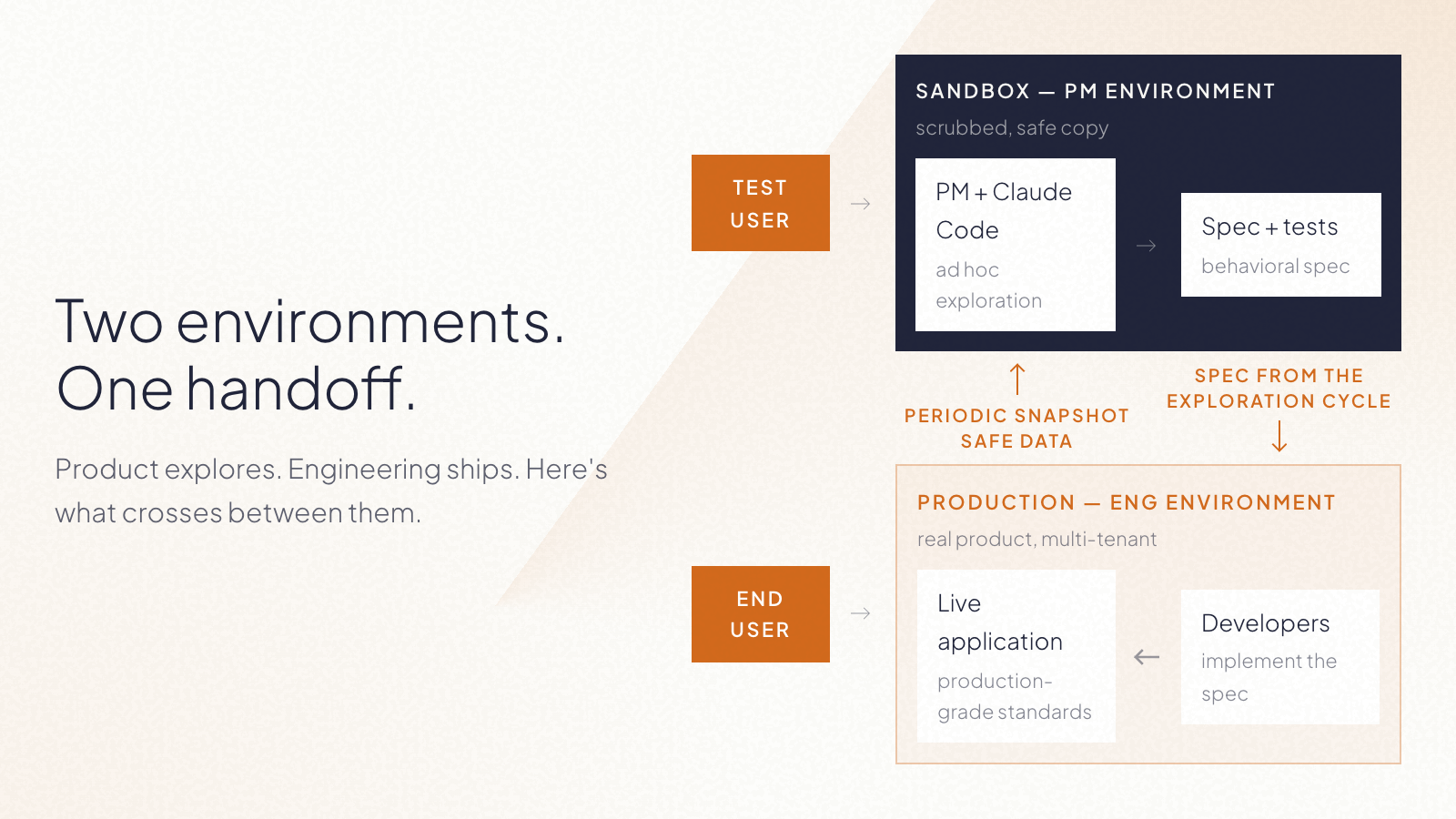
That boundary gives the PM freedom to experiment without requiring the same controls we’d expect from production software. The environment can be designed so experiments can’t affect the live product or access things they shouldn’t.

Now the PM’s workflow can look more like:

Idea → build → test with users → learn → iterate

Engineering doesn’t need to be pulled into every cycle.  Engineering still matters. It  gets brought in once Product has stronger evidence about what’s worth building.

The prototype shouldn’t be the handoff

This is where things can go wrong.

If a PM spends two days building something with AI and then gives the repository to Engineering saying, “It mostly works, can you finish it?”, we haven’t improved the product development process. We may have just moved the mess downstream.

The prototype should help answer product questions. It shouldn’t make technical decisions on Engineering’s behalf.

What Engineering needs from exploration is intent.

  • What does the feature need to do?
  • How should it behave?
  • What did we learn from customers?
  • What happens in the important edge cases?
  • How will we know when the production version works as intended?

That becomes the handoff.

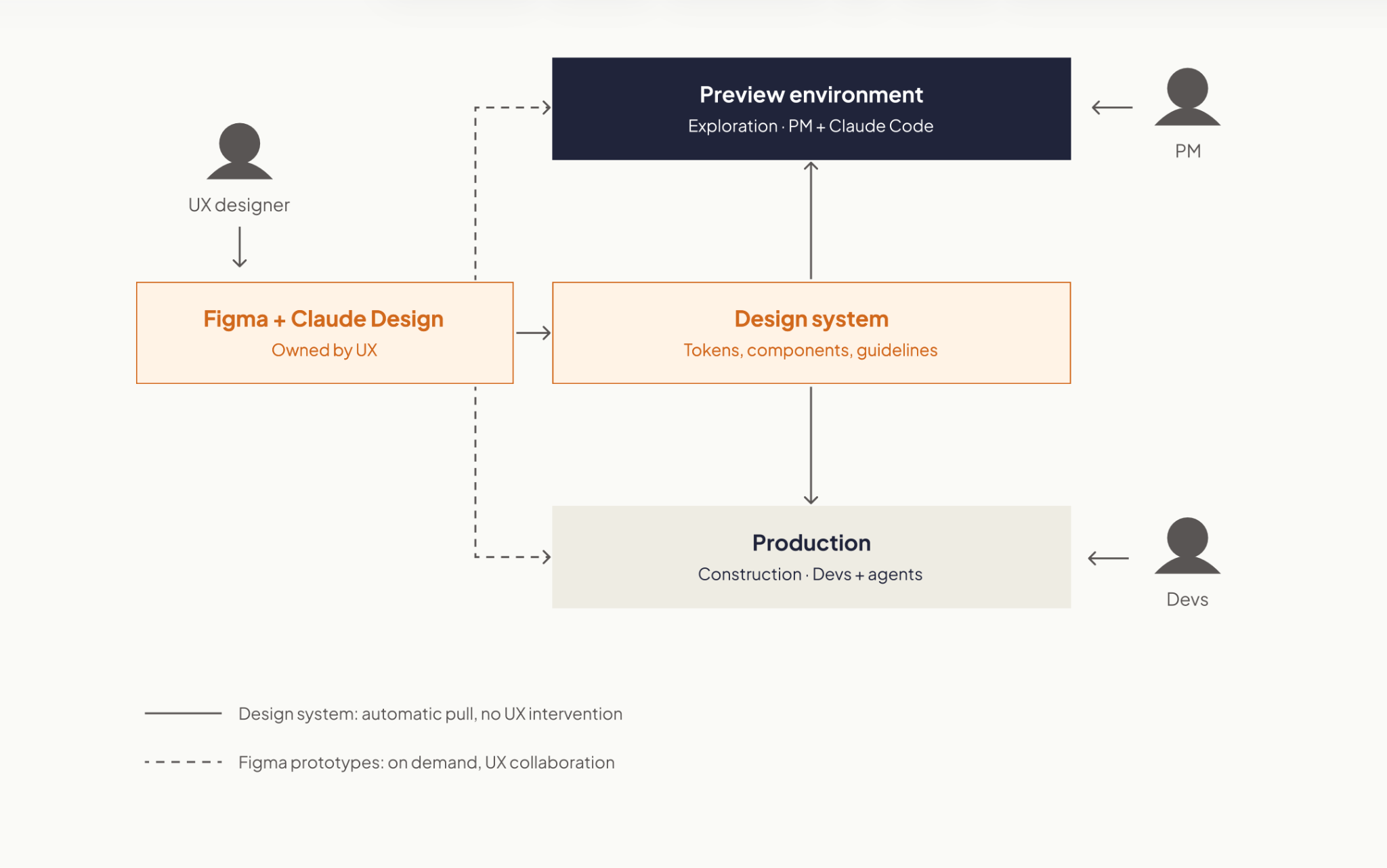
At Kaizen, we’ve been exploring a model where the bridge between the two cycles is a behavioral specification and a test plan, supported by the working prototype as a reference. The implementation itself stays behind.

What crosses into construction is the spec: a behavioral description, a test plan, and a link to the prototype as reference. The prototype itself stays where it was built.

In simple terms:

Product owns the what. Engineering owns the how.

That distinction matters even more now that AI makes it so easy for both sides to generate code.

What the workflow could look like

A PM starts with a product hypothesis. Instead of immediately turning it into a backlog item, they use AI to build enough of the experience to test it. They put it in front of users. They discover that part of the original idea was wrong. So they change it. They test again.

Once the problem and desired behavior are clear enough, the PM closes the exploration cycle with a clear specification and acceptance criteria.

Engineering then starts from that understanding, not from the PM’s experimental code only. They decide how the feature fits into the architecture, how it should be implemented, what needs to be verified, and how it reaches production.

The result is two parallel forms of autonomy:

  • PMs don’t need Engineering for every experiment.
  • Engineers don’t inherit implementation decisions from every experiment.

More autonomy doesn’t have to mean less ownership.
AI can make discovery faster

A lot of the conversation around AI in software teams is still about developer productivity. How much faster can we write code? How much implementation can an agent take on?

Those questions matter. But for Product, there may be an even bigger opportunity upstream. AI can shorten the distance between having an idea and learning whether that idea is any good.

That changes what PMs can bring to an engineering team. Instead of: “We think customers want this.” They can increasingly say: “We tested this behavior with customers. Here’s what worked, what didn’t, and exactly what we now need the product to do.”

That’s a much better starting point for building production software.

If you have a prototype and want to take the idea into production, we can help you determine what needs to happen next.

·

Aug 28, 2026

About Catalyst 26: Partnerships & Ecosystem Conference

Everything to know about Catalyst 26: dates, price, who attends, both keynote recaps, and when the next Catalyst event is.

12 read time

Read more

Catalyst 26 was Partnership Leaders' fifth annual conference for partnership, ecosystem, and go-to-market professionals. It took place August 25 and 26, 2026, at the Marriott Hotel at the Brooklyn Bridge in New York, with more than 1,000 attendees and 70-plus speakers from companies including Anthropic, OpenAI, Google, Microsoft, IBM, BCG, and Siemens.

Dates August 25–26, 2026
Location Marriott Hotel at the Brooklyn Bridge, Brooklyn, NY
Edition 5th annual
Attendees 1,000+ partnership, ecosystem, and GTM professionals
Speakers 70+, including people from Anthropic, OpenAI, Google, Microsoft, IBM, BCG, and Siemens.
Price $849 early bird, rising to $999, then $1,999

Who Catalyst events are for

Catalyst brought together people building and running partner programs across SaaS, AI, consulting, systems integration, agencies, and major cloud platforms.

Attendees included executives leading partnership organizations, and people working directly in alliances, partner sales, marketing, operations, strategy, and enablement.

What Catalyst 26 is like

You can look at the agenda before a conference and have a pretty good idea of what you'll find. Being there is different.

This year's theme was "Navigating Frontier Ecosystems". Anthropic's Head of Partnerships and one of OpenAI's partner program leads appeared on the same agenda as people from Oracle, Siemens, IBM, and BCG, companies that have run formal partner programs for two decades.

That mix was one of the most interesting parts of the conference. Newer AI companies were discussing partner tiers, co-selling, and joint delivery alongside companies where those models have been part of their business for years.

What Catalyst 26 covered

Catalyst 26 split its sessions into eight pillars:

  • Advancing Organizational Maturity: turning partnerships into something measured and repeatable instead of one founder doing favors for another.
  • Become a Strategic Partner: getting partnerships involved when product and business decisions are made, not told about them afterward.
  • Frontier Partner Experience: adapting partner programs as AI changes how companies build and integrate products.
  • Path to CPO: career sessions for people aiming to lead partnerships at the executive level.
  • Co-Build: two companies building something together.
  • Co-Market: two companies running a campaign together.
  • Co-Sell: two sales teams working the same deal.
  • Co-Serve: two companies delivering the same engagement to a client.

Catalyst 26 sessions

Day 1 Keynote

The Day 1 keynote brought together Partnership Leaders’ CEO Asher Mathew, Tribe AI’s Co-founder & CEO Jaclyn Rice Nelson, Anthropic’s Head of Partnerships Phil Samenuk, and Boomi’s Chairman & CEO Steve Lucas.

Their discussion focused on how companies are relying on partners to build, sell, and deliver products across AI, cloud, and enterprise software. A few points stood out:

  • More companies have dedicated partner teams now, which means a generic, one-size-fits-all partner program doesn't cut it anymore. Partners show up when the program fits how they work.
  • New AI products and cloud services are shipping so fast that a partner program can't just get set once and left alone. Incentives, support, and how you work together need regular updates.
  • Partnerships also came up as a way to access data a company couldn’t reach on its own, whether that meant getting access to it, combining it, or putting it to use.
  • AI doesn't change the basics of a good partnership. Account planning, clear ownership, and relationships built over time still matter most.

Day 2 Keynote

The Day 2 keynote featured Ramp’s Lead Economist Ara Kharazian, Eliza’s Founder Brian Benedict, Siemens’ EVP Global Partner Ecosystem Dion Smith, and Oracle’s SVP, Partner Sales & Operations Strategy Leah Yomtovian.

A few points stood out:

  • The spending data told a slower story than expected: AI adoption is mostly going toward productivity gains and task automation, not some overnight shift.
  • Siemens is in the middle of folding more than 68,000 partners and roughly 200 separate programs into a single global one, mainly to make it easier to coordinate across IT and operational technology.
  • Oracle's approach is a running "listening tour": every partner gets the same baseline benefits, then incentives and credits get layered based on the type of partner and how they work with Oracle.
  • There was also talk of a newer kind of service team: bring in engineers, turn AI requirements into working products, and reuse delivery methods that already work instead of starting from scratch each time.

Next Catalyst events

The date and location of Catalyst 27 hasn’t been announced yet. In the meantime, you can check out the half-day Catalyst Summits in different cities:

  • October 20, 2026 - Seattle
  • October 27, 2026 - Chicago
  • October 2026 - Los Angeles
  • December 2026 - Singapore

Check Partnership Leaders’ events page for updates.

llms.txt