





A place where you continuously improve.
Challenging projects to own, people worth learning from, and no micromanaging standing between you and your best work.
US IN A NUTSHELL
12
Years in business
Building software that lasts beyond the first release.
80+
Team members
A size where you still know everyone, and everyone still knows you.
5
Years team tenure
Nobody sticks around that long by accident.
Our Culture
You do the work. You make the calls. That's horizontal.

The team tells it better than we do.
See how we built a transparent salary policy around fairness, market data, purchasing power, and shared decision-making.

12 read time
A transparent, decentralized, and human approach to compensation
Let’s face it, salary decisions in most companies feel like a black box. You work hard, get good feedback… and still wonder: Am I being paid fairly? Who decides that, anyway?
At Kaizen, we decided to do things differently.
We built a transparent and collaborative salary policy, one that doesn't rely on negotiations behind closed doors, or a single person pulling the strings. Instead, it's a decentralized, data-informed system that values fairness, context, and sustainability.
Here’s how our salary policy actually works, and why we believe it reflects the culture we’re building every day at Kaizen.
From a Centralized Bottleneck to a Collaborative System
In the early days, our CEO, Bruno, handled all salary reviews. His intentions were fair and well-meaning, but the process just wasn’t scalable. Reviews took time, data was hard to update, and decisions were largely centralized.
So a few Kaizeners decided to change that.
Martin (our Agile Coach), along with Nacho and Eduardo (two of our tech leads), proposed a change. They started codifying the values and principles Bruno used to make decisions and turned them into a transparent, repeatable process the whole company could see.
They focused on four main goals:
- Standardize the principles that guide compensation.
- Reduce how long salary reviews take.
- Replace case-by-case negotiation with proactive, periodic reviews.
- Open up the process so more people could contribute, not just leadership.
The Four Pillars of Our Compensation Model
We based our salary policy on four clear, concrete pillars. Each one helps us make decisions that are fair, sustainable, and rooted in reality.
1. Market Competitiveness
We subscribe to trusted market surveys (CPA Ferrere and Búsquedas IT) and build salary bands by role and experience.
Instead of guessing or benchmarking against vague “industry averages,” we aim to land between the 20th and 80th percentile of real-world salaries. This gives us flexibility to reward growth while staying competitive across roles.
2. Real-World Purchasing Power
A salary isn’t just a number, it’s what it can actually buy.
That’s why we track inflation, currency fluctuations, and cost of living. We don’t just raise salaries because it’s time; we raise them when people’s actual purchasing power is impacted. It’s about making sure people can live well, not just look good on paper.
This principle of real-world stability also applies to when you get paid. We pay salaries on the first day of each month. If that day is a holiday or weekend, you get paid on the last business day of the previous month.
3. Business Sustainability
We’re transparent about the fact that salaries are a big investment, and we need to manage them responsibly.
We track our Gross Margin (revenue minus direct project costs), and aim to keep it around 50% to stay healthy. Every proposed salary adjustment gets run through simulations to see if it keeps us on track.
It’s a way of saying: yes, we care about people, and we also care about keeping this company strong for the long haul.
4. Internal Equity
Similar work should mean similar pay across different departments, with room to recognize impact.
We use years of experience as our starting point (it’s a reliable guide about 80% of the time), and then enrich that with input from team leads and principals. This helps us identify people who are growing fast and contributing at a higher level, even if they’re earlier in their careers.
How a Salary Review Actually Works
Anyone at Kaizen can request a salary review, for themselves or a colleague. But we also run company-wide reviews twice a year (around March and September), and on every Kaizener’s yearly anniversary.
Here’s what the process looks like:
- Update the Data: We bring in fresh market numbers and adjust our salary bands.
- Analyze the Business: We review company metrics like Gross Margin and economic indicators.
- Evaluate Individually: We assess each person’s place in their band using experience, feedback, and performance.
- Run Simulations: Before making any changes, we simulate the financial impact to ensure company health.
- Build the Proposal: All proposed changes are put together in one doc.
- Final Review: Bruno steps in here for a final pass; not to make top-down decisions, but to ask thoughtful questions and give input.
- Communicate: We sit down with each team member and talk through the outcome and reasoning.
Why This Matters
Our salary policy isn’t perfect. But it’s transparent, thoughtful, and built by the people who live it every day.
It reflects who we are as a company: collaborative, transparent, and constantly evolving. And because we value that long-term commitment, we have other ways of showing it. For example, after three years at Kaizen, your personal laptop bought with an allowance benefit, is 100% yours to keep.
So if you’re someone who values honesty, ownership, and real context behind how things work, you might feel right at home here.
Curious to learn more about life at Kaizen or how we work?
Check out our open roles or reach out to [email protected], we’re always happy to talk.
See how our hiring process brings real teammates into each step to build stronger teams with care, clarity, and shared ownership.
12 read time
At Kaizen, we believe building an amazing team is everyone’s job. That’s why our hiring process isn’t siloed in one department, it's a hands-on, collaborative effort where everyone from developers and designers to project leads has a voice.
The result is a team of people who truly reflect our values and are excited to grow with us. The proof is in our stability: our annual turnover rate is just 5%, and an incredible 0% among key players.
We’ve designed our process to be thorough, not bureaucratic. From start to offer, it typically takes 3 to 6 weeks. Here’s a look at how it works.
We Start on the Inside
Before we post a role publicly, we share it internally through KaizenOS, our web app built to bring transparency into our organizational structure. We’re committed to our team’s growth, so we give them the first shot, whether they’re ready for a new challenge themselves or know someone who’d be a great fit.
Only after we’ve explored internal options do our People Care team and the project lead sit down to define the role and shape a job description that reflects what we truly need.
Step 1: Screening
This is a relaxed, get-to-know-you call with our People Care team. We’ll chat about:
- Your background and work experience
- What drives you and what you’re looking for in your next role
- Your English level
- Salary expectations
But this is a two-way street. We want you to grill us, too. We’ll give you the inside scoop on Kaizen and answer any questions you have.
Step 2: Cultural Interview
This part of the process is special. It’s not run by People Care, it’s led by fellow Kaizeners from all areas of the company: developers, designers, leads, you name it.
Anyone who wants to join in can volunteer. Why? Because our culture is our people. And they’re the best judges of who’ll thrive here.
We’re looking for teammates who:
- Communicate with clarity and kindness
- Believe great ideas can come from anywhere and can challenge them respectfully.
- Take ownership and proactively look for solutions.
- Are naturally curious and always eager to learn.
- Aren't afraid to speak up or ask questions.
Step 3: Technical Interview
This is where we dive into your expertise. You’ll meet with senior team members who know the role and the tech inside and out. We skip the brain teasers and "gotcha" questions, and we focus on practical, real-world problems.
For junior developers, we start with a short (1-hour tops) take-home exercise. It’s not a pass/fail test; it’s a starting point for a conversation about how you think, how you solve problems, and how you approach the work.
Step 4: Team Meeting
In this stage, you'll meet with your potential teammates for a practical conversation about the project's challenges and to assess the mutual fit.
Then, for client-facing roles, there is an optional instance with the client. Think of it as a chemistry check to make sure it’s a great fit for you, the client, and us.
To keep things fair and focused on skills, we often use a "blind" version of your resume for this stage. We remove details like your name and past employers so the focus remains 100% on your skills, experience, and talent. It’s a simple way to reduce bias and let your work speak for itself.
Step 5: Psychotechnical Interview
The final step is a one-on-one psychotechnical interview with a People Care specialist. Through a conversation that includes some competency-based questions, we get to know you on a deeper level.
We believe in a holistic view, so this chat isn't a make-or-break step; it's a valuable part of the overall evaluation. The information gives us insight into how you might behave in certain scenarios and, most importantly, helps us prepare the best possible onboarding for you, tailored to your needs.
Sound Like Your Kind of Team?
This process is how we build the dedicated, invested teams that our clients love. It’s how we find people who don’t just work at Kaizen, but actively shape it.
If this way of working feels like a good fit, we’d love to hear from you.
👉 Explore Careers
And if you’re a company looking for a team that brings this same care, collaboration, and energy to every project, we’re here for that too.
👉 Let’s Discuss Your Project
We don’t have traditional managers. This is how we make decisions and keep things moving.
12 read time
There's a myth that in flat organizations, everyone decides on everything.
That's not how it works. At least not at Kaizen.
When people hear "no managers," they often picture one of two extremes: either total chaos where nobody is accountable, or endless meetings where 80 people vote on which coffee to buy. The reality is neither.
Not everyone decides on everything. Not everyone votes. What we do have is a clear set of decision-making methods that we choose based on context.
It depends on who's affected and how deep the impact goes
Before choosing how to decide, we ask ourselves a few questions:
- Who is affected? A decision that only impacts one team doesn't need the whole company involved. A decision that affects everyone's daily work does.
- How deep is the impact? Changing the office furniture is wide but shallow. Changing the salary model is deep and lasting.
- Is it reversible? If we can easily undo it, we can move fast and just inform. If it's hard to reverse, we slow down and include more people.
- How urgent is it? And here we're careful to distinguish real urgency from anxiety, the pressure to decide quickly because someone already has "the answer" in mind.
These dimensions help us pick the right method. Not every decision deserves the same process.
Our decision-making toolkit
Over the years, we've landed on a few methods that we use depending on the situation:
1. Role-based decisions
Some decisions belong to a specific role. If someone owns a responsibility, say, office logistics or hiring for a team, they decide within that domain. No committee needed. The key is that roles are transparent: everyone knows who owns what, and the scope of each role's authority is clear.
2. Advice Process
When a decision doesn't clearly belong to one role, or when it crosses boundaries, we use the advice process. Here's how it works:
- Someone takes the initiative. They identify the problem and own the process.
- They gather input from people who are affected and people with expertise.
- They seek advice, real conversations, not rubber-stamping.
- They make the decision and communicate it, including what advice they incorporated and what they didn't (and why).
The decision-maker is not a committee. It's one person (or a small group) who takes responsibility. But they don't decide in isolation, they bring in the perspectives that matter.
We sometimes call this "Team Advice" when a working group forms around an issue that doesn't naturally fall into anyone's area, and "Area Advice" when a team opens up a topic that exceeds their own scope.
3. Consent (not consensus)
Consent is not "everyone agrees." Consent means "no one has a strong enough objection to block this." We do use a poll, but not to count votes — we use a 1-to-5 scale to measure the level of agreement and surface objections, not to let the majority rule.
We use it in two flavors:
- High-participation consent: For decisions with deep, company-wide impact. This is our most expensive and slowest method, which is exactly why we reserve it for high-impact decisions that affect many people. The Board sets the boundaries, for example, when we moved offices, they defined the monthly budget. Then a working group produced proposals, collected feedback, evolved them, and the whole company expressed their position for the final decision. Silence is not approval; we explicitly ask people to weigh in, even if it's just "I have no objection."
- Lightweight consent: For decisions that are broad but not deep. Participation is optional, anyone who's interested can jump in. We share the proposal, open a window for objections, and if nobody opposes, we move forward. This gives us speed without sacrificing transparency. If nobody engages, that's a signal too, maybe the proposal doesn't add enough value, or we're using the wrong channel.
4. Inform, don't fake-consult
Not everything needs participation. When a decision has already been made through a legitimate process, the right move is to inform, not to fake-consult. One of the fastest ways to kill self-management is to ask for feedback and then ignore it. If you're not going to change course based on input, don't ask for it, just be transparent about the decision and the reasons behind it.
What we explicitly avoid
- Decision by Voting. In a company context, majority rule creates losers. And losers become detractors, often generating more resistance than an autocratic decision would have. Instead of voting, we prefer to evolve a proposal through feedback until it's "good enough for now," and then introduce a review point to adjust later. If voting happens at all, it's the cherry on top, not the main course.
- The "surprise" approach. Working behind closed doors and then unveiling a finished decision is a recipe for frustration. Adults don't need surprises. Adults need to feel like they're part of the process. The complaints that follow a surprise aren't about the decision itself, they're about not being included.
Why we work this way
We didn't adopt these methods because they're trendy. We adopted them because they solve real problems:
- Better decisions. When you include affected people, you get information you wouldn't have had otherwise. Ideas emerge that no single person would have come up with alone.
- Less resistance. A person who feels heard is far less likely to resist a decision, even one they wouldn't have made themselves.
- Faster execution. It sounds counterintuitive, but participative decisions often execute faster because people already understand and support them. The time you "save" by deciding alone, you spend later managing pushback.
- Distributed authority. When people can make decisions within their domain without escalating everything to a founder, the organization scales. The bottleneck disappears.
- Resilience. If a shared decision fails, the group adjusts together. If a top-down decision fails, the blame falls on one person and the chances of proactive correction drop.
The real principle behind all of this
Transparency is the foundation. Every method we use, from role-based decisions to high-participation consent, works because information flows openly. People know what's being decided, who's deciding it, and how they can participate.
Horizontal doesn't mean structureless. It means fewer hierarchical levels, clearer roles, and intentional decision-making processes that match the weight of each decision.
Not everyone decides on everything. But everyone knows how things get decided.
Benefits & Support
Voted by the team. Revisited every year.

Flexible Schedule
Work from home, the office, or both. Hours that fit your life.

Health & Wellness
Health insurance, subsidized therapy, gym access nationwide.

Extra PTO
More paid days off than standard, plus study days when you finish a course.

Learning & Development
Annual budget for courses and certifications. Writing for our blog earns you a bonus.

Modern Equipment
Allowance for monitors, ergonomic chairs, and personal laptop. Your back will thank us.

Competitive Compensation
Two salary reviews a year: performance, market, inflation. No waiting around.
life at KaizeN
This is why people stay.
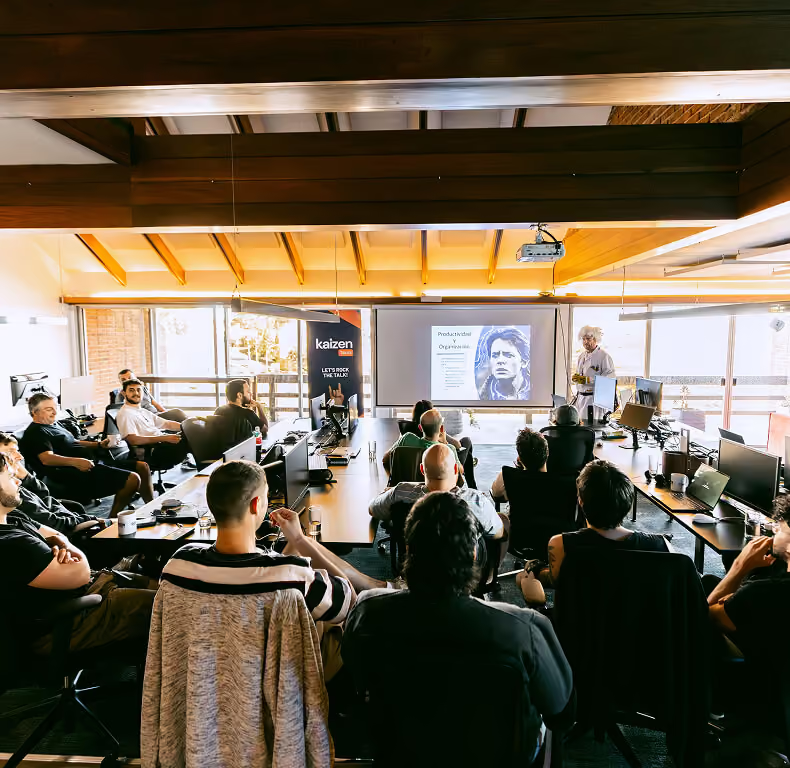
Kaizen Talks
The team teaching the team.

Weekly asados
The most fiercely defended tradition in the company.
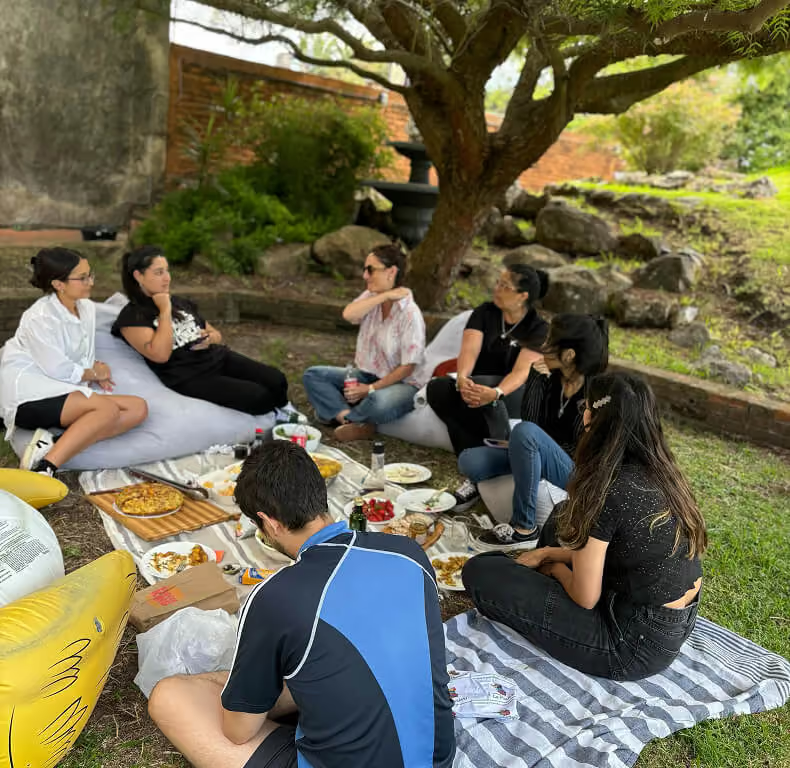
Team hangouts
Because Slack emojis only get you so far.
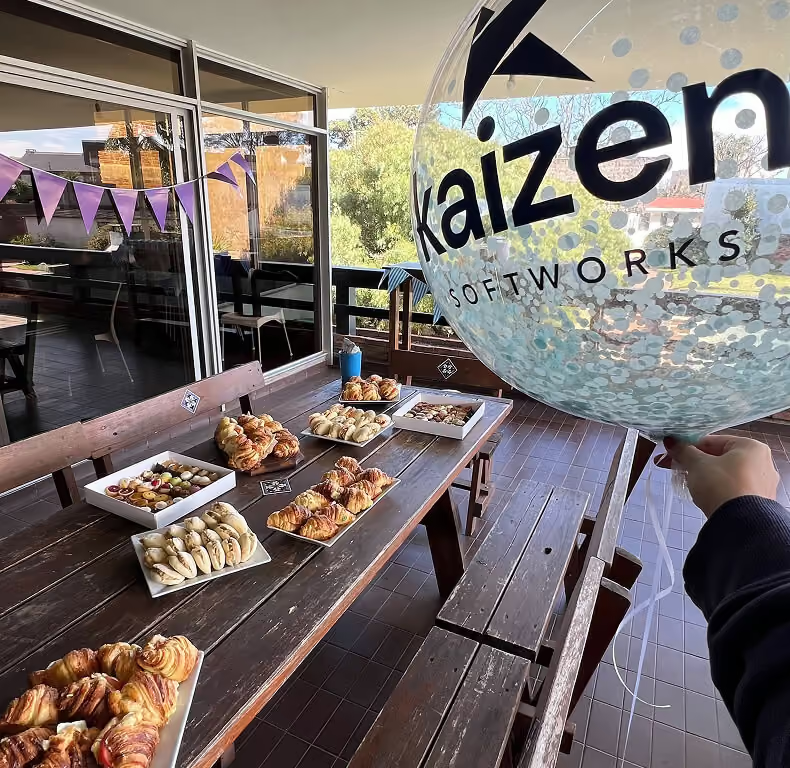
Birthday celebrations
Cake is guaranteed. Singing quality is not.
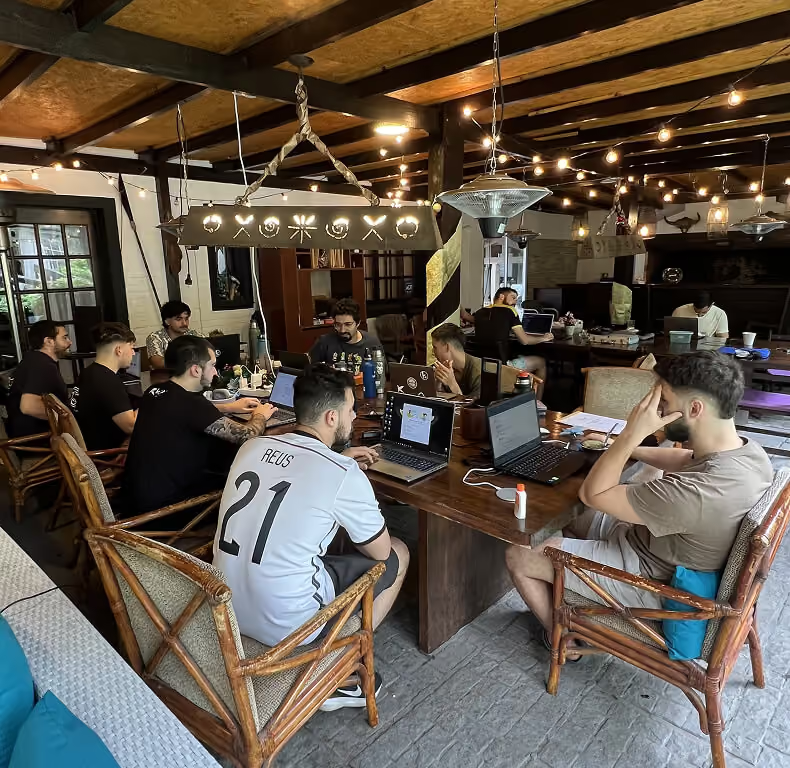
Beach getaways
One week, one beach house, the whole team.
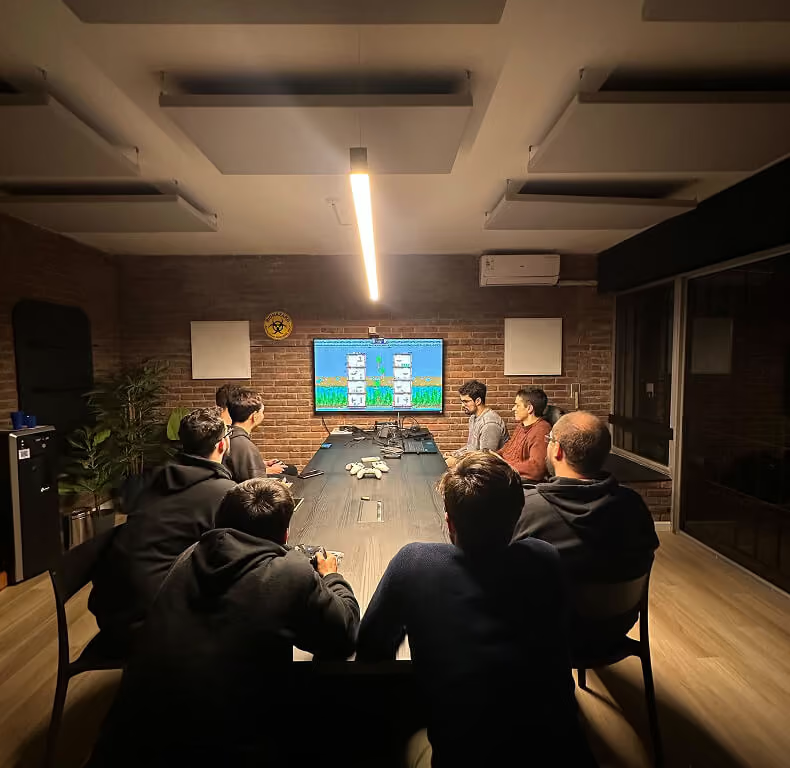
Gaming nights
Friendly matches. Not-so-friendly trash talk.

Pool breaks
In summer, "back in five" means something different.


Hiring Process
Five steps. Zero ghosting.
Meet people from all over Kaizen. Two weeks. You'll always know where you stand.
01
Screening
People Care
A 30-minute video call with our hiring team to discuss your experience, goals, and learn more about the role.
02
Cultural Interview
People from across Kaizen
A conversation focused on values, work style, and how you collaborate to ensure mutual fit with our team culture.
03
Technical Assessment
Technical team
A practical exercise or pair programming session to evaluate your technical skills in a realistic scenario.
04
Team Interview
Your future teammates
Meet potential teammates and leadership to discuss collaboration style, culture fit, and answer any questions.
05
Psychotechnical Interview
People Care
A conversation to evaluate cognitive abilities, problem-solving skills, and behavioral competencies for the role.
Roles
Roles we usually hire for.
Nothing that fits? Reach out anyway. Good people rarely match job titles exactly.
Full-Stack Developer
Build web products that US companies run their business on. .NET, React, Node.js, and cloud.
DevOps Engineer
Own the pipelines, automation, and cloud architecture that keep every deploy uneventful.
UI/UX Designer
Design interfaces for enterprise and consumer products. The kind people use without thinking about them.
QA Automation Engineer
Build the testing frameworks that catch bugs before clients do.
You've read this far. Might as well say hi.
Send a resume, or just an email. We read everything, and we always write back.