





Kaizen Teams

Dropdown

Table of Contents

Time to read

·

12

Published on

·

June 30, 2020

Last updated on

·

April 10, 2026

Valentina Ibinete, Marketing Lead at Kaizen Softworks

Valentina Ibinete

Travel magnet collector

Marketing Lead

About Us

About Us

Project Management

Project Management

How to Choose a Nearshore Software Development Company?

Published on

·

April 10, 2026

Last updated on

·

April 10, 2026

Time to read

·

12

Valentina Ibinete, Marketing Lead at Kaizen Softworks

Valentina Ibinete

Marketing Lead

There’s plenty of material telling you about the benefits of outsourcing software development services to nearshore companies. The upsides are similar time zone, cultural affinity, a high-quality talent pool, and cost reductions. Even though these things are true, that’s just a general idea of what nearshore outsourcing is all about.

You might be already interested in it, but given how many software development teams are out there, how do you know which one you should partner with?

Read on as we point out what factors are most important to consider when choosing your next nearshore software partner.

A bargain might compromise your business

A wooden piggy bank

If you’re considering nearshoring just to save as much money as possible, then you’re missing the point. In fact, just considering the cheapest option could lead to bad experiences.

Magne Jørgensen, researcher and professor at the University of Oslo, showed in a research paper that software providers with bids 25% lower than the average correlate to a 9% increase in the frequency of project failure for the same skill level, suggesting that an excessive emphasis on low prices makes it more likely that projects fail.

Software development is no simple task. It takes hard work, knowledge, skill, and most importantly time, to end up with a scalable, testable, and user-friendly software product ready to run.

Promises of exceptionally quick work at the lowest price should be viewed with healthy skepticism. You might know of folks in your community who have already gone through bad situations when their cheap outsourced software turned sour, like Boeing's offshore outsource fiasco.

Don’t get discouraged though!

Finding quality nearshore software development companies while not breaking the bank is still possible because of the exchange rate, salary differences, and great talent pool. You just need to take your time and correctly assess your potential partners before making a decision, which leads me to my next point.

Agile methodology is key to success

Avoid injecting money into a black box, only to open it months or years later and find something completely different than what you were expecting. Partnering with software companies with a strong agile approach is a great way to prevent this.

The Forbes Technology Council agrees that an agile software development process translates into quality project management: faster feedback cycles, effective problem identification, disrupting changes prevention, flexible prioritization, maintaining high customer satisfaction, identifying benefits sooner, free commitment and continuous improvement.

Software development does better in an ongoing back-and-forth process, where you describe your desired result to your IT partner, evaluate the intermediate results, both parties provide feedback and exchange opinions, and iterate the process until convergence is finally achieved.

And how do I identify a software company with a strong agile culture you ask? You should evaluate how they behave. Shy away from those trying to sell you pre-established solutions, and stick to those who are honestly trying to understand what your needs are and how your business model works.

A good agile team will not only come to the Scrum Ceremonies with regular updates, but they will dive deep into your ideas and actively look to suggest recommendations and improvements to your product.

Every project is unique, and will require the most focused, responsible, and committed development team to bring your ideas down to earth and successfully deliver. Checking references is a good starting point.

The importance of user experience (UX)

Nowadays our brains are being bombarded with information and stimulus coming from everywhere, specifically from our computers and cell phones, constantly distracting us with our social media feed, news updates, work info, and more.

Therefore, customers aren’t only needing, but are demanding, simple and easy-to-use UX/UI that lets them quickly understand and make use of your services, giving a necessary rest to their busy heads meanwhile.

To get an idea of how important this is, take for instance a research study by Baymard where they tracked the global average e-commerce cart abandonment rate for 9 years, concluding it was around 69%. The main reasons were UX/UI flaws at the design and check-out flow that frustrated or made it hard for users to buy.

If this wasn’t enough to make a point, suffice to say that after a no-ROI period, Walmart decided to redesign its website in 2018, paying special attention to UX/UI. The results: Walmart’s e-commerce sales grew by 43%.

The important question here is whether your software consultant can turn all those lines of code into something accessible and easy for your customers to use and love.

When searching for your next nearshore software development agency, take a look at their case studies. See if their previous projects not only do what they say but also look professional, simple, and smooth.

Don’t forget that even if you have the most solid software engine running, it's worthless if users find it counterintuitive.

Go for flexibility

Today's world moves fast. To survive, you must have the ability to quickly adapt to new situations.

What worked for you in the past might not be useful now. Committing to long-term relationships with a partner through hard-binding legal contracts might not be your best bet.

Outstanding nearshore digital transformation agencies know and embrace this. Moreover, they will offer flexible working frameworks where you can easily ramp up and down without any bureaucracy.

They will freely let you decide if you want to stay or leave because they’re committed to consistently providing you with the best service. That way you’ll want to keep choosing them as your software development partner because you continue to see ROI in the relationship. That’s the kind of value-based relationship you’re looking for!

Look for stable countries

So far we’ve talked about software companies and business, but given that nearshoring is the central topic of this post, we can’t avoid talking about countries.

Their strengths and weaknesses vary a lot from region to region, making it difficult to establish generalities. However, there are some key factors you should keep in mind when researching countries: political, economic, and judicial stability.

Usually, nearshore countries fall into the category of “developing countries”, which makes them interesting because of lower costs, but many often suffer from social upheavals, economic crises, and mismanaged governments.

Any of these issues can put your investment or business at risk because they could lead to exchange rate restrictions, massive layoffs, authoritarian governments, or expropriations.

When looking at which country to choose, consider Uruguay. This South American country is recognized worldwide for its enduring democratic institutions and solid rule of lay, high human development index, stable and open economy, excellent English level, the fastest internet connection in the region and massive tech education investment.

Summary

Key things to keep in mind when choosing which nearshore digital transformation agency to partner with:

  • Take advantage of natural nearshore lower costs and aim for quality providers rather than blindly going for the cheapest option available
  • Get close to development teams genuinely trying to understand what you need, instead of imposing their solutions. Value honest and involved development teams who aren’t afraid of telling what they think
  • Give special consideration to software companies with UX/UI expertise. You want your users to experience software that runs as good as it looks
  • Stick to firms that let you freely come and go within flexible working frameworks. They’ll sustain value-based relationships, providing ROI to you
  • Look for the most stable countries to invest in. Stay updated on news about political instability, economic crises, or social upheavals. This way you’ll avoid future pitfalls.

Looking for a true nearshore development partner?

GET IN TOUCH

There’s plenty of material telling you about the benefits of outsourcing software development services to nearshore companies. The upsides are similar time zone, cultural affinity, a high-quality talent pool, and cost reductions. Even though these things are true, that’s just a general idea of what nearshore outsourcing is all about.

You might be already interested in it, but given how many software development teams are out there, how do you know which one you should partner with?

Read on as we point out what factors are most important to consider when choosing your next nearshore software partner.

A bargain might compromise your business

A wooden piggy bank

If you’re considering nearshoring just to save as much money as possible, then you’re missing the point. In fact, just considering the cheapest option could lead to bad experiences.

Magne Jørgensen, researcher and professor at the University of Oslo, showed in a research paper that software providers with bids 25% lower than the average correlate to a 9% increase in the frequency of project failure for the same skill level, suggesting that an excessive emphasis on low prices makes it more likely that projects fail.

Software development is no simple task. It takes hard work, knowledge, skill, and most importantly time, to end up with a scalable, testable, and user-friendly software product ready to run.

Promises of exceptionally quick work at the lowest price should be viewed with healthy skepticism. You might know of folks in your community who have already gone through bad situations when their cheap outsourced software turned sour, like Boeing's offshore outsource fiasco.

Don’t get discouraged though!

Finding quality nearshore software development companies while not breaking the bank is still possible because of the exchange rate, salary differences, and great talent pool. You just need to take your time and correctly assess your potential partners before making a decision, which leads me to my next point.

Agile methodology is key to success

Avoid injecting money into a black box, only to open it months or years later and find something completely different than what you were expecting. Partnering with software companies with a strong agile approach is a great way to prevent this.

The Forbes Technology Council agrees that an agile software development process translates into quality project management: faster feedback cycles, effective problem identification, disrupting changes prevention, flexible prioritization, maintaining high customer satisfaction, identifying benefits sooner, free commitment and continuous improvement.

Software development does better in an ongoing back-and-forth process, where you describe your desired result to your IT partner, evaluate the intermediate results, both parties provide feedback and exchange opinions, and iterate the process until convergence is finally achieved.

And how do I identify a software company with a strong agile culture you ask? You should evaluate how they behave. Shy away from those trying to sell you pre-established solutions, and stick to those who are honestly trying to understand what your needs are and how your business model works.

A good agile team will not only come to the Scrum Ceremonies with regular updates, but they will dive deep into your ideas and actively look to suggest recommendations and improvements to your product.

Every project is unique, and will require the most focused, responsible, and committed development team to bring your ideas down to earth and successfully deliver. Checking references is a good starting point.

The importance of user experience (UX)

Nowadays our brains are being bombarded with information and stimulus coming from everywhere, specifically from our computers and cell phones, constantly distracting us with our social media feed, news updates, work info, and more.

Therefore, customers aren’t only needing, but are demanding, simple and easy-to-use UX/UI that lets them quickly understand and make use of your services, giving a necessary rest to their busy heads meanwhile.

To get an idea of how important this is, take for instance a research study by Baymard where they tracked the global average e-commerce cart abandonment rate for 9 years, concluding it was around 69%. The main reasons were UX/UI flaws at the design and check-out flow that frustrated or made it hard for users to buy.

If this wasn’t enough to make a point, suffice to say that after a no-ROI period, Walmart decided to redesign its website in 2018, paying special attention to UX/UI. The results: Walmart’s e-commerce sales grew by 43%.

The important question here is whether your software consultant can turn all those lines of code into something accessible and easy for your customers to use and love.

When searching for your next nearshore software development agency, take a look at their case studies. See if their previous projects not only do what they say but also look professional, simple, and smooth.

Don’t forget that even if you have the most solid software engine running, it's worthless if users find it counterintuitive.

Go for flexibility

Today's world moves fast. To survive, you must have the ability to quickly adapt to new situations.

What worked for you in the past might not be useful now. Committing to long-term relationships with a partner through hard-binding legal contracts might not be your best bet.

Outstanding nearshore digital transformation agencies know and embrace this. Moreover, they will offer flexible working frameworks where you can easily ramp up and down without any bureaucracy.

They will freely let you decide if you want to stay or leave because they’re committed to consistently providing you with the best service. That way you’ll want to keep choosing them as your software development partner because you continue to see ROI in the relationship. That’s the kind of value-based relationship you’re looking for!

Look for stable countries

So far we’ve talked about software companies and business, but given that nearshoring is the central topic of this post, we can’t avoid talking about countries.

Their strengths and weaknesses vary a lot from region to region, making it difficult to establish generalities. However, there are some key factors you should keep in mind when researching countries: political, economic, and judicial stability.

Usually, nearshore countries fall into the category of “developing countries”, which makes them interesting because of lower costs, but many often suffer from social upheavals, economic crises, and mismanaged governments.

Any of these issues can put your investment or business at risk because they could lead to exchange rate restrictions, massive layoffs, authoritarian governments, or expropriations.

When looking at which country to choose, consider Uruguay. This South American country is recognized worldwide for its enduring democratic institutions and solid rule of lay, high human development index, stable and open economy, excellent English level, the fastest internet connection in the region and massive tech education investment.

Summary

Key things to keep in mind when choosing which nearshore digital transformation agency to partner with:

  • Take advantage of natural nearshore lower costs and aim for quality providers rather than blindly going for the cheapest option available
  • Get close to development teams genuinely trying to understand what you need, instead of imposing their solutions. Value honest and involved development teams who aren’t afraid of telling what they think
  • Give special consideration to software companies with UX/UI expertise. You want your users to experience software that runs as good as it looks
  • Stick to firms that let you freely come and go within flexible working frameworks. They’ll sustain value-based relationships, providing ROI to you
  • Look for the most stable countries to invest in. Stay updated on news about political instability, economic crises, or social upheavals. This way you’ll avoid future pitfalls.

Looking for a true nearshore development partner?

GET IN TOUCH

Related Articles

View all articles

·

Sep 21, 2026

When PMs can ship code, what changes for Engineering?

AI coding agents give Product and Engineering more autonomy, plus a new coordination problem. See how a two-cycle model keeps both moving.

12 read time

Read more

AI has changed what Product Managers can do.

A PM can now go from an idea to working software in hours. They can build a flow, put it in front of a customer, learn from it, change it, and test again without waiting for every iteration to go through Engineering.

That creates an opportunity for product teams. It also creates a new challenge.

Just because a PM can build something doesn’t mean that thing is ready to become production software.

If we don’t rethink how Product and Engineering work together, faster prototyping can become more code for Engineering to untangle, more unclear ownership, and more pressure to turn experiments into production features.

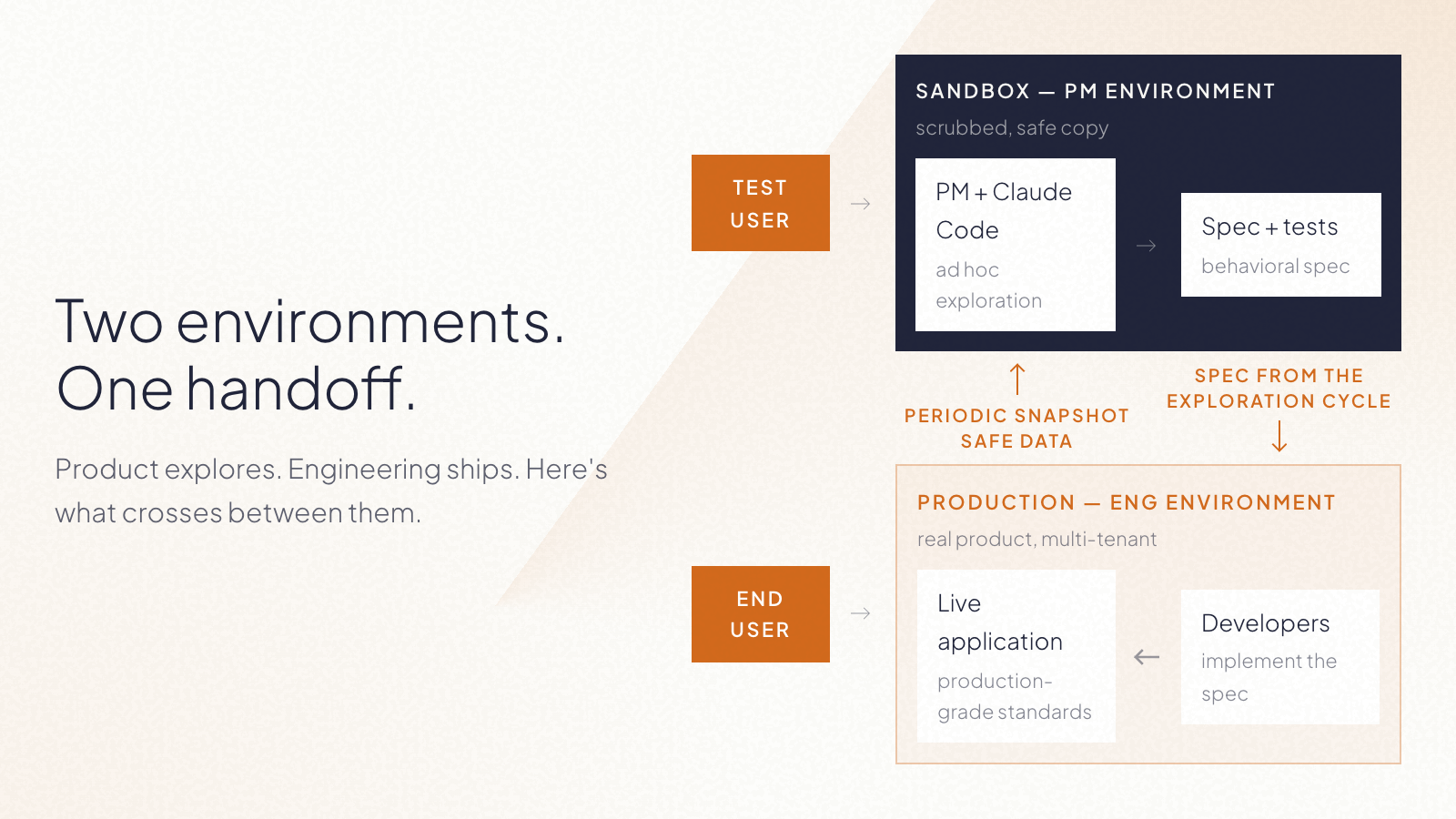
The answer is to separate exploration from construction.

PMs and engineers are solving different problems

During product discovery, the PM is trying to answer: Should we build this?

That means testing assumptions, changing direction quickly, throwing things away, and getting something real enough in front of a customer to learn from it.

Engineering is solving a different problem: How do we build this correctly?

That means thinking about architecture, security, maintainability, performance, edge cases, and everything else required for software that has to live in production.

Both need AI. But they don’t need the same working conditions.

Exploration benefits from speed, autonomy, and low friction. Construction needs stronger guarantees and guardrails. Trying to optimize the same environment for both creates tension.

So instead of asking how PMs can safely contribute code to the production codebase, there’s a more useful question: What if PMs had their own space to build and validate ideas?

Give PMs a safe place to explore

A PM working with an AI coding agent can build functional versions of new ideas. Not a Figma screen. Not a ticket describing what something might do.

Working software that can be used to test the product experience. The important part is that this environment is separate from production.

That boundary gives the PM freedom to experiment without requiring the same controls we’d expect from production software. The environment can be designed so experiments can’t affect the live product or access things they shouldn’t.

Now the PM’s workflow can look more like:

Idea → build → test with users → learn → iterate

Engineering doesn’t need to be pulled into every cycle.  Engineering still matters. It  gets brought in once Product has stronger evidence about what’s worth building.

The prototype shouldn’t be the handoff

This is where things can go wrong.

If a PM spends two days building something with AI and then gives the repository to Engineering saying, “It mostly works, can you finish it?”, we haven’t improved the product development process. We may have just moved the mess downstream.

The prototype should help answer product questions. It shouldn’t make technical decisions on Engineering’s behalf.

What Engineering needs from exploration is intent.

  • What does the feature need to do?
  • How should it behave?
  • What did we learn from customers?
  • What happens in the important edge cases?
  • How will we know when the production version works as intended?

That becomes the handoff.

At Kaizen, we’ve been exploring a model where the bridge between the two cycles is a behavioral specification and a test plan, supported by the working prototype as a reference. The implementation itself stays behind.

What crosses into construction is the spec: a behavioral description, a test plan, and a link to the prototype as reference. The prototype itself stays where it was built.

In simple terms:

Product owns the what. Engineering owns the how.

That distinction matters even more now that AI makes it so easy for both sides to generate code.

What the workflow could look like

A PM starts with a product hypothesis. Instead of immediately turning it into a backlog item, they use AI to build enough of the experience to test it. They put it in front of users. They discover that part of the original idea was wrong. So they change it. They test again.

Once the problem and desired behavior are clear enough, the PM closes the exploration cycle with a clear specification and acceptance criteria.

Engineering then starts from that understanding, not from the PM’s experimental code only. They decide how the feature fits into the architecture, how it should be implemented, what needs to be verified, and how it reaches production.

The result is two parallel forms of autonomy:

  • PMs don’t need Engineering for every experiment.
  • Engineers don’t inherit implementation decisions from every experiment.

More autonomy doesn’t have to mean less ownership.
AI can make discovery faster

A lot of the conversation around AI in software teams is still about developer productivity. How much faster can we write code? How much implementation can an agent take on?

Those questions matter. But for Product, there may be an even bigger opportunity upstream. AI can shorten the distance between having an idea and learning whether that idea is any good.

That changes what PMs can bring to an engineering team. Instead of: “We think customers want this.” They can increasingly say: “We tested this behavior with customers. Here’s what worked, what didn’t, and exactly what we now need the product to do.”

That’s a much better starting point for building production software.

If you have a prototype and want to take the idea into production, we can help you determine what needs to happen next.

·

Aug 28, 2026

About Catalyst 26: Partnerships & Ecosystem Conference

Everything to know about Catalyst 26: dates, price, who attends, both keynote recaps, and when the next Catalyst event is.

12 read time

Read more

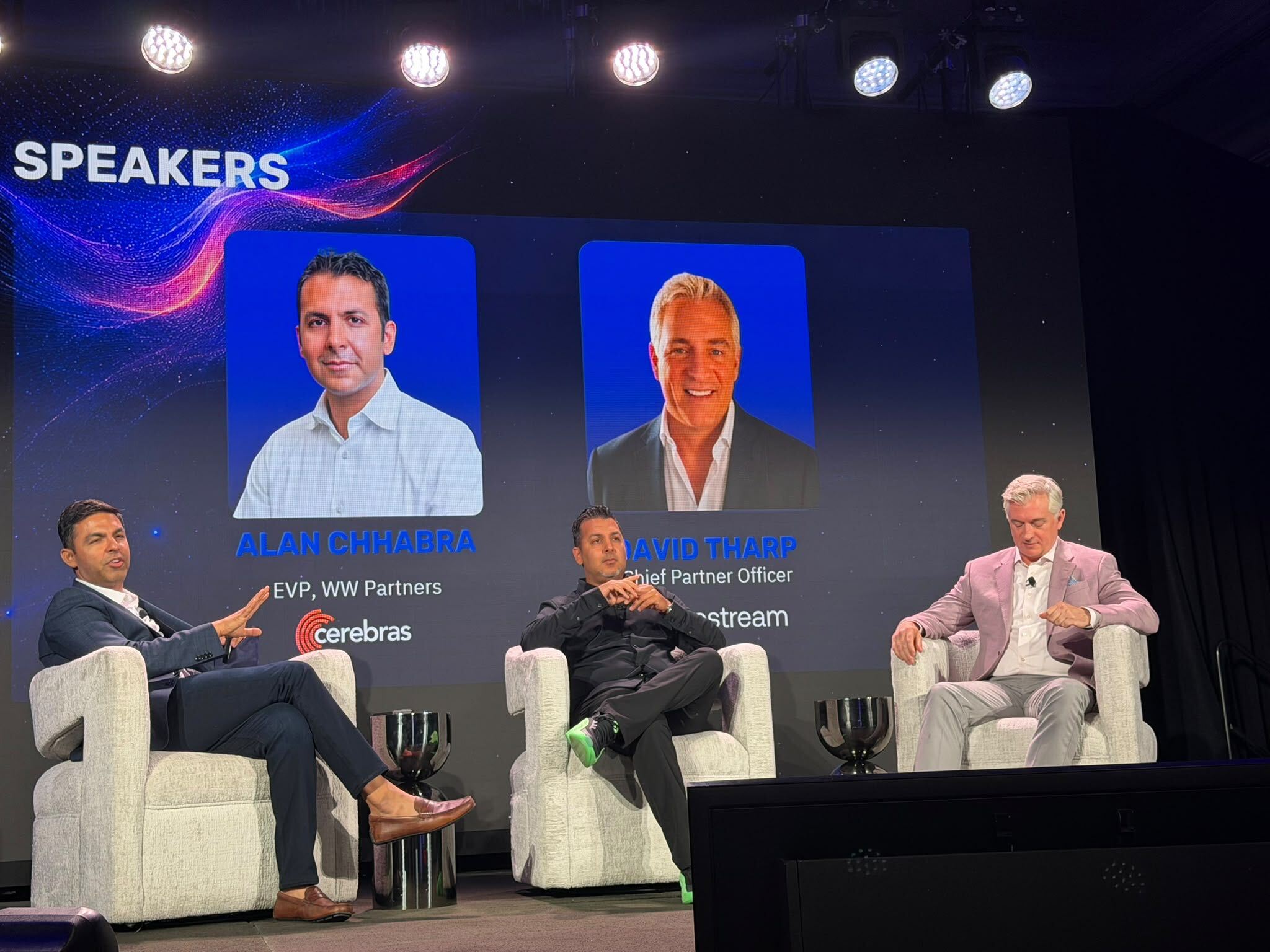
Catalyst 26 was Partnership Leaders' fifth annual conference for partnership, ecosystem, and go-to-market professionals. It took place August 25 and 26, 2026, at the Marriott Hotel at the Brooklyn Bridge in New York, with more than 1,000 attendees and 70-plus speakers from companies including Anthropic, OpenAI, Google, Microsoft, IBM, BCG, and Siemens.

Dates August 25–26, 2026
Location Marriott Hotel at the Brooklyn Bridge, Brooklyn, NY
Edition 5th annual
Attendees 1,000+ partnership, ecosystem, and GTM professionals
Speakers 70+, including people from Anthropic, OpenAI, Google, Microsoft, IBM, BCG, and Siemens.
Price $849 early bird, rising to $999, then $1,999

Who Catalyst events are for

Catalyst brought together people building and running partner programs across SaaS, AI, consulting, systems integration, agencies, and major cloud platforms.

Attendees included executives leading partnership organizations, and people working directly in alliances, partner sales, marketing, operations, strategy, and enablement.

What Catalyst 26 is like

You can look at the agenda before a conference and have a pretty good idea of what you'll find. Being there is different.

This year's theme was "Navigating Frontier Ecosystems". Anthropic's Head of Partnerships and one of OpenAI's partner program leads appeared on the same agenda as people from Oracle, Siemens, IBM, and BCG, companies that have run formal partner programs for two decades.

That mix was one of the most interesting parts of the conference. Newer AI companies were discussing partner tiers, co-selling, and joint delivery alongside companies where those models have been part of their business for years.

What Catalyst 26 covered

Catalyst 26 split its sessions into eight pillars:

  • Advancing Organizational Maturity: turning partnerships into something measured and repeatable instead of one founder doing favors for another.
  • Become a Strategic Partner: getting partnerships involved when product and business decisions are made, not told about them afterward.
  • Frontier Partner Experience: adapting partner programs as AI changes how companies build and integrate products.
  • Path to CPO: career sessions for people aiming to lead partnerships at the executive level.
  • Co-Build: two companies building something together.
  • Co-Market: two companies running a campaign together.
  • Co-Sell: two sales teams working the same deal.
  • Co-Serve: two companies delivering the same engagement to a client.

Catalyst 26 sessions

Day 1 Keynote

The Day 1 keynote brought together Partnership Leaders’ CEO Asher Mathew, Tribe AI’s Co-founder & CEO Jaclyn Rice Nelson, Anthropic’s Head of Partnerships Phil Samenuk, and Boomi’s Chairman & CEO Steve Lucas.

Their discussion focused on how companies are relying on partners to build, sell, and deliver products across AI, cloud, and enterprise software. A few points stood out:

  • More companies have dedicated partner teams now, which means a generic, one-size-fits-all partner program doesn't cut it anymore. Partners show up when the program fits how they work.
  • New AI products and cloud services are shipping so fast that a partner program can't just get set once and left alone. Incentives, support, and how you work together need regular updates.
  • Partnerships also came up as a way to access data a company couldn’t reach on its own, whether that meant getting access to it, combining it, or putting it to use.
  • AI doesn't change the basics of a good partnership. Account planning, clear ownership, and relationships built over time still matter most.

Day 2 Keynote

The Day 2 keynote featured Ramp’s Lead Economist Ara Kharazian, Eliza’s Founder Brian Benedict, Siemens’ EVP Global Partner Ecosystem Dion Smith, and Oracle’s SVP, Partner Sales & Operations Strategy Leah Yomtovian.

A few points stood out:

  • The spending data told a slower story than expected: AI adoption is mostly going toward productivity gains and task automation, not some overnight shift.
  • Siemens is in the middle of folding more than 68,000 partners and roughly 200 separate programs into a single global one, mainly to make it easier to coordinate across IT and operational technology.
  • Oracle's approach is a running "listening tour": every partner gets the same baseline benefits, then incentives and credits get layered based on the type of partner and how they work with Oracle.
  • There was also talk of a newer kind of service team: bring in engineers, turn AI requirements into working products, and reuse delivery methods that already work instead of starting from scratch each time.

Next Catalyst events

The date and location of Catalyst 27 hasn’t been announced yet. In the meantime, you can check out the half-day Catalyst Summits in different cities:

  • October 20, 2026 - Seattle
  • October 27, 2026 - Chicago
  • October 2026 - Los Angeles
  • December 2026 - Singapore

Check Partnership Leaders’ events page for updates.

llms.txt