Outsourcing is a powerful weapon, but if you don’t know how to harness its power, it might end up backfiring.
Offshoring or nearshoring software development tasks could prove very profitable for your organization and professionally enriching. We believe that anyone should be able to get the most out of an outsourcing experience.
Thus, in this post series we will be helping you understand whether to offshore or nearshore software development, with whom, and how. Armed with this knowledge, you’ll be able to make an educated decision on whether to embark on this journey.
In this first part, we will explain the most common risks and rewards associated with outsourcing, define what SMART objectives look like, and understand expectation versus reality so you can check if outsourcing is what you need to achieve your goals today.
Risks and Rewards
Does outsourcing seem like an appropriate technique for addressing your personal goals and professional objectives?
Chances are that if you survey your organization, you will find that some people say that outsourcing steals jobs and destroys organizational culture. Others might say that it could help the company stay in business and beat the competition.
Each side has valid points. Rather than debating, let’s explore some of the risks and rewards of outsourcing to see if it could work for you.
Risk types
Starting with the negatives, we can classify risks into three categories: external, internal, and personal.
External
External risks are related to factors outside your organization’s control. These include: geopolitical instability, intellectual property loss, inadequate vendor capabilities, and failure to meet joint responsibilities.
One of the most dramatic scenarios could involve a terrorist attack in “safe” offshore destinations like Mumbai or Moscow, which underscores the importance of understanding different countries’ political stability.
A less dramatic example would be when an unexpected change in tax regulation at an offshore location suddenly jeopardizes your investment.
Your potential partner’s financial stability, organizational maturity, technical skills, and ability to acquire and retain qualified talent are key to fully understand the situation you are getting into.
Internal
Internal risks are associated with factors your organization can control. The most notable ones include: unrealistic expectations, lack of organizational preparation, and negative staff impact.
Sometimes even the expectation of outsourcing, if incorrectly managed, can create organizational adversity by declining employees’ morale and productivity. Also, outsourcing initiatives will likely imply some degree of changes for existing processes and roles.
Maybe the most important internal challenge will lie in the unrealistic expectations that some organizations set about the end result. Exceptionally high-cost reduction expectations are one of the most common reasons for dissatisfaction.
Personal
Outsourcing can affect you personally in many ways, introducing changes to your lifestyle, career, and reputation.
Outsourcing may require you to increase the percentage of time you spend on activities you don’t enjoy or to shift working hours to cope with different time zones.
The very nature of outsourcing means that someone else does the work. In many cases, this will be someone whom you have little control over, but it is your name that will be in the line.
Moving from the role of individual contributor to representing an offshore or nearshore team might mean becoming a bearer of bad news. And that will have an inevitable impact on your reputation.
Reward types
With all the risks listed above, why would anyone want to outsource abroad anyways?
The answer is that competition is hard, the market is demanding and outsourcing could give your company a competitive edge. We can divide outsourcing benefits into organizational and personal ones:
Organizational
Cheaper salaries, a strong exchange rate between the US dollar and almost any other currency, lower overhead, economies of scale, controlled operation costs, productivity, and quality improvements all contribute to increased profit through resource efficiency and savings.
At the same time, outsourcing allows you to reallocate the workload during your busy season and shift less critical services abroad. This will help you meet deadlines faster and focus on disruptive innovation projects to gain a competitive advantage.
Outsourcing broadens your recruiting horizons. Having access to a huge staffing pool gives you access to hard-to-find personnel and the opportunity to team up with international experts. In addition, many outsourcing providers have a tremendous work ethic and drive to succeed.
A shortened time-to-market can be achieved as well. Having access to specialized skill sets, unique expertise, and certified processes can improve your competitive advantage.
Personal
There are several key personal benefits to choosing an international team.
From your career’s perspective, consider running an outsourcing engagement as a productive training session for developing management and leadership abilities. These are skills you can add to your resume and you would be surprised how often recruiters and companies look for outsourcing management abilities.
The skills you develop like negotiating, learning foreign languages, managing remote teams’ day-to-day, and assertiveness are invaluable skills that will benefit you in the long run. Accomplishing successful outsourcing engagements could catapult your career forward and open new doors.
Let’s not forget traveling! Seeing new places, meeting new and interesting people, experiencing foreign cultures, and trying new cuisines without spending your own money are major perks.
Having discussed outsourcing risks and rewards, you now have a better picture of the potential it has. But before deciding whether it’s for you first let’s consider which objectives you want to accomplish through outsourcing.
Defining SMART Objectives
This might not be the first time you’ve asked yourself if you should outsource a project, an initiative, or a company function.
Each time you face this situation, always remind yourself: you should only offshore or nearshore either when it is the only tool you have at your disposal or when it is the best tool for the job.
Consequently, you will first have to understand and determine what the “job” is in the first place. When determining the “job,” you shouldn’t settle for broad goals like “need to reduce cost” or “put local staff to better use”, since ambiguity and lack of specification are lethal to success.
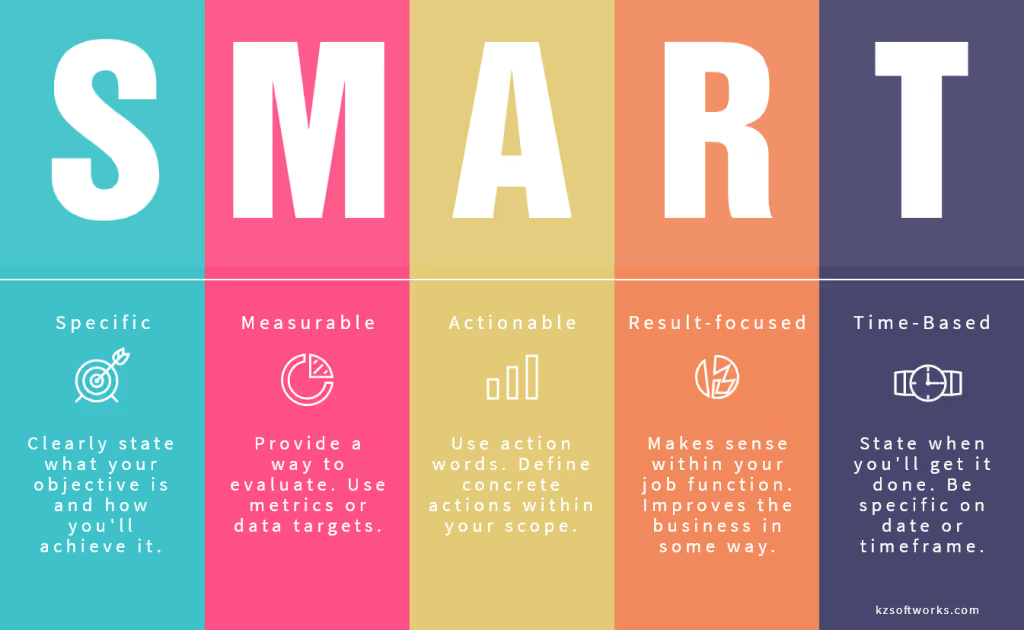
Specify your goal applying the SMART business management technique
Defining SMART criteria objectives help you stay focused on your goal and make good decisions. For instance, let’s check this objective: “Outsource to substantially improve quality assurance (QA).”
What’s the goal here: to use outsourcing or to improve QA? What does “substantially” mean? How long should it take for improvement to occur? This objective is too vague, doesn’t guide you towards actionable steps, and generates more questions than answers.
Now, let’s compare it with this other objective: “Reduce my department’s budget expenditures by 20% next quarter by nearshoring the maintenance of a legacy asset while my in-house team develops a new one”.
This one appears to be SMART since it’s specific and measurable (20%), it defines an action (nearshoring the maintenance of an asset), it focuses on results (reduce my department’s budget expenditures), and it’s time-bound (next quarter).
Defining a SMART goal is the first step when deciding if it makes sense to outsource work. But first, you might want to compare some financial and practical considerations to avoid common mistakes.
Expectations Versus Reality
Offshore outsourcing has been called one of the greatest stories ever sold.
Like many products today, outsourcing comes with a lot of fine print. The pain for smaller companies is that they don’t have the bandwidth even to read it.
However, understanding the fine print is important in these three areas: cost savings, vendor’s ability to scale, and quality of deliverables. Let’s check them out.
Cost Savings
How much money can you save by outsourcing? On the surface, it seems obvious. Even with wage inflation in India, China, and Eastern Europe, rates there are still substantially lower than in the United States.
For example, a mid-level Java developer in San Francisco earns roughly $75 per hour, compared to $25 per hour on average in Bangalore, Shenzhen, or St. Petersburg. At first glance, this lower rate translates into savings of more than 65%, or a 3:1 ratio (for every on-site Java developer you can get three offshore Java developers).
Is it that simple? Will getting three developers for the price of one give you three times the productivity? Unfortunately, no.
Hiring cheaper offshore developers doesn’t mean they will be as productive as local ones. Due to productivity issues, the difference in hourly rates could not necessarily translate into overall cost savings.
Overhead
Overhead expenses related to management, communications, and risk mitigation can eat away what you save in low hourly rates.
For example, if you outsource a small QA team, for example, you’ll probably need both local and offshore QA leads. Without outsourcing, a single lead is enough.
Moreover, if you distribute teams across multiple time zones, language and culture differences could significantly increase the volume of communications required to minimize misunderstandings.
Turnover Ratio
This one is an important expense to keep in mind. Losing a tech team member can be very expensive — as much as three to twelve months of employee salary. The turnover costs come from loss of productivity, hiring fees, training ramp-up, and other factors.
The degree of turnover is typically measured by turnover ratio or the number of lost employees divided by the team size over the course of the engagement. For example, a loss of two developers from a team of ten over the course of the engagement would be a 20% turnover ratio.
Ability to Scale
Many organizations face the challenge of adding personnel for an increased workload and ramping down when demand reduces. Outsourcing seems to be the perfect solution to this problem. Yet some staffing issues are inevitable:
Finding staff with specific skills, especially for cutting-edge technology, can be extremely time-consuming even for a top-tier vendor.
In your search for qualified personnel, consider which country you are outsourcing to and how the government supports young IT professionals.
Quality of Deliverables
There is a strong perception in the industry that the quality of deliverables produced by offshore personnel is inferior to that of local staff.
This perception is deeply flawed because outsourcing partners can either deliver higher or lower quality products and services than those of local employees. The challenge in getting quality deliverables lies in understanding all the aspects of communicating quality expectations to your partners and overseeing their work.
Summary
In this first post of these series, we have brought you general info and insights on outsourcing to help you check whether outsourcing software development is what you need to accomplish your goals.
First you have to be aware of the risks and challenges that come along on this journey. Some of them are external and out of your control, while others are internal to your organization and can be directly dealt with.
Of course, there are plenty of rewards as well like cost reduction, shortening time-to-market, improving workforce usage, improving your management skills, traveling around the world, and increasing productivity and process agility.
Second, you have to ask yourself what your goal is and what you want to accomplish by outsourcing. Remember that ambiguity and lack of detail are lethal to success. Thus defining goals with SMART criteria will go a long way in helping you establish realistic and actionable objectives.
Last, don’t forget to compare expectation versus reality. You would be better off bringing inflated expectations down to earth and taking into account factors like overhead expenses, vendor turnover ratio, scalability, quality of deliverables, and cost-saving versus productivity.
In the next installment of this series, we will be talking about what, with whom, and how to offshore or nearshore software development so you can make an educated decision on whether to do it.
We hope this post has been useful! A special shout-out to Daniel Castro who collaborated in the creation of this post.
Outsourcing is a powerful weapon, but if you don’t know how to harness its power, it might end up backfiring.
Offshoring or nearshoring software development tasks could prove very profitable for your organization and professionally enriching. We believe that anyone should be able to get the most out of an outsourcing experience.
Thus, in this post series we will be helping you understand whether to offshore or nearshore software development, with whom, and how. Armed with this knowledge, you’ll be able to make an educated decision on whether to embark on this journey.
In this first part, we will explain the most common risks and rewards associated with outsourcing, define what SMART objectives look like, and understand expectation versus reality so you can check if outsourcing is what you need to achieve your goals today.
Risks and Rewards
Does outsourcing seem like an appropriate technique for addressing your personal goals and professional objectives?
Chances are that if you survey your organization, you will find that some people say that outsourcing steals jobs and destroys organizational culture. Others might say that it could help the company stay in business and beat the competition.
Each side has valid points. Rather than debating, let’s explore some of the risks and rewards of outsourcing to see if it could work for you.
Risk types
Starting with the negatives, we can classify risks into three categories: external, internal, and personal.
External
External risks are related to factors outside your organization’s control. These include: geopolitical instability, intellectual property loss, inadequate vendor capabilities, and failure to meet joint responsibilities.
One of the most dramatic scenarios could involve a terrorist attack in “safe” offshore destinations like Mumbai or Moscow, which underscores the importance of understanding different countries’ political stability.
A less dramatic example would be when an unexpected change in tax regulation at an offshore location suddenly jeopardizes your investment.
Your potential partner’s financial stability, organizational maturity, technical skills, and ability to acquire and retain qualified talent are key to fully understand the situation you are getting into.
Internal
Internal risks are associated with factors your organization can control. The most notable ones include: unrealistic expectations, lack of organizational preparation, and negative staff impact.
Sometimes even the expectation of outsourcing, if incorrectly managed, can create organizational adversity by declining employees’ morale and productivity. Also, outsourcing initiatives will likely imply some degree of changes for existing processes and roles.
Maybe the most important internal challenge will lie in the unrealistic expectations that some organizations set about the end result. Exceptionally high-cost reduction expectations are one of the most common reasons for dissatisfaction.
Personal
Outsourcing can affect you personally in many ways, introducing changes to your lifestyle, career, and reputation.
Outsourcing may require you to increase the percentage of time you spend on activities you don’t enjoy or to shift working hours to cope with different time zones.
The very nature of outsourcing means that someone else does the work. In many cases, this will be someone whom you have little control over, but it is your name that will be in the line.
Moving from the role of individual contributor to representing an offshore or nearshore team might mean becoming a bearer of bad news. And that will have an inevitable impact on your reputation.
Reward types
With all the risks listed above, why would anyone want to outsource abroad anyways?
The answer is that competition is hard, the market is demanding and outsourcing could give your company a competitive edge. We can divide outsourcing benefits into organizational and personal ones:
Organizational
Cheaper salaries, a strong exchange rate between the US dollar and almost any other currency, lower overhead, economies of scale, controlled operation costs, productivity, and quality improvements all contribute to increased profit through resource efficiency and savings.
At the same time, outsourcing allows you to reallocate the workload during your busy season and shift less critical services abroad. This will help you meet deadlines faster and focus on disruptive innovation projects to gain a competitive advantage.
Outsourcing broadens your recruiting horizons. Having access to a huge staffing pool gives you access to hard-to-find personnel and the opportunity to team up with international experts. In addition, many outsourcing providers have a tremendous work ethic and drive to succeed.
A shortened time-to-market can be achieved as well. Having access to specialized skill sets, unique expertise, and certified processes can improve your competitive advantage.
Personal
There are several key personal benefits to choosing an international team.
From your career’s perspective, consider running an outsourcing engagement as a productive training session for developing management and leadership abilities. These are skills you can add to your resume and you would be surprised how often recruiters and companies look for outsourcing management abilities.
The skills you develop like negotiating, learning foreign languages, managing remote teams’ day-to-day, and assertiveness are invaluable skills that will benefit you in the long run. Accomplishing successful outsourcing engagements could catapult your career forward and open new doors.
Let’s not forget traveling! Seeing new places, meeting new and interesting people, experiencing foreign cultures, and trying new cuisines without spending your own money are major perks.
Having discussed outsourcing risks and rewards, you now have a better picture of the potential it has. But before deciding whether it’s for you first let’s consider which objectives you want to accomplish through outsourcing.
Defining SMART Objectives
This might not be the first time you’ve asked yourself if you should outsource a project, an initiative, or a company function.
Each time you face this situation, always remind yourself: you should only offshore or nearshore either when it is the only tool you have at your disposal or when it is the best tool for the job.
Consequently, you will first have to understand and determine what the “job” is in the first place. When determining the “job,” you shouldn’t settle for broad goals like “need to reduce cost” or “put local staff to better use”, since ambiguity and lack of specification are lethal to success.
Specify your goal applying the SMART business management technique
Defining SMART criteria objectives help you stay focused on your goal and make good decisions. For instance, let’s check this objective: “Outsource to substantially improve quality assurance (QA).”
What’s the goal here: to use outsourcing or to improve QA? What does “substantially” mean? How long should it take for improvement to occur? This objective is too vague, doesn’t guide you towards actionable steps, and generates more questions than answers.
Now, let’s compare it with this other objective: “Reduce my department’s budget expenditures by 20% next quarter by nearshoring the maintenance of a legacy asset while my in-house team develops a new one”.
This one appears to be SMART since it’s specific and measurable (20%), it defines an action (nearshoring the maintenance of an asset), it focuses on results (reduce my department’s budget expenditures), and it’s time-bound (next quarter).
Defining a SMART goal is the first step when deciding if it makes sense to outsource work. But first, you might want to compare some financial and practical considerations to avoid common mistakes.
Expectations Versus Reality
Offshore outsourcing has been called one of the greatest stories ever sold.
Like many products today, outsourcing comes with a lot of fine print. The pain for smaller companies is that they don’t have the bandwidth even to read it.
However, understanding the fine print is important in these three areas: cost savings, vendor’s ability to scale, and quality of deliverables. Let’s check them out.
Cost Savings
How much money can you save by outsourcing? On the surface, it seems obvious. Even with wage inflation in India, China, and Eastern Europe, rates there are still substantially lower than in the United States.
For example, a mid-level Java developer in San Francisco earns roughly $75 per hour, compared to $25 per hour on average in Bangalore, Shenzhen, or St. Petersburg. At first glance, this lower rate translates into savings of more than 65%, or a 3:1 ratio (for every on-site Java developer you can get three offshore Java developers).
Is it that simple? Will getting three developers for the price of one give you three times the productivity? Unfortunately, no.
Hiring cheaper offshore developers doesn’t mean they will be as productive as local ones. Due to productivity issues, the difference in hourly rates could not necessarily translate into overall cost savings.
Overhead
Overhead expenses related to management, communications, and risk mitigation can eat away what you save in low hourly rates.
For example, if you outsource a small QA team, for example, you’ll probably need both local and offshore QA leads. Without outsourcing, a single lead is enough.
Moreover, if you distribute teams across multiple time zones, language and culture differences could significantly increase the volume of communications required to minimize misunderstandings.
Turnover Ratio
This one is an important expense to keep in mind. Losing a tech team member can be very expensive — as much as three to twelve months of employee salary. The turnover costs come from loss of productivity, hiring fees, training ramp-up, and other factors.
The degree of turnover is typically measured by turnover ratio or the number of lost employees divided by the team size over the course of the engagement. For example, a loss of two developers from a team of ten over the course of the engagement would be a 20% turnover ratio.
Ability to Scale
Many organizations face the challenge of adding personnel for an increased workload and ramping down when demand reduces. Outsourcing seems to be the perfect solution to this problem. Yet some staffing issues are inevitable:
Finding staff with specific skills, especially for cutting-edge technology, can be extremely time-consuming even for a top-tier vendor.
In your search for qualified personnel, consider which country you are outsourcing to and how the government supports young IT professionals.
Quality of Deliverables
There is a strong perception in the industry that the quality of deliverables produced by offshore personnel is inferior to that of local staff.
This perception is deeply flawed because outsourcing partners can either deliver higher or lower quality products and services than those of local employees. The challenge in getting quality deliverables lies in understanding all the aspects of communicating quality expectations to your partners and overseeing their work.
Summary
In this first post of these series, we have brought you general info and insights on outsourcing to help you check whether outsourcing software development is what you need to accomplish your goals.
First you have to be aware of the risks and challenges that come along on this journey. Some of them are external and out of your control, while others are internal to your organization and can be directly dealt with.
Of course, there are plenty of rewards as well like cost reduction, shortening time-to-market, improving workforce usage, improving your management skills, traveling around the world, and increasing productivity and process agility.
Second, you have to ask yourself what your goal is and what you want to accomplish by outsourcing. Remember that ambiguity and lack of detail are lethal to success. Thus defining goals with SMART criteria will go a long way in helping you establish realistic and actionable objectives.
Last, don’t forget to compare expectation versus reality. You would be better off bringing inflated expectations down to earth and taking into account factors like overhead expenses, vendor turnover ratio, scalability, quality of deliverables, and cost-saving versus productivity.
In the next installment of this series, we will be talking about what, with whom, and how to offshore or nearshore software development so you can make an educated decision on whether to do it.
We hope this post has been useful! A special shout-out to Daniel Castro who collaborated in the creation of this post.
A PM can now go from an idea to working software in hours. They can build a flow, put it in front of a customer, learn from it, change it, and test again without waiting for every iteration to go through Engineering.
That creates an opportunity for product teams. It also creates a new challenge.
Just because a PM can build something doesn’t mean that thing is ready to become production software.
If we don’t rethink how Product and Engineering work together, faster prototyping can become more code for Engineering to untangle, more unclear ownership, and more pressure to turn experiments into production features.
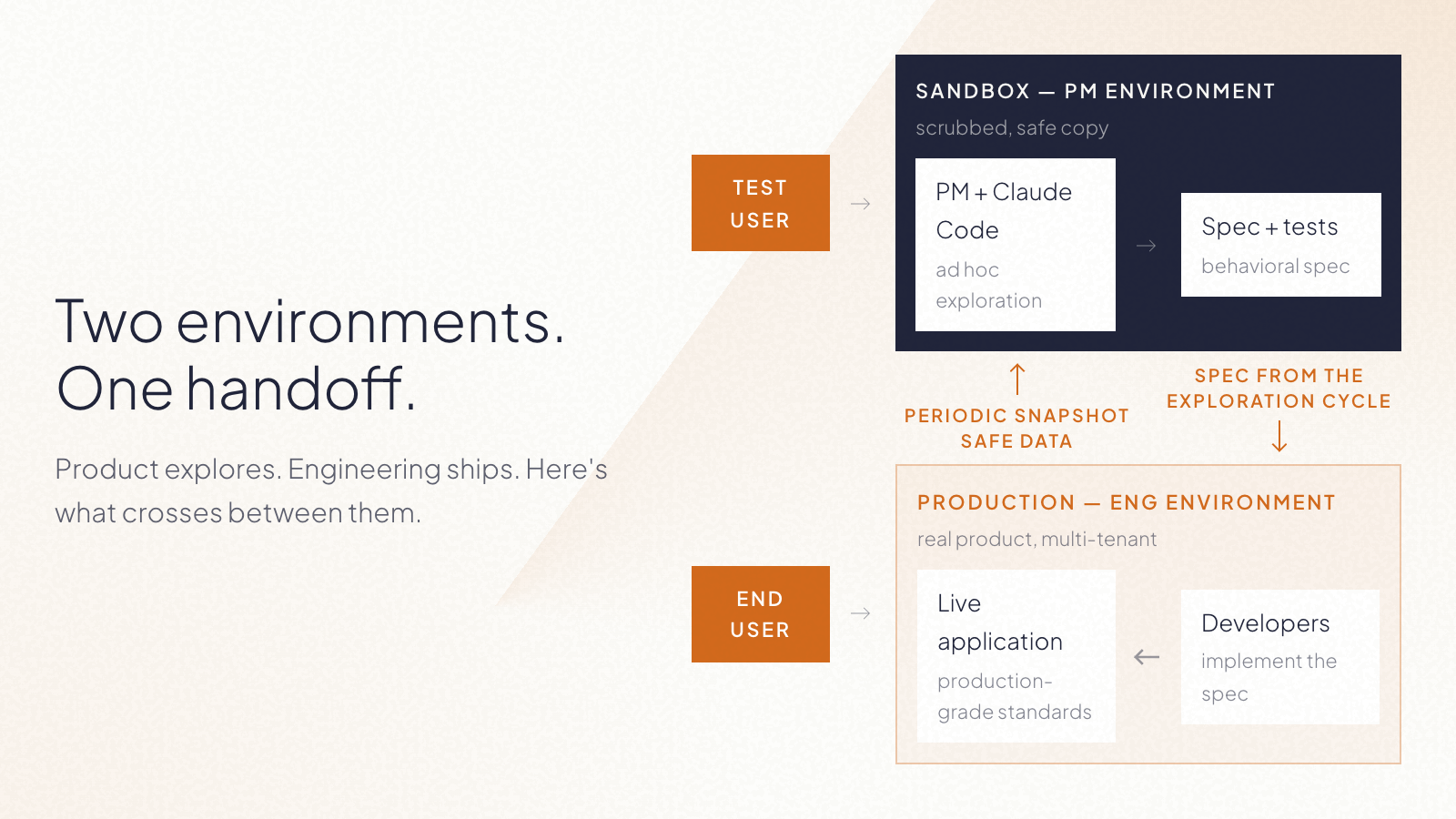
The answer is to separate exploration from construction.
PMs and engineers are solving different problems
During product discovery, the PM is trying to answer: Should we build this?
That means testing assumptions, changing direction quickly, throwing things away, and getting something real enough in front of a customer to learn from it.
Engineering is solving a different problem: How do we build this correctly?
That means thinking about architecture, security, maintainability, performance, edge cases, and everything else required for software that has to live in production.
Both need AI. But they don’t need the same working conditions.
Exploration benefits from speed, autonomy, and low friction. Construction needs stronger guarantees and guardrails. Trying to optimize the same environment for both creates tension.
So instead of asking how PMs can safely contribute code to the production codebase, there’s a more useful question: What if PMs had their own space to build and validate ideas?
Give PMs a safe place to explore
A PM working with an AI coding agent can build functional versions of new ideas. Not a Figma screen. Not a ticket describing what something might do.
Working software that can be used to test the product experience. The important part is that this environment is separate from production.
That boundary gives the PM freedom to experiment without requiring the same controls we’d expect from production software. The environment can be designed so experiments can’t affect the live product or access things they shouldn’t.
Now the PM’s workflow can look more like:
Idea → build → test with users → learn → iterate
Engineering doesn’t need to be pulled into every cycle. Engineering still matters. It gets brought in once Product has stronger evidence about what’s worth building.
The prototype shouldn’t be the handoff
This is where things can go wrong.
If a PM spends two days building something with AI and then gives the repository to Engineering saying, “It mostly works, can you finish it?”, we haven’t improved the product development process. We may have just moved the mess downstream.
The prototype should help answer product questions. It shouldn’t make technical decisions on Engineering’s behalf.
What Engineering needs from exploration is intent.
What does the feature need to do?
How should it behave?
What did we learn from customers?
What happens in the important edge cases?
How will we know when the production version works as intended?
That becomes the handoff.
At Kaizen, we’ve been exploring a model where the bridge between the two cycles is a behavioral specification and a test plan, supported by the working prototype as a reference. The implementation itself stays behind.
What crosses into construction is the spec: a behavioral description, a test plan, and a link to the prototype as reference. The prototype itself stays where it was built.
In simple terms:
Product owns the what. Engineering owns the how.
That distinction matters even more now that AI makes it so easy for both sides to generate code.
What the workflow could look like
A PM starts with a product hypothesis. Instead of immediately turning it into a backlog item, they use AI to build enough of the experience to test it. They put it in front of users. They discover that part of the original idea was wrong. So they change it. They test again.
Once the problem and desired behavior are clear enough, the PM closes the exploration cycle with a clear specification and acceptance criteria.
Engineering then starts from that understanding, not from the PM’s experimental code only. They decide how the feature fits into the architecture, how it should be implemented, what needs to be verified, and how it reaches production.
The result is two parallel forms of autonomy:
PMs don’t need Engineering for every experiment.
Engineers don’t inherit implementation decisions from every experiment.
More autonomy doesn’t have to mean less ownership.
AI can make discovery faster
A lot of the conversation around AI in software teams is still about developer productivity. How much faster can we write code? How much implementation can an agent take on?
Those questions matter. But for Product, there may be an even bigger opportunity upstream. AI can shorten the distance between having an idea and learning whether that idea is any good.
That changes what PMs can bring to an engineering team. Instead of: “We think customers want this.” They can increasingly say: “We tested this behavior with customers. Here’s what worked, what didn’t, and exactly what we now need the product to do.”
That’s a much better starting point for building production software.
If you have a prototype and want to take the idea into production, we can help you determine what needs to happen next.
Catalyst 26 was Partnership Leaders' fifth annual conference for partnership, ecosystem, and go-to-market professionals. It took place August 25 and 26, 2026, at the Marriott Hotel at the Brooklyn Bridge in New York, with more than 1,000 attendees and 70-plus speakers from companies including Anthropic, OpenAI, Google, Microsoft, IBM, BCG, and Siemens.
Dates
August 25–26, 2026
Location
Marriott Hotel at the Brooklyn Bridge, Brooklyn, NY
Edition
5th annual
Attendees
1,000+ partnership, ecosystem, and GTM professionals
Speakers
70+, including people from Anthropic, OpenAI, Google, Microsoft, IBM, BCG, and Siemens.
Price
$849 early bird, rising to $999, then $1,999
Who Catalyst events are for
Catalyst brought together people building and running partner programs across SaaS, AI, consulting, systems integration, agencies, and major cloud platforms.
Attendees included executives leading partnership organizations, and people working directly in alliances, partner sales, marketing, operations, strategy, and enablement.
What Catalyst 26 is like
You can look at the agenda before a conference and have a pretty good idea of what you'll find. Being there is different.
This year's theme was "Navigating Frontier Ecosystems". Anthropic's Head of Partnerships and one of OpenAI's partner program leads appeared on the same agenda as people from Oracle, Siemens, IBM, and BCG, companies that have run formal partner programs for two decades.
That mix was one of the most interesting parts of the conference. Newer AI companies were discussing partner tiers, co-selling, and joint delivery alongside companies where those models have been part of their business for years.
What Catalyst 26 covered
Catalyst 26 split its sessions into eight pillars:
Advancing Organizational Maturity: turning partnerships into something measured and repeatable instead of one founder doing favors for another.
Become a Strategic Partner: getting partnerships involved when product and business decisions are made, not told about them afterward.
Frontier Partner Experience: adapting partner programs as AI changes how companies build and integrate products.
Path to CPO: career sessions for people aiming to lead partnerships at the executive level.
Co-Build: two companies building something together.
Co-Market: two companies running a campaign together.
Co-Sell: two sales teams working the same deal.
Co-Serve: two companies delivering the same engagement to a client.
Catalyst 26 sessions
Day 1 Keynote
The Day 1 keynote brought together Partnership Leaders’ CEO Asher Mathew, Tribe AI’s Co-founder & CEO Jaclyn Rice Nelson, Anthropic’s Head of Partnerships Phil Samenuk, and Boomi’s Chairman & CEO Steve Lucas.
Their discussion focused on how companies are relying on partners to build, sell, and deliver products across AI, cloud, and enterprise software. A few points stood out:
More companies have dedicated partner teams now, which means a generic, one-size-fits-all partner program doesn't cut it anymore. Partners show up when the program fits how they work.
New AI products and cloud services are shipping so fast that a partner program can't just get set once and left alone. Incentives, support, and how you work together need regular updates.
Partnerships also came up as a way to access data a company couldn’t reach on its own, whether that meant getting access to it, combining it, or putting it to use.
AI doesn't change the basics of a good partnership. Account planning, clear ownership, and relationships built over time still matter most.
Day 2 Keynote
The Day 2 keynote featured Ramp’s Lead Economist Ara Kharazian, Eliza’s Founder Brian Benedict, Siemens’ EVP Global Partner Ecosystem Dion Smith, and Oracle’s SVP, Partner Sales & Operations Strategy Leah Yomtovian.
A few points stood out:
The spending data told a slower story than expected: AI adoption is mostly going toward productivity gains and task automation, not some overnight shift.
Siemens is in the middle of folding more than 68,000 partners and roughly 200 separate programs into a single global one, mainly to make it easier to coordinate across IT and operational technology.
Oracle's approach is a running "listening tour": every partner gets the same baseline benefits, then incentives and credits get layered based on the type of partner and how they work with Oracle.
There was also talk of a newer kind of service team: bring in engineers, turn AI requirements into working products, and reuse delivery methods that already work instead of starting from scratch each time.
Next Catalyst events
The date and location of Catalyst 27 hasn’t been announced yet. In the meantime, you can check out the half-day Catalyst Summits in different cities: