








·
Sep 23, 2026
Developer turnover costs capacity for weeks and context for months. What software teams lose, how to measure it, and four questions to ask any partner.

12 read time
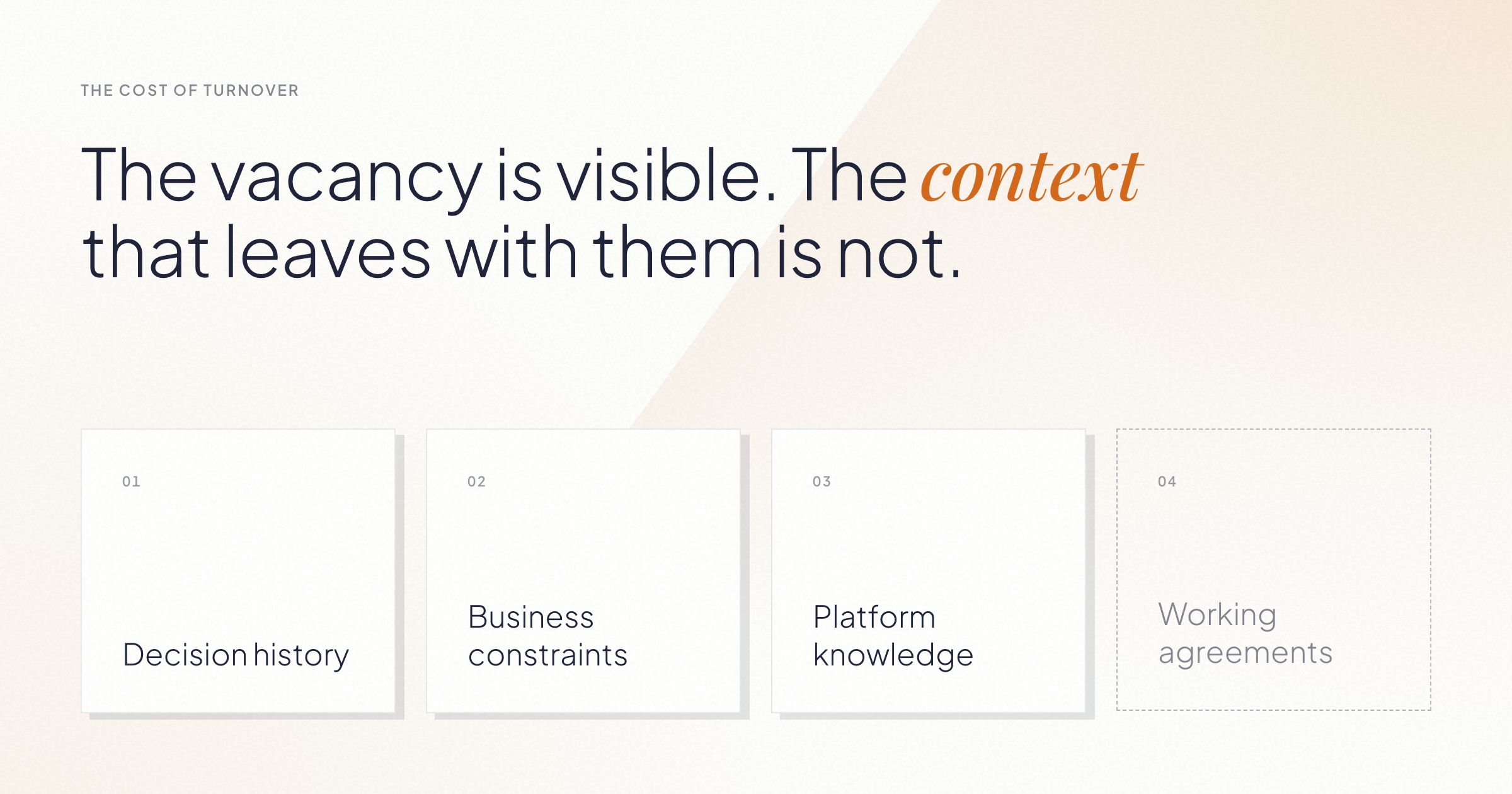
When an engineer leaves a software team, the visible cost is a vacancy. The expensive cost is invisible: the context that leaves with them, and the months the rest of the team spends rebuilding it.
We've seen this play out across client projects for years. This post covers what walks out the door when someone leaves, how to think about the real cost, and a simple framework for making better decisions when it happens, whether you work with us or not.
The short version
- Turnover costs capacity for weeks. It costs context for months.
- Context is specific and nameable: decision history, business constraints, platform knowledge, and working agreements.
- The reflex to replace the exact profile that left is often the most expensive option. Sometimes the answer is already on your team.
- You can evaluate any software partner on continuity with four questions. We include our own answers below.
What does a software team lose when someone leaves?
A software team loses two things when someone leaves: capacity and context. Capacity is visible and replaceable. Context is neither.
Context sounds abstract, so let's make it concrete. It comes in four forms:
A new hire can match the departed engineer's skills on day one. The four things above take months to rebuild, and while they're being rebuilt, the whole team pays: meetings run longer, settled decisions get relitigated, and senior people spend their time explaining instead of building.
What is the cost of developer turnover?
The cost of developer turnover is the ramp-up period multiplied across the team, not the recruiting fee. The math works like this:
The replacement operates below full productivity for months while they absorb the four types of context above. During that same period, the existing team diverts hours to onboarding, re-explaining, and reviewing more carefully than usual. So the cost is one person's ramp-up plus a productivity tax on everyone around them, at exactly the moment the project needed continuity.
This is why turnover gets underestimated. On the day someone resigns, it looks like an operational issue: fill the seat, keep moving. The bill arrives over the following two quarters, itemized as slower delivery, longer meetings, and decisions that used to be obvious.
Why replacing the exact profile is often the wrong reflex
The first thought is to backfill with an identical hire. Sometimes that's right. But the skill that is left with that person may be easier to replace than the context they gained: the client relationship, the platform history, and the judgment behind past decisions.
Someone already on the team may be able to learn a specific skill faster than a new specialist can learn the client, the platform, and the history behind the work. For a real example and four questions to ask before starting a search, see “Why adding people doesn't always fix a struggling team.”
How to evaluate a software partner on continuity
If you work with an external team, their turnover becomes your turnover. Four questions tell you most of what you need to know, and any serious partner should answer them with numbers:
What's your team retention rate? Ours has averaged 96% in recent years. Whatever the number, ask how it's measured and over what period.
How do you know people want to stay? Retention tells you what happened. An engagement measure tells you what's coming. Our eNPS (employee Net Promoter Score) is +83.
How do you spread context across the team? One person holding all the context is a risk with a name: bus factor. Ask how knowledge gets documented and shared, so continuity doesn't depend on any single individual.
Do you prepare capacity before it's needed? On some projects, we bring people up to speed on the business and the platform before there's an immediate need. When the project needs more capacity, nobody starts from zero.
These questions work on any vendor, including us. That's the point.