Kaizen Teams

Dropdown

Table of Contents

Time to read

·

12

Published on

·

January 31, 2024

Last updated on

·

April 10, 2026

Valentina Ibinete, Marketing Lead at Kaizen Softworks

Valentina Ibinete

Travel magnet collector

Marketing Lead

Best Tech Events & Conferences in the United States For 2024

Published on

·

April 10, 2026

Last updated on

·

April 10, 2026

Time to read

·

12

Valentina Ibinete, Marketing Lead at Kaizen Softworks

Valentina Ibinete

Marketing Lead

Welcome to our guide to the top tech events in the United States for 2024. Let's dive into the exciting lineup that awaits tech enthusiasts, innovators, and entrepreneurs.

#1. CES 2024

The Consumer Electronics Show (CES) in Las Vegas has officially kicked off on January 8th, showcasing an array of technological marvels from leading companies. Google, Sony, Samsung, LG, and Asus are among the industry giants revealing their latest innovations in consumer electronics at CES 2024.

From Samsung's cutting-edge Smart TVs and XGIMI's innovative projectors to Belkin's iPhone charging docks, Razer and LG laptops, DELL's curved monitors, and Xreal's alternative to Apple Vision Pro – the market is buzzing with a plethora of groundbreaking products.

However, the common thread tying these diverse offerings together is the prominent role of Artificial Intelligence (AI), the foremost technology trend of the moment. Jessica Boothe, Director of Market Research at the Consumer Technology Association, emphasizes AI's impact across various sectors, from transportation to kitchen appliances and robotics.

Location: Las Vegas, Nevada.

Date: January 9-12, 2024.

Tickets: Digital-Only Pass at $279 or Exhibits Plus Pass for $300, granting access to keynotes, conference sessions, and the exhibit floor.

#2. SXSW '24

Anticipate the highlight of the year with the upcoming SXSW '24, the premier startup conference that transcends boundaries. The SXSW Conference serves as a nexus for the global community of digital creatives, offering a unique space to encounter cutting-edge ideas, explore new interests, and connect with like-minded professionals driven by a shared passion for forward-focused experiences.

Join renowned tech influencers such as Scott Galloway and Kara Swisher in immersing yourself in groundbreaking developments across technology, film, culture, and music. Unveil the future alongside thought leaders, shaping the landscape of innovation and creativity.

Location: Austin, Texas.

Date: March 8-16, 2024.

Tickets: Online Event Pass for $99 or Live Seats starting from $895.

#3. GOOGLE CLOUD NEXT '24

Embark on a transformative journey at Google Cloud Next '24, uniting technology enthusiasts, industry experts, and innovators. Delve into cutting-edge trends in cloud computing through engaging keynote sessions, unveiling insights into the dynamic realms of AI, Cloud, and collaboration. Explore specialized programs on gen AI, crafted to guide IT and business leaders, security professionals, and developers through the fast-evolving landscape of technology.

Location: Las Vegas, Nevada.

Date: April 9-11, 2024.

Tickets: Full Conference starts at $999 Early Bird and $1,999 Regular. 

#4. ODSC EAST 2024

Experience the forefront of community-driven data science at ODSC East 2024 (Open Data Science Conference), a global event taking place both in person and virtually. With an impressive lineup of 300 speakers, 300 hours of content, 1700 companies, and 3800 hybrid attendees, this event provides a comprehensive and community-focused experience. Dive into engaging sessions aimed at fostering connections, skill development, and learning from the entire data science community.

Take advantage of the opportunity to learn from startup founders, gaining valuable insights into data science and machine learning that can significantly impact the future of your venture.

Location: Boston, Massachusetts.

Date: April 23-25, 2024.

Price: Offline seats start at $159.

#5. TECHCRUNCH EARLY STAGE 2024

For those navigating the initial phases of building a company, grappling with product monetization, or wrestling with a budding idea seeking realization, TechCrunch Early Stage 2024 in Boston is the essential destination. Immerse yourself in expert-led sessions offering actionable insights, from safeguarding intellectual property to refining your pitch deck. Engage with experts, share insights, and collaborate with TechCrunch's community of like-minded entrepreneurs.

Location: Boston, Massachusetts.

Date: April 25, 2024. 

Tickets: Student Pass from $99, Founder Pass from $149, Investor’s Pass from $349.

#6. RSA CONFERENCE 2024

Delve into the dynamic realm of cybersecurity at RSA Conference 2024 in San Francisco, California. Explore data breaches, cyber threats, compliance, and social engineering. Experience camaraderie through events like the Welcome Reception and CyBEER Ops, where casual settings foster networking among cybersecurity professionals. Engage in Learning Labs, providing immersive experiences focused on cybersecurity topics.

Location: San Francisco, California.

Date: May 6-9, 2024.

Tickets: Full conference attendance for $2,395 with various options available.

#7. AI & BIG DATA EXPO NORTH AMERICA

The AI & Big Data Expo is a leading conference showcasing next-gen enterprise technologies and strategies in AI & Big Data, offering practical insights for business advancement. Co-hosted with IoT Tech Expo, Unified Communications Conference, Intelligent Automation Conference, Cyber Security & Cloud Expo, Edge Computing Expo, and Digital Transformation Week, this mega event is expected to attract over 21,000 attendees worldwide.

These high-level conferences bring together enterprise brands, market leaders, AI & Big Data experts, and startups to explore advancements, impacts in Enterprise & Consumer sectors, development platforms, and Digital Transformation opportunities.

Engage in insightful talks and discussions that will keep you abreast of the latest technological developments and provide an excellent platform for networking with professionals from across the globe.

Location: Santa Clara, California.

Date: June 5-6, 2024.

Tickets:

  • Ultimate Pass: $599
  • Gold Pass: $399
  • Free Expo Pass: Free
  • Content Library Hub Pass: Free

#8. BLACK HAT USA 2024

Explore the forefront of information security excellence at Black Hat USA 2024, the world's premier event dedicated to cutting-edge research, development, and trends in cybersecurity. With four days of technical training and a two-day main conference featuring Briefings, Arsenal, Business Hall, and more, this event is a cornerstone for cybersecurity professionals.

Location: Las Vegas, Nevada.

Date: August 3-8, 2024.

Tickets: Apply to discover pricing for full conference attendance and other options.

#9. SILICON SLOPES SUMMIT

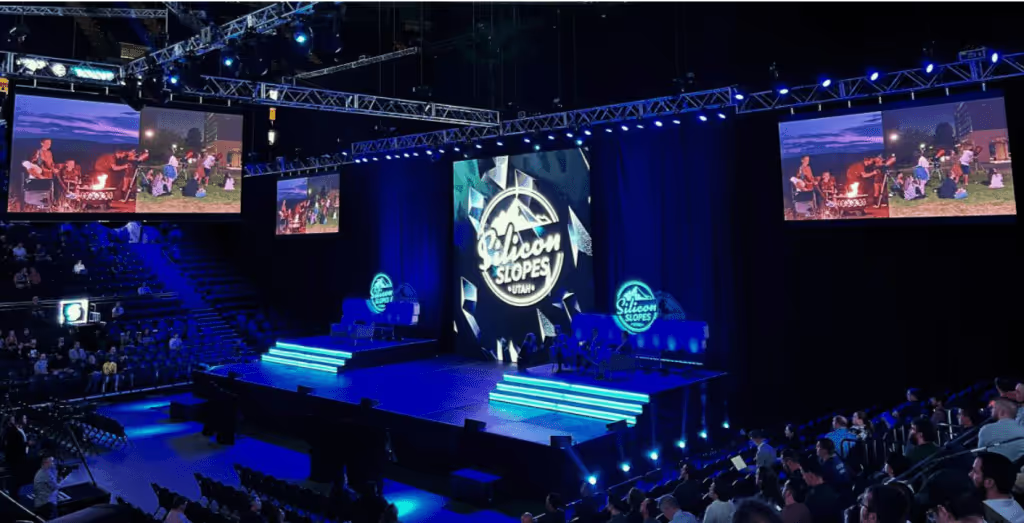
A photo of the main stage at the Silicon Slopes Summit, where keynote speakers and prominent presentations take place

Experience Utah's Annual Global Tech & Business Summit – the Silicon Slopes Summit. Now in its 8th year, this summit promises to be unlike any we've organized before. Brace yourself for an extraordinary lineup of prominent speakers, unforgettable experiences, invaluable networking opportunities, and world-class entertainment. Join the gathering of global tech and business leaders for a fresh approach to learning, connecting, and serving.

Immerse yourself in a whole new way of experiencing the summit, where insights and innovations converge to shape the future of Utah's tech and business landscape. To delve deeper into the essence of this event, check out our blog post where we share our first hand experience.

Location: Salt Lake City, Utah.

Date: Not announced yet (usually at the end of September each year).

Tickets: Not announced yet. 

#10. TECHCRUNCH DISRUPT 2024

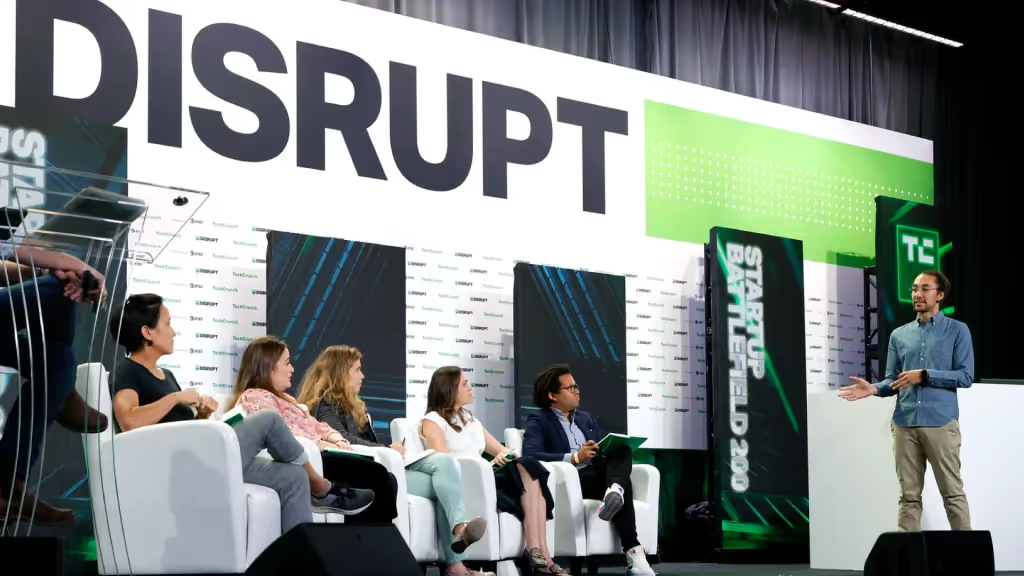
Prepare for TechCrunch Disrupt 2024, the original startup conference that continues to evolve, staying fresh, relevant, and laser-focused on founders, investors, and the future of tech year after year. Whether you're a startup rookie navigating the early stages, a seasoned investor scouting the next big breakthrough, or a determined founder with a vision to change the world – Disrupt delivers the essential tools, knowledge, and connections to empower your journey.

Located in the heart of innovation, San Francisco, California, TechCrunch Disrupt is set to unfold from October 28-30, 2024. While ticket details are yet to be announced, anticipate an immersive experience that goes beyond the ordinary.

Location: San Francisco, California.

Date: October 28-30, 2024.

Tickets: Not announced yet.

WRAPPING UP

I hope you find this info helpful! Sure, there are more events out there, some hyper-focused on specific tech niches. But these ones? They're pretty cool. So, why not take the chance to connect, learn, and stay in the know? Don't let the good stuff pass you by!

Welcome to our guide to the top tech events in the United States for 2024. Let's dive into the exciting lineup that awaits tech enthusiasts, innovators, and entrepreneurs.

#1. CES 2024

The Consumer Electronics Show (CES) in Las Vegas has officially kicked off on January 8th, showcasing an array of technological marvels from leading companies. Google, Sony, Samsung, LG, and Asus are among the industry giants revealing their latest innovations in consumer electronics at CES 2024.

From Samsung's cutting-edge Smart TVs and XGIMI's innovative projectors to Belkin's iPhone charging docks, Razer and LG laptops, DELL's curved monitors, and Xreal's alternative to Apple Vision Pro – the market is buzzing with a plethora of groundbreaking products.

However, the common thread tying these diverse offerings together is the prominent role of Artificial Intelligence (AI), the foremost technology trend of the moment. Jessica Boothe, Director of Market Research at the Consumer Technology Association, emphasizes AI's impact across various sectors, from transportation to kitchen appliances and robotics.

Location: Las Vegas, Nevada.

Date: January 9-12, 2024.

Tickets: Digital-Only Pass at $279 or Exhibits Plus Pass for $300, granting access to keynotes, conference sessions, and the exhibit floor.

#2. SXSW '24

Anticipate the highlight of the year with the upcoming SXSW '24, the premier startup conference that transcends boundaries. The SXSW Conference serves as a nexus for the global community of digital creatives, offering a unique space to encounter cutting-edge ideas, explore new interests, and connect with like-minded professionals driven by a shared passion for forward-focused experiences.

Join renowned tech influencers such as Scott Galloway and Kara Swisher in immersing yourself in groundbreaking developments across technology, film, culture, and music. Unveil the future alongside thought leaders, shaping the landscape of innovation and creativity.

Location: Austin, Texas.

Date: March 8-16, 2024.

Tickets: Online Event Pass for $99 or Live Seats starting from $895.

#3. GOOGLE CLOUD NEXT '24

Embark on a transformative journey at Google Cloud Next '24, uniting technology enthusiasts, industry experts, and innovators. Delve into cutting-edge trends in cloud computing through engaging keynote sessions, unveiling insights into the dynamic realms of AI, Cloud, and collaboration. Explore specialized programs on gen AI, crafted to guide IT and business leaders, security professionals, and developers through the fast-evolving landscape of technology.

Location: Las Vegas, Nevada.

Date: April 9-11, 2024.

Tickets: Full Conference starts at $999 Early Bird and $1,999 Regular. 

#4. ODSC EAST 2024

Experience the forefront of community-driven data science at ODSC East 2024 (Open Data Science Conference), a global event taking place both in person and virtually. With an impressive lineup of 300 speakers, 300 hours of content, 1700 companies, and 3800 hybrid attendees, this event provides a comprehensive and community-focused experience. Dive into engaging sessions aimed at fostering connections, skill development, and learning from the entire data science community.

Take advantage of the opportunity to learn from startup founders, gaining valuable insights into data science and machine learning that can significantly impact the future of your venture.

Location: Boston, Massachusetts.

Date: April 23-25, 2024.

Price: Offline seats start at $159.

#5. TECHCRUNCH EARLY STAGE 2024

For those navigating the initial phases of building a company, grappling with product monetization, or wrestling with a budding idea seeking realization, TechCrunch Early Stage 2024 in Boston is the essential destination. Immerse yourself in expert-led sessions offering actionable insights, from safeguarding intellectual property to refining your pitch deck. Engage with experts, share insights, and collaborate with TechCrunch's community of like-minded entrepreneurs.

Location: Boston, Massachusetts.

Date: April 25, 2024. 

Tickets: Student Pass from $99, Founder Pass from $149, Investor’s Pass from $349.

#6. RSA CONFERENCE 2024

Delve into the dynamic realm of cybersecurity at RSA Conference 2024 in San Francisco, California. Explore data breaches, cyber threats, compliance, and social engineering. Experience camaraderie through events like the Welcome Reception and CyBEER Ops, where casual settings foster networking among cybersecurity professionals. Engage in Learning Labs, providing immersive experiences focused on cybersecurity topics.

Location: San Francisco, California.

Date: May 6-9, 2024.

Tickets: Full conference attendance for $2,395 with various options available.

#7. AI & BIG DATA EXPO NORTH AMERICA

The AI & Big Data Expo is a leading conference showcasing next-gen enterprise technologies and strategies in AI & Big Data, offering practical insights for business advancement. Co-hosted with IoT Tech Expo, Unified Communications Conference, Intelligent Automation Conference, Cyber Security & Cloud Expo, Edge Computing Expo, and Digital Transformation Week, this mega event is expected to attract over 21,000 attendees worldwide.

These high-level conferences bring together enterprise brands, market leaders, AI & Big Data experts, and startups to explore advancements, impacts in Enterprise & Consumer sectors, development platforms, and Digital Transformation opportunities.

Engage in insightful talks and discussions that will keep you abreast of the latest technological developments and provide an excellent platform for networking with professionals from across the globe.

Location: Santa Clara, California.

Date: June 5-6, 2024.

Tickets:

  • Ultimate Pass: $599
  • Gold Pass: $399
  • Free Expo Pass: Free
  • Content Library Hub Pass: Free

#8. BLACK HAT USA 2024

Explore the forefront of information security excellence at Black Hat USA 2024, the world's premier event dedicated to cutting-edge research, development, and trends in cybersecurity. With four days of technical training and a two-day main conference featuring Briefings, Arsenal, Business Hall, and more, this event is a cornerstone for cybersecurity professionals.

Location: Las Vegas, Nevada.

Date: August 3-8, 2024.

Tickets: Apply to discover pricing for full conference attendance and other options.

#9. SILICON SLOPES SUMMIT

A photo of the main stage at the Silicon Slopes Summit, where keynote speakers and prominent presentations take place

Experience Utah's Annual Global Tech & Business Summit – the Silicon Slopes Summit. Now in its 8th year, this summit promises to be unlike any we've organized before. Brace yourself for an extraordinary lineup of prominent speakers, unforgettable experiences, invaluable networking opportunities, and world-class entertainment. Join the gathering of global tech and business leaders for a fresh approach to learning, connecting, and serving.

Immerse yourself in a whole new way of experiencing the summit, where insights and innovations converge to shape the future of Utah's tech and business landscape. To delve deeper into the essence of this event, check out our blog post where we share our first hand experience.

Location: Salt Lake City, Utah.

Date: Not announced yet (usually at the end of September each year).

Tickets: Not announced yet. 

#10. TECHCRUNCH DISRUPT 2024

Prepare for TechCrunch Disrupt 2024, the original startup conference that continues to evolve, staying fresh, relevant, and laser-focused on founders, investors, and the future of tech year after year. Whether you're a startup rookie navigating the early stages, a seasoned investor scouting the next big breakthrough, or a determined founder with a vision to change the world – Disrupt delivers the essential tools, knowledge, and connections to empower your journey.

Located in the heart of innovation, San Francisco, California, TechCrunch Disrupt is set to unfold from October 28-30, 2024. While ticket details are yet to be announced, anticipate an immersive experience that goes beyond the ordinary.

Location: San Francisco, California.

Date: October 28-30, 2024.

Tickets: Not announced yet.

WRAPPING UP

I hope you find this info helpful! Sure, there are more events out there, some hyper-focused on specific tech niches. But these ones? They're pretty cool. So, why not take the chance to connect, learn, and stay in the know? Don't let the good stuff pass you by!

Related Articles

·

May 15, 2026

Can AI Safely Apply Changes Across Microservices?

Learn how AI can apply changes across microservices when service ownership, message contracts, DTOs, and architectural context are clearly defined.

12 read time

Read more

Applying changes across microservices is difficult because business logic is distributed across multiple services, each with its own data, contracts, and responsibilities.

In our experiment at Kaizen Softworks, we tested whether an AI system could safely apply coordinated changes across a microservices architecture using only minimal input.

Short answer: Yes, but only when the AI has enough architectural context.

Why are coordinated changes in microservices so hard?

In distributed systems, a single business change rarely affects just one service.

It often requires:

  • Updating multiple microservices
  • Modifying message contracts
  • Keeping DTOs (Data Transfer Objects) consistent
  • Respecting domain boundaries defined by Domain-Driven Design (DDD)

Key entities in this system:

  • Microservice: An independently deployable service responsible for a specific domain
  • Aggregate (DDD): A cluster of domain objects treated as a single unit
  • DTO (Data Transfer Object): A structured format used to transfer data between services
  • Message/Event: A communication mechanism between services

The complexity is not in the code, it’s in the relationships between components.

The experiment: Can AI reason across services with minimal input?

We designed a controlled experiment to test whether an AI model could apply system-wide changes with limited information.

Input given to the AI:

  • Message definitions (events between services)
  • DTOs (data contracts)

Tasks the AI had to perform:

  1. Identify affected aggregates
  2. Determine service ownership
  3. Apply coordinated changes across services
  4. Maintain consistency in messages and DTOs

In other words, the AI had to behave like a software architect, not just a code generator.

What was the biggest obstacle?

The biggest challenge was not technical, it was contextual.

Before and after diagram showing how ambiguous microservice names prevent AI from understanding service ownership, while aggregate-to-service mapping helps AI apply safe coordinated changes.

Problem: unclear service naming

Instead of descriptive names like:

  • order-service
  • billing-service

Our services were named:

  • john
  • sally
  • roger

This removed any semantic clues about responsibility.

Result: The AI could not infer which service owned which domain logic.

The missing piece: aggregate ownership mapping

To solve this, we introduced a simple but powerful structure:

Aggregate → Service mapping

  • Order → john
  • Shipment → sally
  • Invoice → roger

This created a clear relationship between domain concepts and system components.

Once ownership was explicit, the architecture became understandable.

How we used AI to generate architectural context

Instead of building this mapping manually, we used AI to analyze the codebase and extract:

  • Where each aggregate was defined
  • Which microservice implemented it
  • The relationship between domain and infrastructure

The result was a machine-readable architecture map.

In practice, we used AI to generate the context that AI itself needed.

Results: Can AI safely apply distributed changes?

With the architecture map in place, the AI was able to:

  • Trace message flows across services
  • Identify affected aggregates
  • Locate the correct microservices
  • Apply coordinated updates
  • Maintain consistency between DTOs and messages

While not perfect, the system worked reliably as a proof of concept.

What is the real limitation of AI in microservices?

The main limitation of AI is not code generation, it’s architectural understanding.

Without knowing:

  • Which components exist
  • How they relate
  • Who owns what

AI cannot safely modify a distributed system.

AI performance depends more on context quality than model capability.

When can AI safely modify microservices?

AI works well when:

  • Aggregate ownership is clearly defined
  • Message contracts are explicit
  • Architecture is structured and consistent

AI struggles when:

  • Naming is ambiguous
  • Relationships are implicit
  • Context is incomplete

Simple rule: If the architecture is clear, AI can reason. If not, it guesses.

Final thoughts

This experiment revealed something important:

AI doesn’t fail because it can’t write code.
It fails because it can’t see the system.

As teams move toward AI-assisted development, the focus will likely shift from:

Writing better code to Designing better systems for machines to understand

At Kaizen Softworks, we see this as a foundational shift.

Because when AI can understand architecture, it doesn’t just generate code, it helps evolve systems.

·

Mar 13, 2026

How We Make Decisions Without Managers

We don’t have traditional managers. This is how we make decisions and keep things moving.

12 read time

Read more

There's a myth that in flat organizations, everyone decides on everything.

That's not how it works. At least not at Kaizen.

When people hear "no managers," they often picture one of two extremes: either total chaos where nobody is accountable, or endless meetings where 80 people vote on which coffee to buy. The reality is neither.

Not everyone decides on everything. Not everyone votes. What we do have is a clear set of decision-making methods that we choose based on context.

It depends on who's affected and how deep the impact goes

Before choosing how to decide, we ask ourselves a few questions:

  • Who is affected? A decision that only impacts one team doesn't need the whole company involved. A decision that affects everyone's daily work does.
  • How deep is the impact? Changing the office furniture is wide but shallow. Changing the salary model is deep and lasting.
  • Is it reversible? If we can easily undo it, we can move fast and just inform. If it's hard to reverse, we slow down and include more people.
  • How urgent is it? And here we're careful to distinguish real urgency from anxiety, the pressure to decide quickly because someone already has "the answer" in mind.

These dimensions help us pick the right method. Not every decision deserves the same process.

Our decision-making toolkit

Over the years, we've landed on a few methods that we use depending on the situation:

1. Role-based decisions

Some decisions belong to a specific role. If someone owns a responsibility, say, office logistics or hiring for a team,  they decide within that domain. No committee needed. The key is that roles are transparent: everyone knows who owns what, and the scope of each role's authority is clear.

2. Advice Process

When a decision doesn't clearly belong to one role, or when it crosses boundaries, we use the advice process. Here's how it works:

  1. Someone takes the initiative. They identify the problem and own the process.
  2. They gather input from people who are affected and people with expertise.
  3. They seek advice, real conversations, not rubber-stamping.
  4. They make the decision and communicate it, including what advice they incorporated and what they didn't (and why).

The decision-maker is not a committee. It's one person (or a small group) who takes responsibility. But they don't decide in isolation, they bring in the perspectives that matter.

We sometimes call this "Team Advice" when a working group forms around an issue that doesn't naturally fall into anyone's area, and "Area Advice" when a team opens up a topic that exceeds their own scope.

3. Consent (not consensus)

Consent is not "everyone agrees." Consent means "no one has a strong enough objection to block this." We do use a poll, but not to count votes — we use a 1-to-5 scale to measure the level of agreement and surface objections, not to let the majority rule.

We use it in two flavors:

  • High-participation consent: For decisions with deep, company-wide impact. This is our most expensive and slowest method, which is exactly why we reserve it for high-impact decisions that affect many people. The Board sets the boundaries, for example, when we moved offices, they defined the monthly budget. Then a working group produced proposals, collected feedback, evolved them, and the whole company expressed their position for the final decision. Silence is not approval; we explicitly ask people to weigh in, even if it's just "I have no objection."
  • Lightweight consent: For decisions that are broad but not deep. Participation is optional, anyone who's interested can jump in. We share the proposal, open a window for objections, and if nobody opposes, we move forward. This gives us speed without sacrificing transparency. If nobody engages, that's a signal too, maybe the proposal doesn't add enough value, or we're using the wrong channel.

4. Inform, don't fake-consult

Not everything needs participation. When a decision has already been made through a legitimate process, the right move is to inform, not to fake-consult. One of the fastest ways to kill self-management is to ask for feedback and then ignore it. If you're not going to change course based on input, don't ask for it, just be transparent about the decision and the reasons behind it.

What we explicitly avoid

  • Decision by Voting. In a company context, majority rule creates losers. And losers become detractors, often generating more resistance than an autocratic decision would have. Instead of voting, we prefer to evolve a proposal through feedback until it's "good enough for now," and then introduce a review point to adjust later. If voting happens at all, it's the cherry on top, not the main course.
  • The "surprise" approach. Working behind closed doors and then unveiling a finished decision is a recipe for frustration. Adults don't need surprises. Adults need to feel like they're part of the process. The complaints that follow a surprise aren't about the decision itself, they're about not being included.

Why we work this way

We didn't adopt these methods because they're trendy. We adopted them because they solve real problems:

  • Better decisions. When you include affected people, you get information you wouldn't have had otherwise. Ideas emerge that no single person would have come up with alone.
  • Less resistance. A person who feels heard is far less likely to resist a decision, even one they wouldn't have made themselves.
  • Faster execution. It sounds counterintuitive, but participative decisions often execute faster because people already understand and support them. The time you "save" by deciding alone, you spend later managing pushback.
  • Distributed authority. When people can make decisions within their domain without escalating everything to a founder, the organization scales. The bottleneck disappears.
  • Resilience. If a shared decision fails, the group adjusts together. If a top-down decision fails, the blame falls on one person and the chances of proactive correction drop.

The real principle behind all of this

Transparency is the foundation. Every method we use, from role-based decisions to high-participation consent, works because information flows openly. People know what's being decided, who's deciding it, and how they can participate.

Horizontal doesn't mean structureless. It means fewer hierarchical levels, clearer roles, and intentional decision-making processes that match the weight of each decision.

Not everyone decides on everything. But everyone knows how things get decided.