


Kaizen Teams

Dropdown

Table of Contents

Time to read

·

12

Published on

·

December 20, 2022

Last updated on

·

April 10, 2026

Valentina Ibinete, Marketing Lead at Kaizen Softworks

Valentina Ibinete

Travel magnet collector

Marketing Lead

From Lost Development Project to Gained Friend

Published on

·

April 10, 2026

Last updated on

·

April 10, 2026

Time to read

·

12

Valentina Ibinete, Marketing Lead at Kaizen Softworks

Valentina Ibinete

Marketing Lead

We believe in doing things the right way, and we want to make sure our partners know that. That's why we live and breathe transparency as one of our main corporate values – even if it means saying no to opportunities.

In this post, we will present you with a Product Discovery case with a pretty unusual outcome. Keep reading to find out why we lost a project but ended up gaining a friend.

About UGallery

UGallery is an eCommerce platform founded in 2006, that connects artists directly with collectors on its website. Headquartered in San Francisco, CA, UGallery positions itself as an approachable and convenient alternative to the brick-and-mortar contemporary art gallery.

This platform allows artists to submit their artwork, and after a strict admission process carried out by the UGallery team, the artwork gets published in their e-commerce platform allowing people from all over the world to buy fine art.

Product Discovery

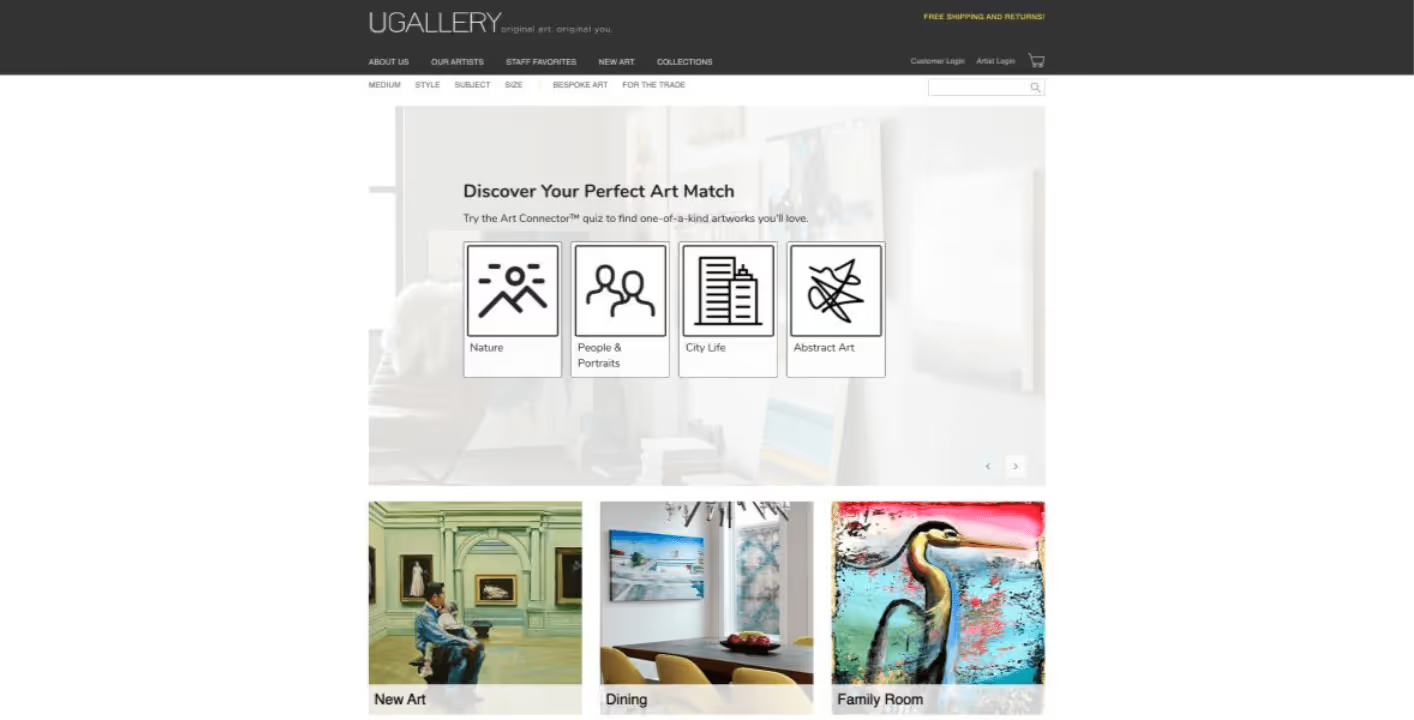
UGallery Home Screen
Product Discovery for UGallery

When UGallery first approached us, they were looking to improve their eCommerce platform but had the challenge of taking care of their profitability too, as each enhancement or modification to the platform implied the concentration of large resources (time and money), making it difficult to accurately estimate plans for the future.

Faced with this challenge, UGallery was concerned about their current development velocity, processes, forecasting abilities and robustness of their product. They thought that the solution would come by approaching a recommended software partner who is familiar and experienced with the technologies that compose their systems.

Our team investigated the root of their problem and we sought to understand whether the approach they considered the most appropriate was actually the most suitable solution based on the problem. Therefore, we investigated the history of UGallery and inquired about the specific pains they were experiencing.

Following a technical deep dive, we conclude that their productivity problems and system weaknesses could not be avoided just by partnering with someone experienced in their tech stack. Their codebase reflected over 2 decades of development with many code smells, moreover some technologies were already obsolete.

Despite our willingness to help, we knew that taking over the development of this platform would not change the experiences they were having. As tech debt grows, predictability, quality and velocity are taxed. When it is not properly managed, the expected return on investment for each development initiative decreases because the cost of maintenance gets higher. Hidden costs emerge, and the system becomes fragile.

After this analysis, we saw no real gain in transferring software development to us. Moreover, the learning curve costs of getting up to speed with non-standard development practices, and getting up to date with outdated technologies would be too high. And, in order to solve technical debt problems in an efficient way they would have to invest in rebuilding the software from scratch, since the cost of paying off tech debt within the current system was higher than rewriting the system.

As a result of this first consultation, UGallery could have a better picture of what was the root of their problem, and they decided not to proceed with the migration at that time, because they were not prepared money-wise.

A year later, UGallery returned to us with the idea of building a software from scratch as a solution to its problems of technical debt and platform scalability.

In order to successfully address their challenge, we stated that it was necessary to take a few steps back from the solution and understand whether a rewriting of Ugallery’s platform could solve the problems they were encountering or not. In other words, before putting hands on the rewriting, it was essential to understand what changes needed to be made and why.

Given this, our team understood that there were three possible solutions and divided the research tasks into the following lines:

  1. Explore a pre-built solution. Our team worked on the analysis of a specific pre-built solution to identify which mix of its plus ‘N’ number of plugins on the market were close to all UGallery’s needs.
  2. Explore other eCommerce frameworks. This would save implementation costs in all those submodules that are common to almost any e-commerce platform.
  3. Custom software development. Understand what they wanted to replicate from their current platform, the particularities of it and what would be the cost of migrating to a new system.

After investing over a month of work on identifying the scope of the project and working on a proof of concept, we found there was a high percentage of Feature Parity with a pre-built solution.

So, the best option for this client was to apply a pre-built solution, covering almost everything of what UGallery needed, instead of a custom software development solution.

This provided the client with a number of advantages:

  • Development cost reduction, making it 10 times cheaper to implement than custom software development.
  • High fidelity platform and tools recommendation with millions of active users.
  • Simpler and faster deployment system.
  • Extensible solution through both custom and third-party add-ons.
  • Possibility of implementing easy changes in real time without the need to know how to program.

Faced with this situation, our team had to discuss what we were going to do, since this result could imply not selling our services. We met internally and decided to give the customer a demo of the research findings to understand whether or not the customer would go ahead with this solution.

This was a tough decision and was very strongly debated. But it was also a values-based decision—we didn't want UGallery to spend the time and money it takes to build a custom solution when there are already tested SaaS solutions available that could do the work.

Here’s what Alex Farkas, founder of UGallery said about us:

“I would like to share a few words of genuine praise for Kaizen. Since launching our online art gallery in 2006, we’ve worked with seven dev shops in four countries. We’ve had mostly positive experiences, however, these external teams generally focused on individual tasks and features.

Big picture planning and particularly cost/benefit analysis of our projects wasn’t usually considered, and my partners and I became accustomed to this. Then we met the Kaizen team. We approached them because our codebase was old and becoming difficult to debug and add new features. Kaizen did a very deep study of both our business model and code and came up with several ideas for moving into the future. They listened to our needs and understood the big picture.

Here’s the most amazing part - in the course of their research, they determined that our best course of action was a SaaS solution that they didn’t offer. And they were right. Choosing this path has saved us considerable time and money. Instead of trying to sell us on something they could do, they gave us expert advice. In all of my years in business, this is one of the most memorable experiences of integrity and technical know-how. We were first referred to Kaizen by an acquaintance who spoke very highly of their team. And now I am happy to pass on the referral. This is how business should be done”.

Conclusion

We can finally say that we've made our contribution to UGallery. Through our Product Discovery process, we provided quality information to determine which solution best served our partner's needs, in terms of efficiency and profitability—and that's what really matters. It's not about closing deals; it’s about building trust and putting the interests of our clients before those of our company to provide differential value.

This serves as an example of why we believe in doing things the right way. We are committed to building long-term relationships with our partners, through an honest and trusting approach. It's also why we value transparency and open communication, so we can make sure both parties are on the same page and no one feels misled or taken advantage of during their project's lifecycle!

What we learned from this experience? That there is a lot more than just the technical stuff behind collaboration and innovation. It’s about understanding each other's needs and goals, being open-minded and flexible when it comes to solutions, respecting people's time, being honest when you don't know something or being humble enough to say “we’re not the right partner for your needs” … in short: being human!

Are you looking expert advice and a trusted partnership?

We are here to help you.

GET IN TOUCH

We believe in doing things the right way, and we want to make sure our partners know that. That's why we live and breathe transparency as one of our main corporate values – even if it means saying no to opportunities.

In this post, we will present you with a Product Discovery case with a pretty unusual outcome. Keep reading to find out why we lost a project but ended up gaining a friend.

About UGallery

UGallery is an eCommerce platform founded in 2006, that connects artists directly with collectors on its website. Headquartered in San Francisco, CA, UGallery positions itself as an approachable and convenient alternative to the brick-and-mortar contemporary art gallery.

This platform allows artists to submit their artwork, and after a strict admission process carried out by the UGallery team, the artwork gets published in their e-commerce platform allowing people from all over the world to buy fine art.

Product Discovery

UGallery Home Screen
Product Discovery for UGallery

When UGallery first approached us, they were looking to improve their eCommerce platform but had the challenge of taking care of their profitability too, as each enhancement or modification to the platform implied the concentration of large resources (time and money), making it difficult to accurately estimate plans for the future.

Faced with this challenge, UGallery was concerned about their current development velocity, processes, forecasting abilities and robustness of their product. They thought that the solution would come by approaching a recommended software partner who is familiar and experienced with the technologies that compose their systems.

Our team investigated the root of their problem and we sought to understand whether the approach they considered the most appropriate was actually the most suitable solution based on the problem. Therefore, we investigated the history of UGallery and inquired about the specific pains they were experiencing.

Following a technical deep dive, we conclude that their productivity problems and system weaknesses could not be avoided just by partnering with someone experienced in their tech stack. Their codebase reflected over 2 decades of development with many code smells, moreover some technologies were already obsolete.

Despite our willingness to help, we knew that taking over the development of this platform would not change the experiences they were having. As tech debt grows, predictability, quality and velocity are taxed. When it is not properly managed, the expected return on investment for each development initiative decreases because the cost of maintenance gets higher. Hidden costs emerge, and the system becomes fragile.

After this analysis, we saw no real gain in transferring software development to us. Moreover, the learning curve costs of getting up to speed with non-standard development practices, and getting up to date with outdated technologies would be too high. And, in order to solve technical debt problems in an efficient way they would have to invest in rebuilding the software from scratch, since the cost of paying off tech debt within the current system was higher than rewriting the system.

As a result of this first consultation, UGallery could have a better picture of what was the root of their problem, and they decided not to proceed with the migration at that time, because they were not prepared money-wise.

A year later, UGallery returned to us with the idea of building a software from scratch as a solution to its problems of technical debt and platform scalability.

In order to successfully address their challenge, we stated that it was necessary to take a few steps back from the solution and understand whether a rewriting of Ugallery’s platform could solve the problems they were encountering or not. In other words, before putting hands on the rewriting, it was essential to understand what changes needed to be made and why.

Given this, our team understood that there were three possible solutions and divided the research tasks into the following lines:

  1. Explore a pre-built solution. Our team worked on the analysis of a specific pre-built solution to identify which mix of its plus ‘N’ number of plugins on the market were close to all UGallery’s needs.
  2. Explore other eCommerce frameworks. This would save implementation costs in all those submodules that are common to almost any e-commerce platform.
  3. Custom software development. Understand what they wanted to replicate from their current platform, the particularities of it and what would be the cost of migrating to a new system.

After investing over a month of work on identifying the scope of the project and working on a proof of concept, we found there was a high percentage of Feature Parity with a pre-built solution.

So, the best option for this client was to apply a pre-built solution, covering almost everything of what UGallery needed, instead of a custom software development solution.

This provided the client with a number of advantages:

  • Development cost reduction, making it 10 times cheaper to implement than custom software development.
  • High fidelity platform and tools recommendation with millions of active users.
  • Simpler and faster deployment system.
  • Extensible solution through both custom and third-party add-ons.
  • Possibility of implementing easy changes in real time without the need to know how to program.

Faced with this situation, our team had to discuss what we were going to do, since this result could imply not selling our services. We met internally and decided to give the customer a demo of the research findings to understand whether or not the customer would go ahead with this solution.

This was a tough decision and was very strongly debated. But it was also a values-based decision—we didn't want UGallery to spend the time and money it takes to build a custom solution when there are already tested SaaS solutions available that could do the work.

Here’s what Alex Farkas, founder of UGallery said about us:

“I would like to share a few words of genuine praise for Kaizen. Since launching our online art gallery in 2006, we’ve worked with seven dev shops in four countries. We’ve had mostly positive experiences, however, these external teams generally focused on individual tasks and features.

Big picture planning and particularly cost/benefit analysis of our projects wasn’t usually considered, and my partners and I became accustomed to this. Then we met the Kaizen team. We approached them because our codebase was old and becoming difficult to debug and add new features. Kaizen did a very deep study of both our business model and code and came up with several ideas for moving into the future. They listened to our needs and understood the big picture.

Here’s the most amazing part - in the course of their research, they determined that our best course of action was a SaaS solution that they didn’t offer. And they were right. Choosing this path has saved us considerable time and money. Instead of trying to sell us on something they could do, they gave us expert advice. In all of my years in business, this is one of the most memorable experiences of integrity and technical know-how. We were first referred to Kaizen by an acquaintance who spoke very highly of their team. And now I am happy to pass on the referral. This is how business should be done”.

Conclusion

We can finally say that we've made our contribution to UGallery. Through our Product Discovery process, we provided quality information to determine which solution best served our partner's needs, in terms of efficiency and profitability—and that's what really matters. It's not about closing deals; it’s about building trust and putting the interests of our clients before those of our company to provide differential value.

This serves as an example of why we believe in doing things the right way. We are committed to building long-term relationships with our partners, through an honest and trusting approach. It's also why we value transparency and open communication, so we can make sure both parties are on the same page and no one feels misled or taken advantage of during their project's lifecycle!

What we learned from this experience? That there is a lot more than just the technical stuff behind collaboration and innovation. It’s about understanding each other's needs and goals, being open-minded and flexible when it comes to solutions, respecting people's time, being honest when you don't know something or being humble enough to say “we’re not the right partner for your needs” … in short: being human!

Are you looking expert advice and a trusted partnership?

We are here to help you.

GET IN TOUCH

Related Articles

·

May 27, 2026

What AI Can and Can’t Replace in Design Systems

What happens when you build a design system from v0, Figma, and Windsurf, and let AI handle the speed while you keep the judgment.

12 read time

Read more

Just this month, I built a full design system in about 20 hours.

What used to take weeks, sometimes months, is now dramatically faster. So… what actually changed? And more importantly: what didn’t?

Design systems take time. On complex platforms, they can take hundreds of hours.

We were working with a large and complex product where inconsistencies had started to pile up. Different modules had evolved in isolation, teams were making independent decisions, and there were no shared guidelines. The answer was clear: we needed a design system.

AI tools were just starting to emerge back then. They were mostly useful for simple tasks as they tended to hallucinate when things got complex. Developers had started using them earlier than designers, MCP didn't exist yet, and Figma plugins were the best automation we had.

But the context has changed. Fast.

The Manual Era

We did what most teams did. We stopped, and we built it. Manually.

Picture two designers, a mountain of inconsistencies, and no map. We had to cross-reference information manually, digging through the code, detecting what could be merged, agreeing on naming conventions, deciding how to name components. Hours and hours of discussion until we finally landed on a solution.

In the end, we got there. A cleaner system, faster workflows, and for the first time, both teams speaking the same visual language. Hard-won, but it worked.

But now every month a new AI model seems to be released. Design is finally catching up with what developers faced about two years ago. New tools arose, and with that, the scope of our work as designers completely changed.

The Human Factor

For an internal project, I used our Kaizen site as a reference, combined with documentation from industry leaders as a guideline.

I started in v0, which is essentially a chat interface where you can generate UI components through prompts. I fed it the colors, typographies, and a reference image, and from there it was a back-and-forth: the AI generated, I reacted, adjusted, and pushed until the output matched what I had in my head. And just like that, I started prompting my way through a Design System.

Once a component was ready, I used the html.to.design plugin to bring it into Figma (yes, plugins are still alive!). Think of it as a bridge: the plugin exports designs directly from the browser into a Figma file.

Inside Figma, the intervention was more hands-on. First, I checked that everything was visually consistent with what was defined in v0: colors, typography, styles. Then I used Figma's built-in AI to rename all the component layers using BEM convention (something that would have taken a significant amount of time to do so manually).

BEM, which stands for Block Element Modifier, is a widely adopted naming convention in CSS. It structures layer names hierarchically and predictably, for example: button__label--disabled.

Using it keeps the code clean, readable, and consistent, especially when you're working alongside a developer who needs to understand what came out the other side.

Beyond naming, I also made sure the layer structure would generate the right properties when building component sets in Figma, so that all the variants would be correctly exposed and usable. My team also pointed out that adding descriptions to components and variants was key as context for any agent using them through an MCP.

The last step was connecting everything to Windsurf via MCP. With a frame selected in Dev Mode, Windsurf could read the Figma file and use the components to build more complex screens.

We worked closely with a developer throughout this phase. Not just for the technical knowledge, but because having someone who reads code fluently meant catching things we wouldn't have spotted otherwise. The design role here was direction and supervision: making sure the AI used the components correctly and didn't invent solutions where context was missing.

Every step of the process had a human decision behind it.

AI-assisted UI design workflow showing v0 component generation, html.to.design export to Figma, BEM layer organization, and Windsurf MCP development handoff.

An Unexpected Discovery

At one point, before we had any of the naming conventions figured out, I selected a frame and asked Windsurf to build a form using the components inside it, styled to match a specific card. The developer next to me was skeptical until he saw the result, and then he was just as surprised as I was.

What we realized is that the MCP wasn't reading layer names to understand context. It was reading everything inside the frame, even the loose text sitting alongside the components. Good naming is still worth doing. But the MCP doesn't need it to understand what it's looking at.

UI component library preview with cards, testimonials, service blocks, statistics, and a contact form for a modern software development website.

Learning to Talk to an AI

The more specific and contained your prompt, the better the outcome. We started with the most atomic component: the button, and worked outward from there. Each approved component became context for the next one, so the system gradually picked up the visual language we were building.

At some point I got ambitious and asked for five cards in a single prompt: blog card, service card, testimonial card, stats card, feature card… structures, states and all. The AI delivered.

Visually, everything looked fine. Then the developer looked at the code and pointed out that all five cards were independent components instead of variants of one. For a design system, that breaks everything.

One correction prompt fixed it. But it was a good reminder: the AI does exactly what you ask, not what you mean. And fixing it after the fact can cost more than getting it right from the start.

Some Things Learned Along the Way

  • Precision is key. Natural language is fine when you're asking for a cooking recipe, but when referring to a component, if you say things like "create" instead of "add", you'll probably end up with a whole new set of components instead of additional variants of an existing one.
  • The "Frame" is the context: MCPs can read everything inside the frame you select. This is a game-changer. It means the "naming conventions" debate might be shifting. If the AI understands the context visually and structurally, will we still spend hours discussing nomenclature in 2027?
  • No matter what happens, you can always roll back in less than 5 minutes and start over.
  • Work closely with a developer: they can help you understand MCPs and clear up any code-related doubts. Once you start to grasp their logic, you'll learn very quickly how to prompt in ways that AI actually understands.
  • There's nothing to lose by asking the AI to follow a specific naming convention for the code. It keeps everything clean and readable, and it takes no extra effort.
  • The AI covers roughly 80% of the work (generation, variations, exploration...), but the remaining 20% is where quality lives, and that part is not delegable. The AI executes. The judgment is still yours. And if you skip the review, you're not saving time: you'll spend it later.
  • Context matters more than tooling. What you don't define, the AI will invent. Small components may be resolved well, but large interfaces require more definition from the start. A well-defined system scales. An undefined one generates inconsistencies faster than you can fix them.
  • Figma is no longer the mandatory starting point. It's useful as a visual reference, a QA space, or a consolidation layer. But the AI doesn't need it. We still do.
  • There's no single right workflow yet. What you do depends on the project. We're in a transition moment where the tools change faster than the standards. The best thing you can do right now is experiment.

What AI Still Can’t Replace

Through all of this, a few things became very clear. These are the parts that didn’t change:

  • Knowing when something looks off. The AI generates, but it doesn't notice when the result doesn't feel right. That eye is yours.
  • Direction and supervision. The AI used the components we gave it, but without someone supervising it, it invents solutions where there is no context to work from.
  • The definition of done is still a human call, whether it's a conversation with a PO, a stakeholder, or just the designer's criteria. There's no prompt for that.
  • The context: knowing why certain decisions matter, what a component should communicate, what the user will actually feel. Business knowledge, stakeholder dynamics, unwritten rules, empathy for the end user. These take years to build and live in the people doing the work, not in the tools they use.

My Two Cents

The tools changed, and that gave me the chills, but throughout this experience I found that the designer's role is more alive than ever.

What once took a team weeks can now be prototyped in hours. That’s not a threat; it’s an invitation to get curious.

I'm still figuring a lot of this out, and I suspect most of us are. There's no right workflow yet, and honestly, that's fine. We are in a transition where tools change faster than standards. The best thing you can do is experiment. Don't wait for a "definitive" workflow, it might be obsolete by next month.

Go ahead, try prompting your way through a component. You might be surprised how fast the system starts to take shape.

·

May 15, 2026

Can AI Safely Apply Changes Across Microservices?

AI can update microservices safely, but only when it understands the system’s architecture, ownership, and service relationships.

12 read time

Read more

Applying changes across microservices is difficult because business logic is distributed across multiple services, each with its own data, contracts, and responsibilities.

In our experiment at Kaizen Softworks, we tested whether an AI system could safely apply coordinated changes across a microservices architecture using only minimal input.

Short answer: Yes, but only when the AI has enough architectural context.

Why are coordinated changes in microservices so hard?

In distributed systems, a single business change rarely affects just one service.

It often requires:

  • Updating multiple microservices
  • Modifying message contracts
  • Keeping DTOs (Data Transfer Objects) consistent
  • Respecting domain boundaries defined by Domain-Driven Design (DDD)

Key entities in this system:

  • Microservice: An independently deployable service responsible for a specific domain
  • Aggregate (DDD): A cluster of domain objects treated as a single unit
  • DTO (Data Transfer Object): A structured format used to transfer data between services
  • Message/Event: A communication mechanism between services

The complexity is not in the code, it’s in the relationships between components.

The experiment: Can AI reason across services with minimal input?

We designed a controlled experiment to test whether an AI model could apply system-wide changes with limited information.

Input given to the AI:

  • Message definitions (events between services)
  • DTOs (data contracts)

Tasks the AI had to perform:

  1. Identify affected aggregates
  2. Determine service ownership
  3. Apply coordinated changes across services
  4. Maintain consistency in messages and DTOs

In other words, the AI had to behave like a software architect, not just a code generator.

What was the biggest obstacle?

The biggest challenge was not technical, it was contextual.

Before and after diagram showing how ambiguous microservice names prevent AI from understanding service ownership, while aggregate-to-service mapping helps AI apply safe coordinated changes.

Problem: unclear service naming

Instead of descriptive names like:

  • order-service
  • billing-service

Our services were named:

  • john
  • sally
  • roger

This removed any semantic clues about responsibility.

Result: The AI could not infer which service owned which domain logic.

The missing piece: aggregate ownership mapping

To solve this, we introduced a simple but powerful structure:

Aggregate → Service mapping

  • Order → john
  • Shipment → sally
  • Invoice → roger

This created a clear relationship between domain concepts and system components.

Once ownership was explicit, the architecture became understandable.

How we used AI to generate architectural context

Instead of building this mapping manually, we used AI to analyze the codebase and extract:

  • Where each aggregate was defined
  • Which microservice implemented it
  • The relationship between domain and infrastructure

The result was a machine-readable architecture map.

In practice, we used AI to generate the context that AI itself needed.

Results: Can AI safely apply distributed changes?

With the architecture map in place, the AI was able to:

  • Trace message flows across services
  • Identify affected aggregates
  • Locate the correct microservices
  • Apply coordinated updates
  • Maintain consistency between DTOs and messages

While not perfect, the system worked reliably as a proof of concept.

What is the real limitation of AI in microservices?

The main limitation of AI is not code generation, it’s architectural understanding.

Without knowing:

  • Which components exist
  • How they relate
  • Who owns what

AI cannot safely modify a distributed system.

AI performance depends more on context quality than model capability.

When can AI safely modify microservices?

AI works well when:

  • Aggregate ownership is clearly defined
  • Message contracts are explicit
  • Architecture is structured and consistent

AI struggles when:

  • Naming is ambiguous
  • Relationships are implicit
  • Context is incomplete

Simple rule: If the architecture is clear, AI can reason. If not, it guesses.

Final thoughts

This experiment revealed something important:

AI doesn’t fail because it can’t write code.
It fails because it can’t see the system.

As teams move toward AI-assisted development, the focus will likely shift from:

Writing better code to Designing better systems for machines to understand

At Kaizen Softworks, we see this as a foundational shift.

Because when AI can understand architecture, it doesn’t just generate code, it helps evolve systems.