Kaizen Teams

Dropdown

Table of Contents

Time to read

·

12

Published on

·

September 3, 2020

Last updated on

·

February 16, 2026

Valentina Ibinete, Marketing Lead at Kaizen Softworks

Valentina Ibinete

Travel magnet collector

Marketing Lead

Should You Be Outsourcing Software Development?

Published on

·

February 23, 2026

Last updated on

·

February 16, 2026

Time to read

·

12

Valentina Ibinete, Marketing Lead at Kaizen Softworks

Valentina Ibinete

Marketing Lead

Why Outsourcing?

Outsourcing is a powerful weapon, but if you don’t know how to harness its power, it might end up backfiring.

Offshoring or nearshoring software development tasks could prove very profitable for your organization and professionally enriching. We believe that anyone should be able to get the most out of an outsourcing experience.

Thus, in this post series we will be helping you understand whether to offshore or nearshore software development, with whom, and how. Armed with this knowledge, you’ll be able to make an educated decision on whether to embark on this journey.

In this first part, we will explain the most common risks and rewards associated with outsourcing, define what SMART objectives look like, and understand expectation versus reality so you can check if outsourcing is what you need to achieve your goals today.

Risks and Rewards

Does outsourcing seem like an appropriate technique for addressing your personal goals and professional objectives?

Chances are that if you survey your organization, you will find that some people say that outsourcing steals jobs and destroys organizational culture. Others might say that it could help the company stay in business and beat the competition.

Each side has valid points. Rather than debating, let’s explore some of the risks and rewards of outsourcing to see if it could work for you.

Risk types

Starting with the negatives, we can classify risks into three categories: external, internal, and personal.

External

External risks are related to factors outside your organization’s control. These include: geopolitical instability, intellectual property loss, inadequate vendor capabilities, and failure to meet joint responsibilities.

One of the most dramatic scenarios could involve a terrorist attack in “safe” offshore destinations like Mumbai or Moscow, which underscores the importance of understanding different countries’ political stability.

A less dramatic example would be when an unexpected change in tax regulation at an offshore location suddenly jeopardizes your investment.

Your potential partner’s financial stability, organizational maturity, technical skills, and ability to acquire and retain qualified talent are key to fully understand the situation you are getting into.

Internal

Internal risks are associated with factors your organization can control. The most notable ones include: unrealistic expectations, lack of organizational preparation, and negative staff impact.

Sometimes even the expectation of outsourcing, if incorrectly managed, can create organizational adversity by declining employees’ morale and productivity. Also, outsourcing initiatives will likely imply some degree of changes for existing processes and roles.

Maybe the most important internal challenge will lie in the unrealistic expectations that some organizations set about the end result. Exceptionally high-cost reduction expectations are one of the most common reasons for dissatisfaction.

Personal

Outsourcing can affect you personally in many ways, introducing changes to your lifestyle, career, and reputation.

Outsourcing may require you to increase the percentage of time you spend on activities you don’t enjoy or to shift working hours to cope with different time zones.

The very nature of outsourcing means that someone else does the work. In many cases, this will be someone whom you have little control over, but it is your name that will be in the line.

Moving from the role of individual contributor to representing an offshore or nearshore team might mean becoming a bearer of bad news. And that will have an inevitable impact on your reputation.

Reward types

With all the risks listed above, why would anyone want to outsource abroad anyways?

The answer is that competition is hard, the market is demanding and outsourcing could give your company a competitive edge. We can divide outsourcing benefits into organizational and personal ones:

Organizational

Cheaper salaries, a strong exchange rate between the US dollar and almost any other currency, lower overhead, economies of scale, controlled operation costs, productivity, and quality improvements all contribute to increased profit through resource efficiency and savings.

At the same time, outsourcing allows you to reallocate the workload during your busy season and shift less critical services abroad. This will help you meet deadlines faster and focus on disruptive innovation projects to gain a competitive advantage.

Outsourcing broadens your recruiting horizons. Having access to a huge staffing pool gives you access to hard-to-find personnel and the opportunity to team up with international experts. In addition, many outsourcing providers have a tremendous work ethic and drive to succeed.

A shortened time-to-market can be achieved as well. Having access to specialized skill sets, unique expertise, and certified processes can improve your competitive advantage.

Personal

There are several key personal benefits to choosing an international team.

From your career’s perspective, consider running an outsourcing engagement as a productive training session for developing management and leadership abilities. These are skills you can add to your resume and you would be surprised how often recruiters and companies look for outsourcing management abilities.

The skills you develop like negotiating, learning foreign languages, managing remote teams’ day-to-day, and assertiveness are invaluable skills that will benefit you in the long run. Accomplishing successful outsourcing engagements could catapult your career forward and open new doors.

Let’s not forget traveling! Seeing new places, meeting new and interesting people, experiencing foreign cultures, and trying new cuisines without spending your own money are major perks.

Having discussed outsourcing risks and rewards, you now have a better picture of the potential it has. But before deciding whether it’s for you first let’s consider which objectives you want to accomplish through outsourcing.

Defining SMART Objectives

This might not be the first time you’ve asked yourself if you should outsource a project, an initiative, or a company function.

Each time you face this situation, always remind yourself: you should only offshore or nearshore either when it is the only tool you have at your disposal or when it is the best tool for the job.

Consequently, you will first have to understand and determine what the “job” is in the first place.
When determining the “job,” you shouldn’t settle for broad goals like “need to reduce cost” or “put local staff to better use”, since ambiguity and lack of specification are lethal to success.

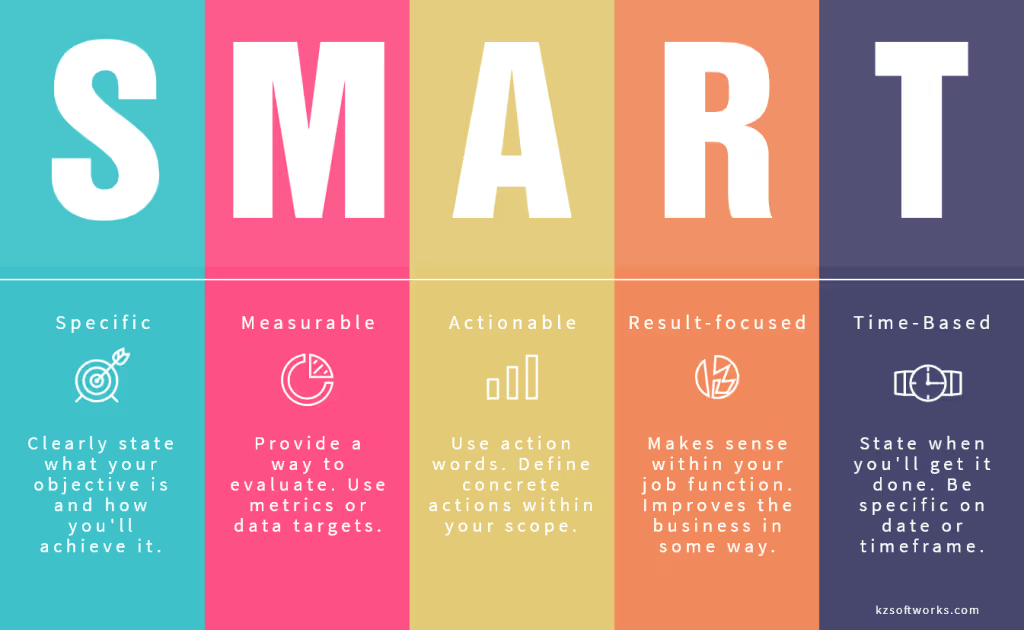
Specify your goal applying the SMART business management technique

Graphic of SMART objectives

Defining SMART criteria objectives help you stay focused on your goal and make good decisions. For instance, let’s check this objective: “Outsource to substantially improve quality assurance (QA).”

What’s the goal here: to use outsourcing or to improve QA? What does “substantially” mean? How long should it take for improvement to occur? This objective is too vague, doesn’t guide you towards actionable steps, and generates more questions than answers.

Now, let’s compare it with this other objective: “Reduce my department’s budget expenditures by 20% next quarter by nearshoring the maintenance of a legacy asset while my in-house team develops a new one”.

This one appears to be SMART since it’s specific and measurable (20%), it defines an action (nearshoring the maintenance of an asset), it focuses on results (reduce my department’s budget expenditures), and it’s time-bound (next quarter).

Defining a SMART goal is the first step when deciding if it makes sense to outsource work. But first, you might want to compare some financial and practical considerations to avoid common mistakes.

Expectations Versus Reality

Offshore outsourcing has been called one of the greatest stories ever sold.

Like many products today, outsourcing comes with a lot of fine print. The pain for smaller companies is that they don’t have the bandwidth even to read it.

However, understanding the fine print is important in these three areas: cost savings, vendor’s ability to scale, and quality of deliverables. Let’s check them out.

Cost Savings

How much money can you save by outsourcing? On the surface, it seems obvious. Even with wage inflation in India, China, and Eastern Europe, rates there are still substantially lower than in the United States.

For example, a mid-level Java developer in San Francisco earns roughly $75 per hour, compared to $25 per hour on average in Bangalore, Shenzhen, or St. Petersburg. At first glance, this lower rate translates into savings of more than 65%, or a 3:1 ratio (for every on-site Java developer you can get three offshore Java developers).

Is it that simple? Will getting three developers for the price of one give you three times the productivity? Unfortunately, no.

Hiring cheaper offshore developers doesn’t mean they will be as productive as local ones. Due to productivity issues, the difference in hourly rates could not necessarily translate into overall cost savings.

Overhead

Overhead expenses related to management, communications, and risk mitigation can eat away what you save in low hourly rates.

For example, if you outsource a small QA team, for example, you’ll probably need both local and offshore QA leads. Without outsourcing, a single lead is enough.

Moreover, if you distribute teams across multiple time zones, language and culture differences could significantly increase the volume of communications required to minimize misunderstandings.

Turnover Ratio

This one is an important expense to keep in mind. Losing a tech team member can be very expensive — as much as three to twelve months of employee salary. The turnover costs come from loss of productivity, hiring fees, training ramp-up, and other factors.

The degree of turnover is typically measured by turnover ratio or the number of lost employees divided by the team size over the course of the engagement. For example, a loss of two developers from a team of ten over the course of the engagement would be a 20% turnover ratio.

Ability to Scale

Many organizations face the challenge of adding personnel for an increased workload and ramping down when demand reduces. Outsourcing seems to be the perfect solution to this problem. Yet some staffing issues are inevitable:

Finding staff with specific skills, especially for cutting-edge technology, can be extremely time-consuming even for a top-tier vendor.

In your search for qualified personnel, consider which country you are outsourcing to and how the government supports young IT professionals.

Quality of Deliverables

There is a strong perception in the industry that the quality of deliverables produced by offshore personnel is inferior to that of local staff.

This perception is deeply flawed because outsourcing partners can either deliver higher or lower quality products and services than those of local employees. The challenge in getting quality deliverables lies in understanding all the aspects of communicating quality expectations to your partners and overseeing their work.

Summary

In this first post of these series, we have brought you general info and insights on outsourcing to help you check whether outsourcing software development is what you need to accomplish your goals.

First you have to be aware of the risks and challenges that come along on this journey. Some of them are external and out of your control, while others are internal to your organization and can be directly dealt with.

Of course, there are plenty of rewards as well like cost reduction, shortening time-to-market, improving workforce usage, improving your management skills, traveling around the world, and increasing productivity and process agility.

Second, you have to ask yourself what your goal is and what you want to accomplish by outsourcing. Remember that ambiguity and lack of detail are lethal to success. Thus defining goals with SMART criteria will go a long way in helping you establish realistic and actionable objectives.

Last, don’t forget to compare expectation versus reality. You would be better off bringing inflated expectations down to earth and taking into account factors like overhead expenses, vendor turnover ratio, scalability, quality of deliverables, and cost-saving versus productivity.

In the next installment of this series, we will be talking about what, with whom, and how to offshore or nearshore software development so you can make an educated decision on whether to do it.

We hope this post has been useful! A special shout-out to Daniel Castro who collaborated in the creation of this post.

Bibliography

Why Outsourcing?

Outsourcing is a powerful weapon, but if you don’t know how to harness its power, it might end up backfiring.

Offshoring or nearshoring software development tasks could prove very profitable for your organization and professionally enriching. We believe that anyone should be able to get the most out of an outsourcing experience.

Thus, in this post series we will be helping you understand whether to offshore or nearshore software development, with whom, and how. Armed with this knowledge, you’ll be able to make an educated decision on whether to embark on this journey.

In this first part, we will explain the most common risks and rewards associated with outsourcing, define what SMART objectives look like, and understand expectation versus reality so you can check if outsourcing is what you need to achieve your goals today.

Risks and Rewards

Does outsourcing seem like an appropriate technique for addressing your personal goals and professional objectives?

Chances are that if you survey your organization, you will find that some people say that outsourcing steals jobs and destroys organizational culture. Others might say that it could help the company stay in business and beat the competition.

Each side has valid points. Rather than debating, let’s explore some of the risks and rewards of outsourcing to see if it could work for you.

Risk types

Starting with the negatives, we can classify risks into three categories: external, internal, and personal.

External

External risks are related to factors outside your organization’s control. These include: geopolitical instability, intellectual property loss, inadequate vendor capabilities, and failure to meet joint responsibilities.

One of the most dramatic scenarios could involve a terrorist attack in “safe” offshore destinations like Mumbai or Moscow, which underscores the importance of understanding different countries’ political stability.

A less dramatic example would be when an unexpected change in tax regulation at an offshore location suddenly jeopardizes your investment.

Your potential partner’s financial stability, organizational maturity, technical skills, and ability to acquire and retain qualified talent are key to fully understand the situation you are getting into.

Internal

Internal risks are associated with factors your organization can control. The most notable ones include: unrealistic expectations, lack of organizational preparation, and negative staff impact.

Sometimes even the expectation of outsourcing, if incorrectly managed, can create organizational adversity by declining employees’ morale and productivity. Also, outsourcing initiatives will likely imply some degree of changes for existing processes and roles.

Maybe the most important internal challenge will lie in the unrealistic expectations that some organizations set about the end result. Exceptionally high-cost reduction expectations are one of the most common reasons for dissatisfaction.

Personal

Outsourcing can affect you personally in many ways, introducing changes to your lifestyle, career, and reputation.

Outsourcing may require you to increase the percentage of time you spend on activities you don’t enjoy or to shift working hours to cope with different time zones.

The very nature of outsourcing means that someone else does the work. In many cases, this will be someone whom you have little control over, but it is your name that will be in the line.

Moving from the role of individual contributor to representing an offshore or nearshore team might mean becoming a bearer of bad news. And that will have an inevitable impact on your reputation.

Reward types

With all the risks listed above, why would anyone want to outsource abroad anyways?

The answer is that competition is hard, the market is demanding and outsourcing could give your company a competitive edge. We can divide outsourcing benefits into organizational and personal ones:

Organizational

Cheaper salaries, a strong exchange rate between the US dollar and almost any other currency, lower overhead, economies of scale, controlled operation costs, productivity, and quality improvements all contribute to increased profit through resource efficiency and savings.

At the same time, outsourcing allows you to reallocate the workload during your busy season and shift less critical services abroad. This will help you meet deadlines faster and focus on disruptive innovation projects to gain a competitive advantage.

Outsourcing broadens your recruiting horizons. Having access to a huge staffing pool gives you access to hard-to-find personnel and the opportunity to team up with international experts. In addition, many outsourcing providers have a tremendous work ethic and drive to succeed.

A shortened time-to-market can be achieved as well. Having access to specialized skill sets, unique expertise, and certified processes can improve your competitive advantage.

Personal

There are several key personal benefits to choosing an international team.

From your career’s perspective, consider running an outsourcing engagement as a productive training session for developing management and leadership abilities. These are skills you can add to your resume and you would be surprised how often recruiters and companies look for outsourcing management abilities.

The skills you develop like negotiating, learning foreign languages, managing remote teams’ day-to-day, and assertiveness are invaluable skills that will benefit you in the long run. Accomplishing successful outsourcing engagements could catapult your career forward and open new doors.

Let’s not forget traveling! Seeing new places, meeting new and interesting people, experiencing foreign cultures, and trying new cuisines without spending your own money are major perks.

Having discussed outsourcing risks and rewards, you now have a better picture of the potential it has. But before deciding whether it’s for you first let’s consider which objectives you want to accomplish through outsourcing.

Defining SMART Objectives

This might not be the first time you’ve asked yourself if you should outsource a project, an initiative, or a company function.

Each time you face this situation, always remind yourself: you should only offshore or nearshore either when it is the only tool you have at your disposal or when it is the best tool for the job.

Consequently, you will first have to understand and determine what the “job” is in the first place.
When determining the “job,” you shouldn’t settle for broad goals like “need to reduce cost” or “put local staff to better use”, since ambiguity and lack of specification are lethal to success.

Specify your goal applying the SMART business management technique

Graphic of SMART objectives

Defining SMART criteria objectives help you stay focused on your goal and make good decisions. For instance, let’s check this objective: “Outsource to substantially improve quality assurance (QA).”

What’s the goal here: to use outsourcing or to improve QA? What does “substantially” mean? How long should it take for improvement to occur? This objective is too vague, doesn’t guide you towards actionable steps, and generates more questions than answers.

Now, let’s compare it with this other objective: “Reduce my department’s budget expenditures by 20% next quarter by nearshoring the maintenance of a legacy asset while my in-house team develops a new one”.

This one appears to be SMART since it’s specific and measurable (20%), it defines an action (nearshoring the maintenance of an asset), it focuses on results (reduce my department’s budget expenditures), and it’s time-bound (next quarter).

Defining a SMART goal is the first step when deciding if it makes sense to outsource work. But first, you might want to compare some financial and practical considerations to avoid common mistakes.

Expectations Versus Reality

Offshore outsourcing has been called one of the greatest stories ever sold.

Like many products today, outsourcing comes with a lot of fine print. The pain for smaller companies is that they don’t have the bandwidth even to read it.

However, understanding the fine print is important in these three areas: cost savings, vendor’s ability to scale, and quality of deliverables. Let’s check them out.

Cost Savings

How much money can you save by outsourcing? On the surface, it seems obvious. Even with wage inflation in India, China, and Eastern Europe, rates there are still substantially lower than in the United States.

For example, a mid-level Java developer in San Francisco earns roughly $75 per hour, compared to $25 per hour on average in Bangalore, Shenzhen, or St. Petersburg. At first glance, this lower rate translates into savings of more than 65%, or a 3:1 ratio (for every on-site Java developer you can get three offshore Java developers).

Is it that simple? Will getting three developers for the price of one give you three times the productivity? Unfortunately, no.

Hiring cheaper offshore developers doesn’t mean they will be as productive as local ones. Due to productivity issues, the difference in hourly rates could not necessarily translate into overall cost savings.

Overhead

Overhead expenses related to management, communications, and risk mitigation can eat away what you save in low hourly rates.

For example, if you outsource a small QA team, for example, you’ll probably need both local and offshore QA leads. Without outsourcing, a single lead is enough.

Moreover, if you distribute teams across multiple time zones, language and culture differences could significantly increase the volume of communications required to minimize misunderstandings.

Turnover Ratio

This one is an important expense to keep in mind. Losing a tech team member can be very expensive — as much as three to twelve months of employee salary. The turnover costs come from loss of productivity, hiring fees, training ramp-up, and other factors.

The degree of turnover is typically measured by turnover ratio or the number of lost employees divided by the team size over the course of the engagement. For example, a loss of two developers from a team of ten over the course of the engagement would be a 20% turnover ratio.

Ability to Scale

Many organizations face the challenge of adding personnel for an increased workload and ramping down when demand reduces. Outsourcing seems to be the perfect solution to this problem. Yet some staffing issues are inevitable:

Finding staff with specific skills, especially for cutting-edge technology, can be extremely time-consuming even for a top-tier vendor.

In your search for qualified personnel, consider which country you are outsourcing to and how the government supports young IT professionals.

Quality of Deliverables

There is a strong perception in the industry that the quality of deliverables produced by offshore personnel is inferior to that of local staff.

This perception is deeply flawed because outsourcing partners can either deliver higher or lower quality products and services than those of local employees. The challenge in getting quality deliverables lies in understanding all the aspects of communicating quality expectations to your partners and overseeing their work.

Summary

In this first post of these series, we have brought you general info and insights on outsourcing to help you check whether outsourcing software development is what you need to accomplish your goals.

First you have to be aware of the risks and challenges that come along on this journey. Some of them are external and out of your control, while others are internal to your organization and can be directly dealt with.

Of course, there are plenty of rewards as well like cost reduction, shortening time-to-market, improving workforce usage, improving your management skills, traveling around the world, and increasing productivity and process agility.

Second, you have to ask yourself what your goal is and what you want to accomplish by outsourcing. Remember that ambiguity and lack of detail are lethal to success. Thus defining goals with SMART criteria will go a long way in helping you establish realistic and actionable objectives.

Last, don’t forget to compare expectation versus reality. You would be better off bringing inflated expectations down to earth and taking into account factors like overhead expenses, vendor turnover ratio, scalability, quality of deliverables, and cost-saving versus productivity.

In the next installment of this series, we will be talking about what, with whom, and how to offshore or nearshore software development so you can make an educated decision on whether to do it.

We hope this post has been useful! A special shout-out to Daniel Castro who collaborated in the creation of this post.

Bibliography

Related Articles

·

May 15, 2026

Can AI Safely Apply Changes Across Microservices?

Learn how AI can apply changes across microservices when service ownership, message contracts, DTOs, and architectural context are clearly defined.

12 read time

Read more

Applying changes across microservices is difficult because business logic is distributed across multiple services, each with its own data, contracts, and responsibilities.

In our experiment at Kaizen Softworks, we tested whether an AI system could safely apply coordinated changes across a microservices architecture using only minimal input.

Short answer: Yes, but only when the AI has enough architectural context.

Why are coordinated changes in microservices so hard?

In distributed systems, a single business change rarely affects just one service.

It often requires:

  • Updating multiple microservices
  • Modifying message contracts
  • Keeping DTOs (Data Transfer Objects) consistent
  • Respecting domain boundaries defined by Domain-Driven Design (DDD)

Key entities in this system:

  • Microservice: An independently deployable service responsible for a specific domain
  • Aggregate (DDD): A cluster of domain objects treated as a single unit
  • DTO (Data Transfer Object): A structured format used to transfer data between services
  • Message/Event: A communication mechanism between services

The complexity is not in the code, it’s in the relationships between components.

The experiment: Can AI reason across services with minimal input?

We designed a controlled experiment to test whether an AI model could apply system-wide changes with limited information.

Input given to the AI:

  • Message definitions (events between services)
  • DTOs (data contracts)

Tasks the AI had to perform:

  1. Identify affected aggregates
  2. Determine service ownership
  3. Apply coordinated changes across services
  4. Maintain consistency in messages and DTOs

In other words, the AI had to behave like a software architect, not just a code generator.

What was the biggest obstacle?

The biggest challenge was not technical, it was contextual.

Before and after diagram showing how ambiguous microservice names prevent AI from understanding service ownership, while aggregate-to-service mapping helps AI apply safe coordinated changes.

Problem: unclear service naming

Instead of descriptive names like:

  • order-service
  • billing-service

Our services were named:

  • john
  • sally
  • roger

This removed any semantic clues about responsibility.

Result: The AI could not infer which service owned which domain logic.

The missing piece: aggregate ownership mapping

To solve this, we introduced a simple but powerful structure:

Aggregate → Service mapping

  • Order → john
  • Shipment → sally
  • Invoice → roger

This created a clear relationship between domain concepts and system components.

Once ownership was explicit, the architecture became understandable.

How we used AI to generate architectural context

Instead of building this mapping manually, we used AI to analyze the codebase and extract:

  • Where each aggregate was defined
  • Which microservice implemented it
  • The relationship between domain and infrastructure

The result was a machine-readable architecture map.

In practice, we used AI to generate the context that AI itself needed.

Results: Can AI safely apply distributed changes?

With the architecture map in place, the AI was able to:

  • Trace message flows across services
  • Identify affected aggregates
  • Locate the correct microservices
  • Apply coordinated updates
  • Maintain consistency between DTOs and messages

While not perfect, the system worked reliably as a proof of concept.

What is the real limitation of AI in microservices?

The main limitation of AI is not code generation, it’s architectural understanding.

Without knowing:

  • Which components exist
  • How they relate
  • Who owns what

AI cannot safely modify a distributed system.

AI performance depends more on context quality than model capability.

When can AI safely modify microservices?

AI works well when:

  • Aggregate ownership is clearly defined
  • Message contracts are explicit
  • Architecture is structured and consistent

AI struggles when:

  • Naming is ambiguous
  • Relationships are implicit
  • Context is incomplete

Simple rule: If the architecture is clear, AI can reason. If not, it guesses.

Final thoughts

This experiment revealed something important:

AI doesn’t fail because it can’t write code.
It fails because it can’t see the system.

As teams move toward AI-assisted development, the focus will likely shift from:

Writing better code to Designing better systems for machines to understand

At Kaizen Softworks, we see this as a foundational shift.

Because when AI can understand architecture, it doesn’t just generate code, it helps evolve systems.

·

Mar 13, 2026

How We Make Decisions Without Managers

We don’t have traditional managers. This is how we make decisions and keep things moving.

12 read time

Read more

There's a myth that in flat organizations, everyone decides on everything.

That's not how it works. At least not at Kaizen.

When people hear "no managers," they often picture one of two extremes: either total chaos where nobody is accountable, or endless meetings where 80 people vote on which coffee to buy. The reality is neither.

Not everyone decides on everything. Not everyone votes. What we do have is a clear set of decision-making methods that we choose based on context.

It depends on who's affected and how deep the impact goes

Before choosing how to decide, we ask ourselves a few questions:

  • Who is affected? A decision that only impacts one team doesn't need the whole company involved. A decision that affects everyone's daily work does.
  • How deep is the impact? Changing the office furniture is wide but shallow. Changing the salary model is deep and lasting.
  • Is it reversible? If we can easily undo it, we can move fast and just inform. If it's hard to reverse, we slow down and include more people.
  • How urgent is it? And here we're careful to distinguish real urgency from anxiety, the pressure to decide quickly because someone already has "the answer" in mind.

These dimensions help us pick the right method. Not every decision deserves the same process.

Our decision-making toolkit

Over the years, we've landed on a few methods that we use depending on the situation:

1. Role-based decisions

Some decisions belong to a specific role. If someone owns a responsibility, say, office logistics or hiring for a team,  they decide within that domain. No committee needed. The key is that roles are transparent: everyone knows who owns what, and the scope of each role's authority is clear.

2. Advice Process

When a decision doesn't clearly belong to one role, or when it crosses boundaries, we use the advice process. Here's how it works:

  1. Someone takes the initiative. They identify the problem and own the process.
  2. They gather input from people who are affected and people with expertise.
  3. They seek advice, real conversations, not rubber-stamping.
  4. They make the decision and communicate it, including what advice they incorporated and what they didn't (and why).

The decision-maker is not a committee. It's one person (or a small group) who takes responsibility. But they don't decide in isolation, they bring in the perspectives that matter.

We sometimes call this "Team Advice" when a working group forms around an issue that doesn't naturally fall into anyone's area, and "Area Advice" when a team opens up a topic that exceeds their own scope.

3. Consent (not consensus)

Consent is not "everyone agrees." Consent means "no one has a strong enough objection to block this." We do use a poll, but not to count votes — we use a 1-to-5 scale to measure the level of agreement and surface objections, not to let the majority rule.

We use it in two flavors:

  • High-participation consent: For decisions with deep, company-wide impact. This is our most expensive and slowest method, which is exactly why we reserve it for high-impact decisions that affect many people. The Board sets the boundaries, for example, when we moved offices, they defined the monthly budget. Then a working group produced proposals, collected feedback, evolved them, and the whole company expressed their position for the final decision. Silence is not approval; we explicitly ask people to weigh in, even if it's just "I have no objection."
  • Lightweight consent: For decisions that are broad but not deep. Participation is optional, anyone who's interested can jump in. We share the proposal, open a window for objections, and if nobody opposes, we move forward. This gives us speed without sacrificing transparency. If nobody engages, that's a signal too, maybe the proposal doesn't add enough value, or we're using the wrong channel.

4. Inform, don't fake-consult

Not everything needs participation. When a decision has already been made through a legitimate process, the right move is to inform, not to fake-consult. One of the fastest ways to kill self-management is to ask for feedback and then ignore it. If you're not going to change course based on input, don't ask for it, just be transparent about the decision and the reasons behind it.

What we explicitly avoid

  • Decision by Voting. In a company context, majority rule creates losers. And losers become detractors, often generating more resistance than an autocratic decision would have. Instead of voting, we prefer to evolve a proposal through feedback until it's "good enough for now," and then introduce a review point to adjust later. If voting happens at all, it's the cherry on top, not the main course.
  • The "surprise" approach. Working behind closed doors and then unveiling a finished decision is a recipe for frustration. Adults don't need surprises. Adults need to feel like they're part of the process. The complaints that follow a surprise aren't about the decision itself, they're about not being included.

Why we work this way

We didn't adopt these methods because they're trendy. We adopted them because they solve real problems:

  • Better decisions. When you include affected people, you get information you wouldn't have had otherwise. Ideas emerge that no single person would have come up with alone.
  • Less resistance. A person who feels heard is far less likely to resist a decision, even one they wouldn't have made themselves.
  • Faster execution. It sounds counterintuitive, but participative decisions often execute faster because people already understand and support them. The time you "save" by deciding alone, you spend later managing pushback.
  • Distributed authority. When people can make decisions within their domain without escalating everything to a founder, the organization scales. The bottleneck disappears.
  • Resilience. If a shared decision fails, the group adjusts together. If a top-down decision fails, the blame falls on one person and the chances of proactive correction drop.

The real principle behind all of this

Transparency is the foundation. Every method we use, from role-based decisions to high-participation consent, works because information flows openly. People know what's being decided, who's deciding it, and how they can participate.

Horizontal doesn't mean structureless. It means fewer hierarchical levels, clearer roles, and intentional decision-making processes that match the weight of each decision.

Not everyone decides on everything. But everyone knows how things get decided.