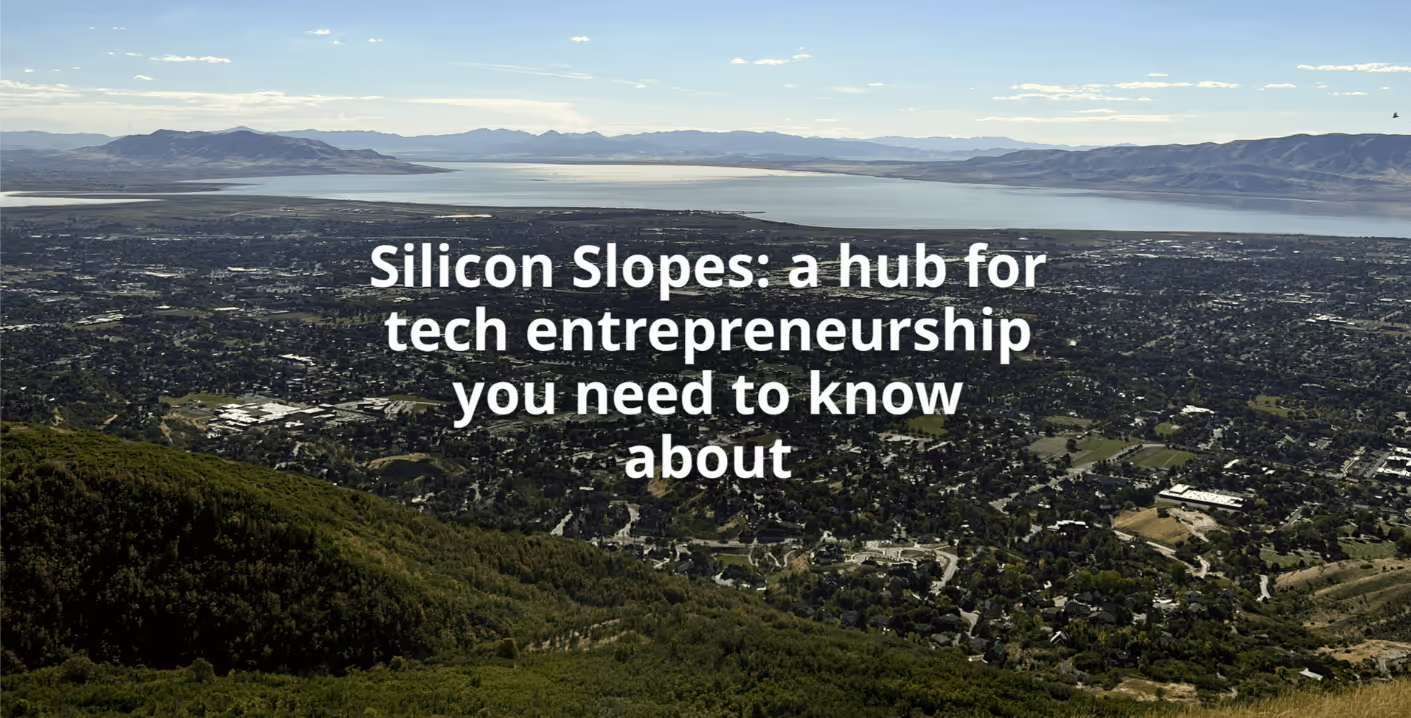
Silicon Slopes: a Hub for Tech Entrepreneurship You Need to Know About
Published on
·
February 23, 2026
Last updated on
·
February 16, 2026
Time to read
·
12
Valentina Ibinete
Marketing Lead
Utah is not just known for their snowboarding and Mormon lifestyle. Technology and entrepreneurship are booming in the State, especially in the area known as Silicon Slopes.
This area that goes from Salt Lake City to Provo has become one of the most diverse tech hubs in the U.S. The nickname combines the region’s tie to technology and Silicon Valley, with the mountains found all over the place.
The area also has a long history of entrepreneurship and is home to a well-known cluster of IT, software development and hardware manufacturing tech companies such as Adobe, Ancestry.com, SanDisk, Overstock, Vivint, eBay, and more.
From September 24th to October 1st, Daniel Castro and myself visited Silicon Slopes, with the aim of getting to know better the Utah entrepreneurial ecosystem on-site.
Keep reading if you’re interested in our top three impressions of this booming technological hub.
Technological history: it’s not just for Silicon Valley
Utah is a state known for many things: its beautiful scenery, its large Mormon population, and skiing facilities. But what you may not know is that Utah has a rich history of tech innovation that goes back well before the days of Facebook and Google.
The state is home to some of the most impressive technological achievements in history, including the first electronic television transmission in 1927, which was operated by Philo Farnsworth—a man who also invented the first all-electronic TV set.
Utah is also home to the spawning of Atari, which we all know and love for its retro gaming systems (and modern ones too). Nolan Bushnell, the company’s iconic founder, was born in Clearfield, Utah, and studied at The University of Utah before moving to Sunnyvale, California and founding Atari.
The state has also been home to a number of early tech companies and founders that have had an impact on the technology industry as a whole and attracted more businesses to the area such as:
Evans & Sutherland, which was founded there in 1968 by David Evans and Ivan Sutherland as the world's first computer graphics company (in operation for over four decades supplying advanced computer graphics technologies to the market);
John Warnock, a co-founder of Adobe Systems;
Alan Ashton, co-founder of WordPerfect;
David C. Evans, founder and first chairman of the University of Utah School of Computing;
James H. Clark, founder of Silicon Graphics, Inc; and
Edwin Catmull, co-founder of Pixar.
The first wave of the tech scene in Utah began in 1979 when two companies, WordPerfect and Novell, were founded. Novell was a software development company that produced programs to network computers together so they could share peripheral devices like printers and hard drives. As desktop computers became more affordable, Novell captured a large segment of the market with its NetWare program. At their height in the early 1990s, Novell controlled 65% of the market for network operating systems in the high-tech industry.
A second wave of tech companies came along in the 1990s with the founding of Omnitureby Josh James and Jeff Taylor. During that same period, Utah became known on the world stage after hosting the 2002 Winter Olympics—and it's been riding that wave ever since! The 2009 acquisition of Omniture by Adobe for $1.8 billion led Adobe to establish a permanent presence in Utah.
In more recent years, Utah has spawned a number of unicorns. From SaaS unicorns like Route (which made Forbes’ 2021 list of Next Billion-Dollar Startups) to e-commerce giants like Overstock, dozens of tech influencers are either headquartered or have satellite offices in Silicon Slopes.
Many companies take advantage of Utah’s pro-business climate and Silicon Slopes’ innovative culture include:
Adobe
Ancestry.com
Domo
EA Sports
eBay
Pluralsight
SanDisk
Vivint
Workfront
Zions Bank
SLC Main St; Temple Square; Silicon Slopes area
Diverse community
One of the most interesting aspects about this new hub is its diversity. The area has welcomed a diverse group of people and companies to its laid-back, welcoming vibe—and they've responded in kind. Young families are flocking here to find affordable housing, good public schools, and the ability to build their own small businesses or work for larger ones.
Utah has a lot going for it when it comes to creating a thriving business ecosystem: a streamlined tax code; tax incentives; an educated workforce; and a strong emphasis on entrepreneurship and innovation.
But there’s more than just business happening in the area. Silicon Slopes has also made tremendous progress toward becoming more open to entrepreneurs of every background—particularly underrepresented minorities such as women—, and seeks to take a leading role in the region’s diversity, equity, and inclusion initiatives.
Diversity isn't just an issue of recruitment, it's an issue of culture. Companies at Silicon Slopes are making an effort not just to look for more diverse employees; they're looking for highly talented people who can help them reshape the culture. And this means every person at every level of a company—from the boardroom to the mail room—has a responsibility to make things better by being themselves and speaking up when they see something that needs changing.
After all, diversity is more than just a buzzword—it's a catalyst for innovation!
Commitment to the local community
Silicon Slopes is not just a bunch of tech companies. They're a community.
The area has retained its small-town community feeling while still being a hub for growth. Something that we particularly notice when talking to different partners and companies, is the commitment and contribution to the local community:
It is home to a huge number of ambitious young graduates from the University of Utah and Brigham Young University. And as the area is still growing, there's plenty of talent to go around, which means companies can hire them young and promote internally to build the kind of team that can drive success.
It is highly valued that companies have a real commitment to focus on empowering people: investing in their learning path, fostering a collaborative work culture, and a people-focused mindset.
Money or just business services are not what motivates close partnerships between companies, but the most important thing is the validation of trust and alignment in values focused on collaboration.
The contribution to the community and the social impact that a company/person can generate is very important: charity volunteering, coaching sessions, workshops, among other initiatives are highly praised
One of the best things about the tech scene in Silicon Slopes is that there are plenty of events for startups, like Silicon Slopes Summit and Pitch Competition that are a great way for entrepreneurs to bring new ideas in an ever-changing business environment. I recommend attending to as many of these as you can, especially when you’re first getting started. New businesses face different challenges and through these platforms you can share your ideas, learn and grow through top business leaders too. When you’re passionate about what you do, it’s clever to feed off of the energy of other people.
And best of all, you learn more from other innovators. The collaboration and information exchange eliminates the feelings of isolation that a lot of startup founders feel. This is a concept known as "connecting with your tribe," and it’s something that more entrepreneurs need to embrace.
Whether you want to start a business in tech or anything else for that matter, making a name for yourself means that networking is the key to success. Instead of focusing on how many people there are in the same field as you (which can be very discouraging) try looking at how many successful entrepreneurs there are who have found success in their field.
It seems like everyone here has a vested interest in making sure people and businesses grow—and why wouldn't they? It's not only good for morale (which means more productivity), but it also makes a sense of belonging to the community stronger.
Final thoughts
Silicon Slopes serves as an interesting example of a tech cluster that is growing in size, scope and influence. It has already seen great change, and there is a lot more to come in the coming years, becoming one of the most prevalent startup hubs in the country with its innovative tech companies.
While still most well-known for their ties to the larger Valley, it is their own growing community that should inspire us all. It seems to be a region where people love living in, and they support and celebrate the vibrant business community that contributes to it.
This shows how a group of like-minded people can push into the future together and form a new hub of technology. Silicon Slopes is an exciting place in Utah and in tech, period.
Utah is not just known for their snowboarding and Mormon lifestyle. Technology and entrepreneurship are booming in the State, especially in the area known as Silicon Slopes.
This area that goes from Salt Lake City to Provo has become one of the most diverse tech hubs in the U.S. The nickname combines the region’s tie to technology and Silicon Valley, with the mountains found all over the place.
The area also has a long history of entrepreneurship and is home to a well-known cluster of IT, software development and hardware manufacturing tech companies such as Adobe, Ancestry.com, SanDisk, Overstock, Vivint, eBay, and more.
From September 24th to October 1st, Daniel Castro and myself visited Silicon Slopes, with the aim of getting to know better the Utah entrepreneurial ecosystem on-site.
Keep reading if you’re interested in our top three impressions of this booming technological hub.
Technological history: it’s not just for Silicon Valley
Utah is a state known for many things: its beautiful scenery, its large Mormon population, and skiing facilities. But what you may not know is that Utah has a rich history of tech innovation that goes back well before the days of Facebook and Google.
The state is home to some of the most impressive technological achievements in history, including the first electronic television transmission in 1927, which was operated by Philo Farnsworth—a man who also invented the first all-electronic TV set.
Utah is also home to the spawning of Atari, which we all know and love for its retro gaming systems (and modern ones too). Nolan Bushnell, the company’s iconic founder, was born in Clearfield, Utah, and studied at The University of Utah before moving to Sunnyvale, California and founding Atari.
The state has also been home to a number of early tech companies and founders that have had an impact on the technology industry as a whole and attracted more businesses to the area such as:
Evans & Sutherland, which was founded there in 1968 by David Evans and Ivan Sutherland as the world's first computer graphics company (in operation for over four decades supplying advanced computer graphics technologies to the market);
John Warnock, a co-founder of Adobe Systems;
Alan Ashton, co-founder of WordPerfect;
David C. Evans, founder and first chairman of the University of Utah School of Computing;
James H. Clark, founder of Silicon Graphics, Inc; and
Edwin Catmull, co-founder of Pixar.
The first wave of the tech scene in Utah began in 1979 when two companies, WordPerfect and Novell, were founded. Novell was a software development company that produced programs to network computers together so they could share peripheral devices like printers and hard drives. As desktop computers became more affordable, Novell captured a large segment of the market with its NetWare program. At their height in the early 1990s, Novell controlled 65% of the market for network operating systems in the high-tech industry.
A second wave of tech companies came along in the 1990s with the founding of Omnitureby Josh James and Jeff Taylor. During that same period, Utah became known on the world stage after hosting the 2002 Winter Olympics—and it's been riding that wave ever since! The 2009 acquisition of Omniture by Adobe for $1.8 billion led Adobe to establish a permanent presence in Utah.
In more recent years, Utah has spawned a number of unicorns. From SaaS unicorns like Route (which made Forbes’ 2021 list of Next Billion-Dollar Startups) to e-commerce giants like Overstock, dozens of tech influencers are either headquartered or have satellite offices in Silicon Slopes.
Many companies take advantage of Utah’s pro-business climate and Silicon Slopes’ innovative culture include:
Adobe
Ancestry.com
Domo
EA Sports
eBay
Pluralsight
SanDisk
Vivint
Workfront
Zions Bank
SLC Main St; Temple Square; Silicon Slopes area
Diverse community
One of the most interesting aspects about this new hub is its diversity. The area has welcomed a diverse group of people and companies to its laid-back, welcoming vibe—and they've responded in kind. Young families are flocking here to find affordable housing, good public schools, and the ability to build their own small businesses or work for larger ones.
Utah has a lot going for it when it comes to creating a thriving business ecosystem: a streamlined tax code; tax incentives; an educated workforce; and a strong emphasis on entrepreneurship and innovation.
But there’s more than just business happening in the area. Silicon Slopes has also made tremendous progress toward becoming more open to entrepreneurs of every background—particularly underrepresented minorities such as women—, and seeks to take a leading role in the region’s diversity, equity, and inclusion initiatives.
Diversity isn't just an issue of recruitment, it's an issue of culture. Companies at Silicon Slopes are making an effort not just to look for more diverse employees; they're looking for highly talented people who can help them reshape the culture. And this means every person at every level of a company—from the boardroom to the mail room—has a responsibility to make things better by being themselves and speaking up when they see something that needs changing.
After all, diversity is more than just a buzzword—it's a catalyst for innovation!
Commitment to the local community
Silicon Slopes is not just a bunch of tech companies. They're a community.
The area has retained its small-town community feeling while still being a hub for growth. Something that we particularly notice when talking to different partners and companies, is the commitment and contribution to the local community:
It is home to a huge number of ambitious young graduates from the University of Utah and Brigham Young University. And as the area is still growing, there's plenty of talent to go around, which means companies can hire them young and promote internally to build the kind of team that can drive success.
It is highly valued that companies have a real commitment to focus on empowering people: investing in their learning path, fostering a collaborative work culture, and a people-focused mindset.
Money or just business services are not what motivates close partnerships between companies, but the most important thing is the validation of trust and alignment in values focused on collaboration.
The contribution to the community and the social impact that a company/person can generate is very important: charity volunteering, coaching sessions, workshops, among other initiatives are highly praised
One of the best things about the tech scene in Silicon Slopes is that there are plenty of events for startups, like Silicon Slopes Summit and Pitch Competition that are a great way for entrepreneurs to bring new ideas in an ever-changing business environment. I recommend attending to as many of these as you can, especially when you’re first getting started. New businesses face different challenges and through these platforms you can share your ideas, learn and grow through top business leaders too. When you’re passionate about what you do, it’s clever to feed off of the energy of other people.
And best of all, you learn more from other innovators. The collaboration and information exchange eliminates the feelings of isolation that a lot of startup founders feel. This is a concept known as "connecting with your tribe," and it’s something that more entrepreneurs need to embrace.
Whether you want to start a business in tech or anything else for that matter, making a name for yourself means that networking is the key to success. Instead of focusing on how many people there are in the same field as you (which can be very discouraging) try looking at how many successful entrepreneurs there are who have found success in their field.
It seems like everyone here has a vested interest in making sure people and businesses grow—and why wouldn't they? It's not only good for morale (which means more productivity), but it also makes a sense of belonging to the community stronger.
Final thoughts
Silicon Slopes serves as an interesting example of a tech cluster that is growing in size, scope and influence. It has already seen great change, and there is a lot more to come in the coming years, becoming one of the most prevalent startup hubs in the country with its innovative tech companies.
While still most well-known for their ties to the larger Valley, it is their own growing community that should inspire us all. It seems to be a region where people love living in, and they support and celebrate the vibrant business community that contributes to it.
This shows how a group of like-minded people can push into the future together and form a new hub of technology. Silicon Slopes is an exciting place in Utah and in tech, period.
Applying changes across microservices is difficult because business logic is distributed across multiple services, each with its own data, contracts, and responsibilities.
In our experiment at Kaizen Softworks, we tested whether an AI system could safely apply coordinated changes across a microservices architecture using only minimal input.
Short answer: Yes, but only when the AI has enough architectural context.
Why are coordinated changes in microservices so hard?
In distributed systems, a single business change rarely affects just one service.
It often requires:
Updating multiple microservices
Modifying message contracts
Keeping DTOs (Data Transfer Objects) consistent
Respecting domain boundaries defined by Domain-Driven Design (DDD)
Key entities in this system:
Microservice: An independently deployable service responsible for a specific domain
Aggregate (DDD): A cluster of domain objects treated as a single unit
DTO (Data Transfer Object): A structured format used to transfer data between services
Message/Event: A communication mechanism between services
The complexity is not in the code, it’s in the relationships between components.
The experiment: Can AI reason across services with minimal input?
We designed a controlled experiment to test whether an AI model could apply system-wide changes with limited information.
Input given to the AI:
Message definitions (events between services)
DTOs (data contracts)
Tasks the AI had to perform:
Identify affected aggregates
Determine service ownership
Apply coordinated changes across services
Maintain consistency in messages and DTOs
In other words, the AI had to behave like a software architect, not just a code generator.
What was the biggest obstacle?
The biggest challenge was not technical, it was contextual.
Problem: unclear service naming
Instead of descriptive names like:
order-service
billing-service
Our services were named:
john
sally
roger
This removed any semantic clues about responsibility.
Result: The AI could not infer which service owned which domain logic.
The missing piece: aggregate ownership mapping
To solve this, we introduced a simple but powerful structure:
Aggregate → Service mapping
Order → john
Shipment → sally
Invoice → roger
This created a clear relationship between domain concepts and system components.
Once ownership was explicit, the architecture became understandable.
How we used AI to generate architectural context
Instead of building this mapping manually, we used AI to analyze the codebase and extract:
Where each aggregate was defined
Which microservice implemented it
The relationship between domain and infrastructure
The result was a machine-readable architecture map.
In practice, we used AI to generate the context that AI itself needed.
Results: Can AI safely apply distributed changes?
With the architecture map in place, the AI was able to:
Trace message flows across services
Identify affected aggregates
Locate the correct microservices
Apply coordinated updates
Maintain consistency between DTOs and messages
While not perfect, the system worked reliably as a proof of concept.
What is the real limitation of AI in microservices?
The main limitation of AI is not code generation, it’s architectural understanding.
Without knowing:
Which components exist
How they relate
Who owns what
AI cannot safely modify a distributed system.
AI performance depends more on context quality than model capability.
When can AI safely modify microservices?
AI works well when:
Aggregate ownership is clearly defined
Message contracts are explicit
Architecture is structured and consistent
AI struggles when:
Naming is ambiguous
Relationships are implicit
Context is incomplete
Simple rule: If the architecture is clear, AI can reason. If not, it guesses.
Final thoughts
This experiment revealed something important:
AI doesn’t fail because it can’t write code. It fails because it can’t see the system.
As teams move toward AI-assisted development, the focus will likely shift from:
Writing better code to Designing better systems for machines to understand
At Kaizen Softworks, we see this as a foundational shift.
Because when AI can understand architecture, it doesn’t just generate code, it helps evolve systems.
There's a myth that in flat organizations, everyone decides on everything.
That's not how it works. At least not at Kaizen.
When people hear "no managers," they often picture one of two extremes: either total chaos where nobody is accountable, or endless meetings where 80 people vote on which coffee to buy. The reality is neither.
Not everyone decides on everything. Not everyone votes. What we do have is a clear set of decision-making methods that we choose based on context.
It depends on who's affected and how deep the impact goes
Before choosing how to decide, we ask ourselves a few questions:
Who is affected? A decision that only impacts one team doesn't need the whole company involved. A decision that affects everyone's daily work does.
How deep is the impact? Changing the office furniture is wide but shallow. Changing the salary model is deep and lasting.
Is it reversible? If we can easily undo it, we can move fast and just inform. If it's hard to reverse, we slow down and include more people.
How urgent is it? And here we're careful to distinguish real urgency from anxiety, the pressure to decide quickly because someone already has "the answer" in mind.
These dimensions help us pick the right method. Not every decision deserves the same process.
Our decision-making toolkit
Over the years, we've landed on a few methods that we use depending on the situation:
1. Role-based decisions
Some decisions belong to a specific role. If someone owns a responsibility, say, office logistics or hiring for a team, they decide within that domain. No committee needed. The key is that roles are transparent: everyone knows who owns what, and the scope of each role's authority is clear.
2. Advice Process
When a decision doesn't clearly belong to one role, or when it crosses boundaries, we use the advice process. Here's how it works:
Someone takes the initiative. They identify the problem and own the process.
They gather input from people who are affected and people with expertise.
They seek advice, real conversations, not rubber-stamping.
They make the decision and communicate it, including what advice they incorporated and what they didn't (and why).
The decision-maker is not a committee. It's one person (or a small group) who takes responsibility. But they don't decide in isolation, they bring in the perspectives that matter.
We sometimes call this "Team Advice" when a working group forms around an issue that doesn't naturally fall into anyone's area, and "Area Advice" when a team opens up a topic that exceeds their own scope.
3. Consent (not consensus)
Consent is not "everyone agrees." Consent means "no one has a strong enough objection to block this." We do use a poll, but not to count votes — we use a 1-to-5 scale to measure the level of agreement and surface objections, not to let the majority rule.
We use it in two flavors:
High-participation consent: For decisions with deep, company-wide impact. This is our most expensive and slowest method, which is exactly why we reserve it for high-impact decisions that affect many people. The Board sets the boundaries, for example, when we moved offices, they defined the monthly budget. Then a working group produced proposals, collected feedback, evolved them, and the whole company expressed their position for the final decision. Silence is not approval; we explicitly ask people to weigh in, even if it's just "I have no objection."
Lightweight consent: For decisions that are broad but not deep. Participation is optional, anyone who's interested can jump in. We share the proposal, open a window for objections, and if nobody opposes, we move forward. This gives us speed without sacrificing transparency. If nobody engages, that's a signal too, maybe the proposal doesn't add enough value, or we're using the wrong channel.
4. Inform, don't fake-consult
Not everything needs participation. When a decision has already been made through a legitimate process, the right move is to inform, not to fake-consult. One of the fastest ways to kill self-management is to ask for feedback and then ignore it. If you're not going to change course based on input, don't ask for it, just be transparent about the decision and the reasons behind it.
What we explicitly avoid
Decision by Voting. In a company context, majority rule creates losers. And losers become detractors, often generating more resistance than an autocratic decision would have. Instead of voting, we prefer to evolve a proposal through feedback until it's "good enough for now," and then introduce a review point to adjust later. If voting happens at all, it's the cherry on top, not the main course.
The "surprise" approach. Working behind closed doors and then unveiling a finished decision is a recipe for frustration. Adults don't need surprises. Adults need to feel like they're part of the process. The complaints that follow a surprise aren't about the decision itself, they're about not being included.
Why we work this way
We didn't adopt these methods because they're trendy. We adopted them because they solve real problems:
Better decisions. When you include affected people, you get information you wouldn't have had otherwise. Ideas emerge that no single person would have come up with alone.
Less resistance. A person who feels heard is far less likely to resist a decision, even one they wouldn't have made themselves.
Faster execution. It sounds counterintuitive, but participative decisions often execute faster because people already understand and support them. The time you "save" by deciding alone, you spend later managing pushback.
Distributed authority. When people can make decisions within their domain without escalating everything to a founder, the organization scales. The bottleneck disappears.
Resilience. If a shared decision fails, the group adjusts together. If a top-down decision fails, the blame falls on one person and the chances of proactive correction drop.
The real principle behind all of this
Transparency is the foundation. Every method we use, from role-based decisions to high-participation consent, works because information flows openly. People know what's being decided, who's deciding it, and how they can participate.
Horizontal doesn't mean structureless. It means fewer hierarchical levels, clearer roles, and intentional decision-making processes that match the weight of each decision.
Not everyone decides on everything. But everyone knows how things get decided.