Why is Uruguay a Top Nearshore Software Development Country?
Published on
·
February 23, 2026
Last updated on
·
February 16, 2026
Time to read
·
12
Valentina Ibinete
Marketing Lead
In a previous blog post, we explored the factors that have led Uruguay to transform into an IT hub in Latin America. From its strong connectivity and network infrastructure to its high-quality tech talent, Uruguay has become an attractive destination for global companies like IBM, Microsoft and Oracle, seeking software development services.
In this second part, we will explore why Uruguay is a top Nearshore software development destination.
Reasons Why Uruguay is a Top Nearshore Software Development Country
1. Transparent Business Environment and Economic Freedom
Uruguay's dedication to transparency it's remarkable. It's the least corrupt country in Latin America, and stands tall at the 18th global spot in the Corruption Perceptions Index (CPI), boasting a remarkable score of 73/100. The CPI draws its strength from an impressive array of data sources, including the World Bank and the World Economic Forum.
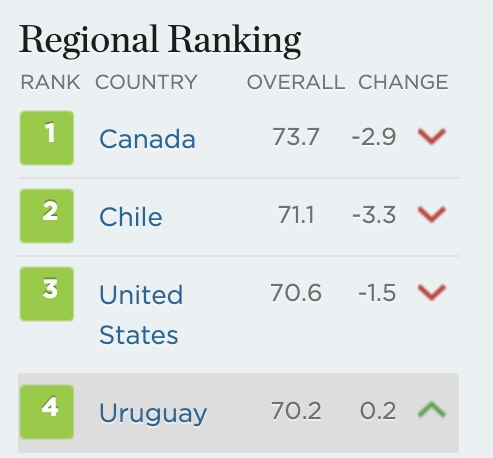
In economic freedom, Uruguay takes the 27th position worldwide and an astonishing 4th place in the Americas. With an economic freedom score of 70.2, it surpasses both global and regional averages. What does this mean for you? An environment that is finely tuned for efficiency, offering not only cost-effective services but also the promise of success.
2023 Index of Economic Freedom
Uruguay's impeccable reputation for upholding ethical business practices and a deep understanding of client expectations sets the stage for an exceptionally trustworthy and reliable partnership. When you entrust your software projects to a third party, these factors not only minimize risks but also ensure the ethical handling of your business needs.
2. Time Zone Compatibility
Uruguay's time zone compatibility is a gift to U.S. clients. Operating on the Uruguay Standard Time (UYT), it's just one hour ahead of the Eastern Time Zone (ET) in the United States.
The advantages of this time zone compatibility are crystal clear:
Real-Time Collaboration: With synchronized time zones, real-time collaboration is second nature. Both you and your nearshore development teams can work during regular business hours, ensuring rapid responses to queries, swift issue resolution, and prompt project updates.
Overlap of Working Hours: The critical overlap of working hours ensures seamless communication and efficient project management. Uruguay's proximity to the U.S. East Coast ensures several hours of shared working time, creating the ideal window for meetings, discussions, and immediate problem-solving.
Reduced Communication Delays: Similar time zones dramatically reduce the risk of communication delays due to time zone disparities. Messages, emails, and calls flow freely during your regular workday, elevating the efficiency and responsiveness of your development process.
2. English Proficiency
While Spanish is the official language of Uruguay, the country has a notable level of English proficiency for several reasons:
Educational System: Uruguay places a strong emphasis on education, with English being a mandatory subject in its national curriculum. The journey begins early, often in kindergarten, and continues throughout academic years. This enduring commitment to language education molds a population with a heightened level of English proficiency.
Global Business and Trade: Uruguay has a thriving business environment with a focus on international trade and services. Many companies in Uruguay engage in global commerce, and English is often the preferred language for international communication. This necessity for English proficiency in the business world encourages individuals to learn and improve their English skills.
Data from the EF English Proficiency Index, which ranks countries by their English proficiency, consistently places Uruguay at a relatively high level compared to other Latin American countries. In the 2021 index, Uruguay was ranked 36th out of 100 countries, indicating a moderate-to-high level of English proficiency.
Moreover, the Organization of Ibero-American States for Education, Science, and Culture (OEI) reported in 2020 that approximately 50% of the Uruguayan population possesses some level of English knowledge. This widespread effort to promote English language education underscores Uruguay's commitment to a bilingual future.
Uruguay's dedication to English proficiency, deeply embedded in its educational system and thriving business landscape, offers a bridge of communication and understanding for our U.S. clients. With Uruguay as your nearshore partner, you'll experience not only technical expertise but also a seamless flow of ideas, ensuring the success of your projects.
4. Cultural Fit: A Seamless Blend of Values and Vision
In the quest for a nearshore partner who understands and aligns with your cultural ethos, Uruguay shines as a beacon of cultural affinity. Here's why it resonates with U.S. clients:
Education and Professional Training: Uruguay has a well-developed education system that emphasizes the acquisition of skills and knowledge relevant to the global market. Many educational institutions in Uruguay offer English language programs and incorporate international standards in their curriculum, preparing students to work effectively in cross-cultural settings. The focus on education, particularly in the fields of science, technology and engineering, has contributed to the growth of the country's tech industry and its emergence as a tech hub in the region.
International Exposure: Uruguay has a high degree of international exposure, with a significant number of its population having traveled or lived abroad. This exposure contributes to a broader understanding of Western cultures, work practices, and business expectations, enhancing the cultural affinity between Uruguay and Western countries.
The result? An enriched cultural affinity between Uruguay and Western countries, including the United States. With Uruguay as your nearshore ally, you're not only investing in technical excellence but also in a shared culture of success and understanding.
5. Agile and Flexible Workforce: Your Partners in Innovation
Uruguay's agile and flexible workforce is primed to be your trusted ally in the pursuit of innovation. Here's why it resonates with U.S. clients:
Educational and Training Programs: Uruguay has invested in educational programs and training initiatives focused on agile methodologies. Universities and technical institutions offer courses and training in agile practices, which has contributed to a skilled workforce that is well-versed in agile development.
Adaptability and Problem-Solving Culture: Uruguayan culture emphasizes adaptability and creative problem-solving. This cultural mindset aligns well with agile principles, such as responding to change and finding innovative solutions, making it a natural fit for the software development process.
Start-up Ecosystem: Uruguay has a growing start-up ecosystem that values agility and rapid product development. This entrepreneurial culture has reinforced the adoption of agile methodologies, as start-ups are often at the forefront of innovation and methodology adoption.
With Uruguayan professionals, you'll find partners who thrive in the face of challenges, embrace change as an opportunity, and view problems as puzzles waiting to be solved. It's this natural fit with agile methodologies that ensures your software development process is not just efficient but also an innovative journey.
6. Cost Efficiency
Software Development companies in Uruguay often use the "Time & Materials" cost structure to estimate and bill for their services. This model is synonymous with flexibility and transparency. It operates on a simple premise: clients pay for the time and resources invested in a project, along with the materials or tools used. Here's what this model entails:
Hourly Rates: Service providers typically charge clients on an hourly basis. This means you pay for the number of hours worked on your project.
Resource Allocation: The model allows for resource allocation to be adjusted as the project evolves. If you need more or fewer team members, the model accommodates these changes.
Flexibility: The time and materials model provides the flexibility to adapt to changing project requirements. If new features are added or scope adjustments are necessary, it's easier to accommodate them without a significant overhaul of the project plan.
Uruguay's cost-efficiency shines through its competitive hourly rates for software development services. The majority of companies in the field charge between $50 to $99 per hour, depending on the seniority level of the talent involved in the project. Here's what this pricing structure means for you:
Affordability: With hourly rates that are significantly lower than those in developed countries, you can access top-tier software development services at a fraction of the cost.
Quality vs. Cost: While the rates are budget-friendly, it doesn't translate to a compromise on quality. Uruguay prides itself on delivering high-quality work that meets or exceeds industry standards.
Customization: The time and materials model, combined with competitive rates, allows you to customize the scope and scale of your project according to your specific needs and budget.
Value Proposition: Uruguay's cost-efficiency isn't about cutting corners; it's about offering exceptional value. The combination of competitive pricing, highly skilled professionals, and a transparent cost structure positions Uruguay as a cost-effective destination for nearshore software development services.
Conclusion
In the world of nearshore software development, the choice of your partner is not just a decision; it's a strategic move that shapes the future of your projects. We invite you to embark on a journey of trust, innovation, and success with Uruguay, your ultimate nearshore destination.
At Kaizen Softworks, we are ready to be your guide on this journey, providing you with not just technical expertise but also trust and reliability. With Uruguay as your ally, your path to software development success begins with confidence.
In a previous blog post, we explored the factors that have led Uruguay to transform into an IT hub in Latin America. From its strong connectivity and network infrastructure to its high-quality tech talent, Uruguay has become an attractive destination for global companies like IBM, Microsoft and Oracle, seeking software development services.
In this second part, we will explore why Uruguay is a top Nearshore software development destination.
Reasons Why Uruguay is a Top Nearshore Software Development Country
1. Transparent Business Environment and Economic Freedom
Uruguay's dedication to transparency it's remarkable. It's the least corrupt country in Latin America, and stands tall at the 18th global spot in the Corruption Perceptions Index (CPI), boasting a remarkable score of 73/100. The CPI draws its strength from an impressive array of data sources, including the World Bank and the World Economic Forum.
In economic freedom, Uruguay takes the 27th position worldwide and an astonishing 4th place in the Americas. With an economic freedom score of 70.2, it surpasses both global and regional averages. What does this mean for you? An environment that is finely tuned for efficiency, offering not only cost-effective services but also the promise of success.
2023 Index of Economic Freedom
Uruguay's impeccable reputation for upholding ethical business practices and a deep understanding of client expectations sets the stage for an exceptionally trustworthy and reliable partnership. When you entrust your software projects to a third party, these factors not only minimize risks but also ensure the ethical handling of your business needs.
2. Time Zone Compatibility
Uruguay's time zone compatibility is a gift to U.S. clients. Operating on the Uruguay Standard Time (UYT), it's just one hour ahead of the Eastern Time Zone (ET) in the United States.
The advantages of this time zone compatibility are crystal clear:
Real-Time Collaboration: With synchronized time zones, real-time collaboration is second nature. Both you and your nearshore development teams can work during regular business hours, ensuring rapid responses to queries, swift issue resolution, and prompt project updates.
Overlap of Working Hours: The critical overlap of working hours ensures seamless communication and efficient project management. Uruguay's proximity to the U.S. East Coast ensures several hours of shared working time, creating the ideal window for meetings, discussions, and immediate problem-solving.
Reduced Communication Delays: Similar time zones dramatically reduce the risk of communication delays due to time zone disparities. Messages, emails, and calls flow freely during your regular workday, elevating the efficiency and responsiveness of your development process.
2. English Proficiency
While Spanish is the official language of Uruguay, the country has a notable level of English proficiency for several reasons:
Educational System: Uruguay places a strong emphasis on education, with English being a mandatory subject in its national curriculum. The journey begins early, often in kindergarten, and continues throughout academic years. This enduring commitment to language education molds a population with a heightened level of English proficiency.
Global Business and Trade: Uruguay has a thriving business environment with a focus on international trade and services. Many companies in Uruguay engage in global commerce, and English is often the preferred language for international communication. This necessity for English proficiency in the business world encourages individuals to learn and improve their English skills.
Data from the EF English Proficiency Index, which ranks countries by their English proficiency, consistently places Uruguay at a relatively high level compared to other Latin American countries. In the 2021 index, Uruguay was ranked 36th out of 100 countries, indicating a moderate-to-high level of English proficiency.
Moreover, the Organization of Ibero-American States for Education, Science, and Culture (OEI) reported in 2020 that approximately 50% of the Uruguayan population possesses some level of English knowledge. This widespread effort to promote English language education underscores Uruguay's commitment to a bilingual future.
Uruguay's dedication to English proficiency, deeply embedded in its educational system and thriving business landscape, offers a bridge of communication and understanding for our U.S. clients. With Uruguay as your nearshore partner, you'll experience not only technical expertise but also a seamless flow of ideas, ensuring the success of your projects.
4. Cultural Fit: A Seamless Blend of Values and Vision
In the quest for a nearshore partner who understands and aligns with your cultural ethos, Uruguay shines as a beacon of cultural affinity. Here's why it resonates with U.S. clients:
Education and Professional Training: Uruguay has a well-developed education system that emphasizes the acquisition of skills and knowledge relevant to the global market. Many educational institutions in Uruguay offer English language programs and incorporate international standards in their curriculum, preparing students to work effectively in cross-cultural settings. The focus on education, particularly in the fields of science, technology and engineering, has contributed to the growth of the country's tech industry and its emergence as a tech hub in the region.
International Exposure: Uruguay has a high degree of international exposure, with a significant number of its population having traveled or lived abroad. This exposure contributes to a broader understanding of Western cultures, work practices, and business expectations, enhancing the cultural affinity between Uruguay and Western countries.
The result? An enriched cultural affinity between Uruguay and Western countries, including the United States. With Uruguay as your nearshore ally, you're not only investing in technical excellence but also in a shared culture of success and understanding.
5. Agile and Flexible Workforce: Your Partners in Innovation
Uruguay's agile and flexible workforce is primed to be your trusted ally in the pursuit of innovation. Here's why it resonates with U.S. clients:
Educational and Training Programs: Uruguay has invested in educational programs and training initiatives focused on agile methodologies. Universities and technical institutions offer courses and training in agile practices, which has contributed to a skilled workforce that is well-versed in agile development.
Adaptability and Problem-Solving Culture: Uruguayan culture emphasizes adaptability and creative problem-solving. This cultural mindset aligns well with agile principles, such as responding to change and finding innovative solutions, making it a natural fit for the software development process.
Start-up Ecosystem: Uruguay has a growing start-up ecosystem that values agility and rapid product development. This entrepreneurial culture has reinforced the adoption of agile methodologies, as start-ups are often at the forefront of innovation and methodology adoption.
With Uruguayan professionals, you'll find partners who thrive in the face of challenges, embrace change as an opportunity, and view problems as puzzles waiting to be solved. It's this natural fit with agile methodologies that ensures your software development process is not just efficient but also an innovative journey.
6. Cost Efficiency
Software Development companies in Uruguay often use the "Time & Materials" cost structure to estimate and bill for their services. This model is synonymous with flexibility and transparency. It operates on a simple premise: clients pay for the time and resources invested in a project, along with the materials or tools used. Here's what this model entails:
Hourly Rates: Service providers typically charge clients on an hourly basis. This means you pay for the number of hours worked on your project.
Resource Allocation: The model allows for resource allocation to be adjusted as the project evolves. If you need more or fewer team members, the model accommodates these changes.
Flexibility: The time and materials model provides the flexibility to adapt to changing project requirements. If new features are added or scope adjustments are necessary, it's easier to accommodate them without a significant overhaul of the project plan.
Uruguay's cost-efficiency shines through its competitive hourly rates for software development services. The majority of companies in the field charge between $50 to $99 per hour, depending on the seniority level of the talent involved in the project. Here's what this pricing structure means for you:
Affordability: With hourly rates that are significantly lower than those in developed countries, you can access top-tier software development services at a fraction of the cost.
Quality vs. Cost: While the rates are budget-friendly, it doesn't translate to a compromise on quality. Uruguay prides itself on delivering high-quality work that meets or exceeds industry standards.
Customization: The time and materials model, combined with competitive rates, allows you to customize the scope and scale of your project according to your specific needs and budget.
Value Proposition: Uruguay's cost-efficiency isn't about cutting corners; it's about offering exceptional value. The combination of competitive pricing, highly skilled professionals, and a transparent cost structure positions Uruguay as a cost-effective destination for nearshore software development services.
Conclusion
In the world of nearshore software development, the choice of your partner is not just a decision; it's a strategic move that shapes the future of your projects. We invite you to embark on a journey of trust, innovation, and success with Uruguay, your ultimate nearshore destination.
At Kaizen Softworks, we are ready to be your guide on this journey, providing you with not just technical expertise but also trust and reliability. With Uruguay as your ally, your path to software development success begins with confidence.
Applying changes across microservices is difficult because business logic is distributed across multiple services, each with its own data, contracts, and responsibilities.
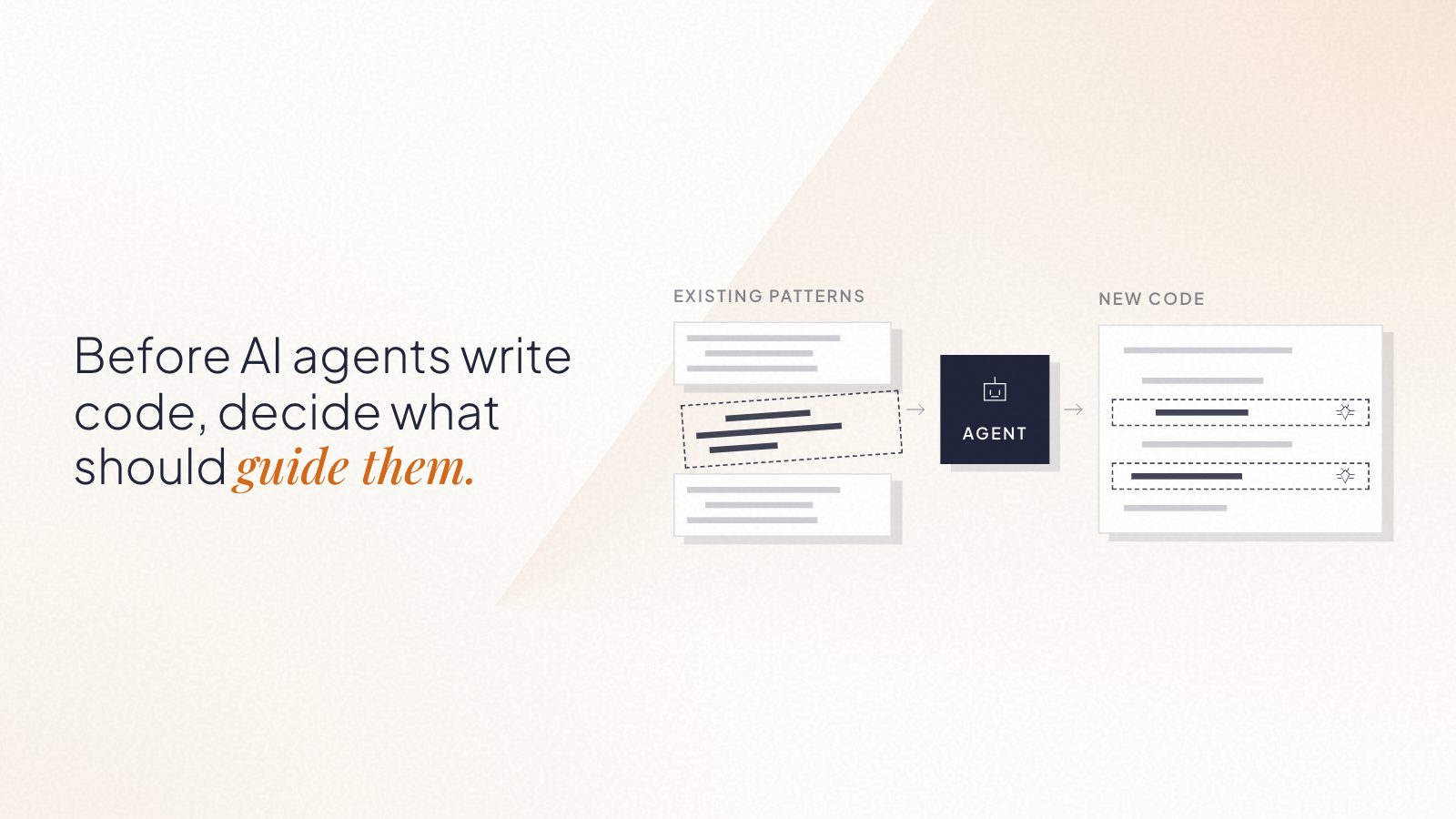
In our experiment at Kaizen Softworks, we tested whether an AI system could safely apply coordinated changes across a microservices architecture using only minimal input.
Short answer: Yes, but only when the AI has enough architectural context.
Why are coordinated changes in microservices so hard?
In distributed systems, a single business change rarely affects just one service.
It often requires:
Updating multiple microservices
Modifying message contracts
Keeping DTOs (Data Transfer Objects) consistent
Respecting domain boundaries defined by Domain-Driven Design (DDD)
Key entities in this system:
Microservice: An independently deployable service responsible for a specific domain
Aggregate (DDD): A cluster of domain objects treated as a single unit
DTO (Data Transfer Object): A structured format used to transfer data between services
Message/Event: A communication mechanism between services
The complexity is not in the code, it’s in the relationships between components.
The experiment: Can AI reason across services with minimal input?
We designed a controlled experiment to test whether an AI model could apply system-wide changes with limited information.
Input given to the AI:
Message definitions (events between services)
DTOs (data contracts)
Tasks the AI had to perform:
Identify affected aggregates
Determine service ownership
Apply coordinated changes across services
Maintain consistency in messages and DTOs
In other words, the AI had to behave like a software architect, not just a code generator.
What was the biggest obstacle?
The biggest challenge was not technical, it was contextual.
Problem: unclear service naming
Instead of descriptive names like:
order-service
billing-service
Our services were named:
john
sally
roger
This removed any semantic clues about responsibility.
Result: The AI could not infer which service owned which domain logic.
The missing piece: aggregate ownership mapping
To solve this, we introduced a simple but powerful structure:
Aggregate → Service mapping
Order → john
Shipment → sally
Invoice → roger
This created a clear relationship between domain concepts and system components.
Once ownership was explicit, the architecture became understandable.
How we used AI to generate architectural context
Instead of building this mapping manually, we used AI to analyze the codebase and extract:
Where each aggregate was defined
Which microservice implemented it
The relationship between domain and infrastructure
The result was a machine-readable architecture map.
In practice, we used AI to generate the context that AI itself needed.
Results: Can AI safely apply distributed changes?
With the architecture map in place, the AI was able to:
Trace message flows across services
Identify affected aggregates
Locate the correct microservices
Apply coordinated updates
Maintain consistency between DTOs and messages
While not perfect, the system worked reliably as a proof of concept.
What is the real limitation of AI in microservices?
The main limitation of AI is not code generation, it’s architectural understanding.
Without knowing:
Which components exist
How they relate
Who owns what
AI cannot safely modify a distributed system.
AI performance depends more on context quality than model capability.
When can AI safely modify microservices?
AI works well when:
Aggregate ownership is clearly defined
Message contracts are explicit
Architecture is structured and consistent
AI struggles when:
Naming is ambiguous
Relationships are implicit
Context is incomplete
Simple rule: If the architecture is clear, AI can reason. If not, it guesses.
Final thoughts
This experiment revealed something important:
AI doesn’t fail because it can’t write code. It fails because it can’t see the system.
As teams move toward AI-assisted development, the focus will likely shift from:
Writing better code to Designing better systems for machines to understand
At Kaizen Softworks, we see this as a foundational shift.
Because when AI can understand architecture, it doesn’t just generate code, it helps evolve systems.
There's a myth that in flat organizations, everyone decides on everything.
That's not how it works. At least not at Kaizen.
When people hear "no managers," they often picture one of two extremes: either total chaos where nobody is accountable, or endless meetings where 80 people vote on which coffee to buy. The reality is neither.
Not everyone decides on everything. Not everyone votes. What we do have is a clear set of decision-making methods that we choose based on context.
It depends on who's affected and how deep the impact goes
Before choosing how to decide, we ask ourselves a few questions:
Who is affected? A decision that only impacts one team doesn't need the whole company involved. A decision that affects everyone's daily work does.
How deep is the impact? Changing the office furniture is wide but shallow. Changing the salary model is deep and lasting.
Is it reversible? If we can easily undo it, we can move fast and just inform. If it's hard to reverse, we slow down and include more people.
How urgent is it? And here we're careful to distinguish real urgency from anxiety, the pressure to decide quickly because someone already has "the answer" in mind.
These dimensions help us pick the right method. Not every decision deserves the same process.
Our decision-making toolkit
Over the years, we've landed on a few methods that we use depending on the situation:
1. Role-based decisions
Some decisions belong to a specific role. If someone owns a responsibility, say, office logistics or hiring for a team, they decide within that domain. No committee needed. The key is that roles are transparent: everyone knows who owns what, and the scope of each role's authority is clear.
2. Advice Process
When a decision doesn't clearly belong to one role, or when it crosses boundaries, we use the advice process. Here's how it works:
Someone takes the initiative. They identify the problem and own the process.
They gather input from people who are affected and people with expertise.
They seek advice, real conversations, not rubber-stamping.
They make the decision and communicate it, including what advice they incorporated and what they didn't (and why).
The decision-maker is not a committee. It's one person (or a small group) who takes responsibility. But they don't decide in isolation, they bring in the perspectives that matter.
We sometimes call this "Team Advice" when a working group forms around an issue that doesn't naturally fall into anyone's area, and "Area Advice" when a team opens up a topic that exceeds their own scope.
3. Consent (not consensus)
Consent is not "everyone agrees." Consent means "no one has a strong enough objection to block this." We do use a poll, but not to count votes — we use a 1-to-5 scale to measure the level of agreement and surface objections, not to let the majority rule.
We use it in two flavors:
High-participation consent: For decisions with deep, company-wide impact. This is our most expensive and slowest method, which is exactly why we reserve it for high-impact decisions that affect many people. The Board sets the boundaries, for example, when we moved offices, they defined the monthly budget. Then a working group produced proposals, collected feedback, evolved them, and the whole company expressed their position for the final decision. Silence is not approval; we explicitly ask people to weigh in, even if it's just "I have no objection."
Lightweight consent: For decisions that are broad but not deep. Participation is optional, anyone who's interested can jump in. We share the proposal, open a window for objections, and if nobody opposes, we move forward. This gives us speed without sacrificing transparency. If nobody engages, that's a signal too, maybe the proposal doesn't add enough value, or we're using the wrong channel.
4. Inform, don't fake-consult
Not everything needs participation. When a decision has already been made through a legitimate process, the right move is to inform, not to fake-consult. One of the fastest ways to kill self-management is to ask for feedback and then ignore it. If you're not going to change course based on input, don't ask for it, just be transparent about the decision and the reasons behind it.
What we explicitly avoid
Decision by Voting. In a company context, majority rule creates losers. And losers become detractors, often generating more resistance than an autocratic decision would have. Instead of voting, we prefer to evolve a proposal through feedback until it's "good enough for now," and then introduce a review point to adjust later. If voting happens at all, it's the cherry on top, not the main course.
The "surprise" approach. Working behind closed doors and then unveiling a finished decision is a recipe for frustration. Adults don't need surprises. Adults need to feel like they're part of the process. The complaints that follow a surprise aren't about the decision itself, they're about not being included.
Why we work this way
We didn't adopt these methods because they're trendy. We adopted them because they solve real problems:
Better decisions. When you include affected people, you get information you wouldn't have had otherwise. Ideas emerge that no single person would have come up with alone.
Less resistance. A person who feels heard is far less likely to resist a decision, even one they wouldn't have made themselves.
Faster execution. It sounds counterintuitive, but participative decisions often execute faster because people already understand and support them. The time you "save" by deciding alone, you spend later managing pushback.
Distributed authority. When people can make decisions within their domain without escalating everything to a founder, the organization scales. The bottleneck disappears.
Resilience. If a shared decision fails, the group adjusts together. If a top-down decision fails, the blame falls on one person and the chances of proactive correction drop.
The real principle behind all of this
Transparency is the foundation. Every method we use, from role-based decisions to high-participation consent, works because information flows openly. People know what's being decided, who's deciding it, and how they can participate.
Horizontal doesn't mean structureless. It means fewer hierarchical levels, clearer roles, and intentional decision-making processes that match the weight of each decision.
Not everyone decides on everything. But everyone knows how things get decided.