



Generative UI: What it is, how it works, and when to use it
Generative UI lets AI build the screen each user needs, in real time. What it is, how it works, the trade-offs, and two working demos we built.

12 min read
Read more

Insights, stories, and experiments from our team.
AI
UX Design
Generative UI lets AI build the screen each user needs, in real time. What it is, how it works, the trade-offs, and two working demos we built.

Santiago Chiappa
·

Jul 17, 2026
·
12 min read

Generative UI is a full-stack architecture that lets AI create, modify, and render user interfaces in real time, based on what each user needs at that exact moment. Instead of static, predefined screens, the interface assembles itself on the fly: a bar chart, a table, a comparison card when you're comparing things.
We've been building proofs of concept with it for the past few weeks. Most of what's written about generative UI is either too abstract or too exciting, so this is our attempt at neither: what it is, how it works, where it helps, where it doesn't, and what we learned from two demos we built.
Generative UI is a full-stack architecture: the backend talks to the LLM, decides what the answer should look like, and picks the components, while the frontend renders them and handles how the user interacts with what’s on screen.
Compare that with how interfaces have always worked. A designer decides what goes on each screen, a developer builds it, and every user sees the same thing. Forever, or until the next redesign.
Generative UI flips that. The interface becomes dynamic and personal instead of static and universal. The AI doesn't just answer your question, it designs the screen that answers your question.
Dashboards and reporting are the most common use cases, but they're far from the only one. The same pattern works for dynamic forms, onboarding flows, and customer support, as it takes input just as easily as it presents output. It can even adjust font size, contrast, or layout for users with low vision, color blindness, or cognitive load.
There are three levels of generative UI, from most constrained to most open (Google Cloud, 2026):
Most production systems today use the declarative approach, and that's what this post assumes from here on. The AI isn't writing HTML or CSS freestyle. It selects components, fills in pre-designed widgets, and composes them into the right screen.
Generative UI works by turning a user request into structured data that describes an interface, then rendering that data as real components. The flow looks like this:
To the user, the result feels like magic. Behind the scenes, it's structured data flowing through a well-defined pipeline. We prefer the second description. It's the one you can build on.
Generative UI trades real personalization and faster development for added latency, inference costs, and less predictable layouts. That's the honest version. Here are the details.
None of these are dealbreakers. There are known techniques to mitigate each one.
We built two demos. One with fictional data, one on top of a tool we use every day.
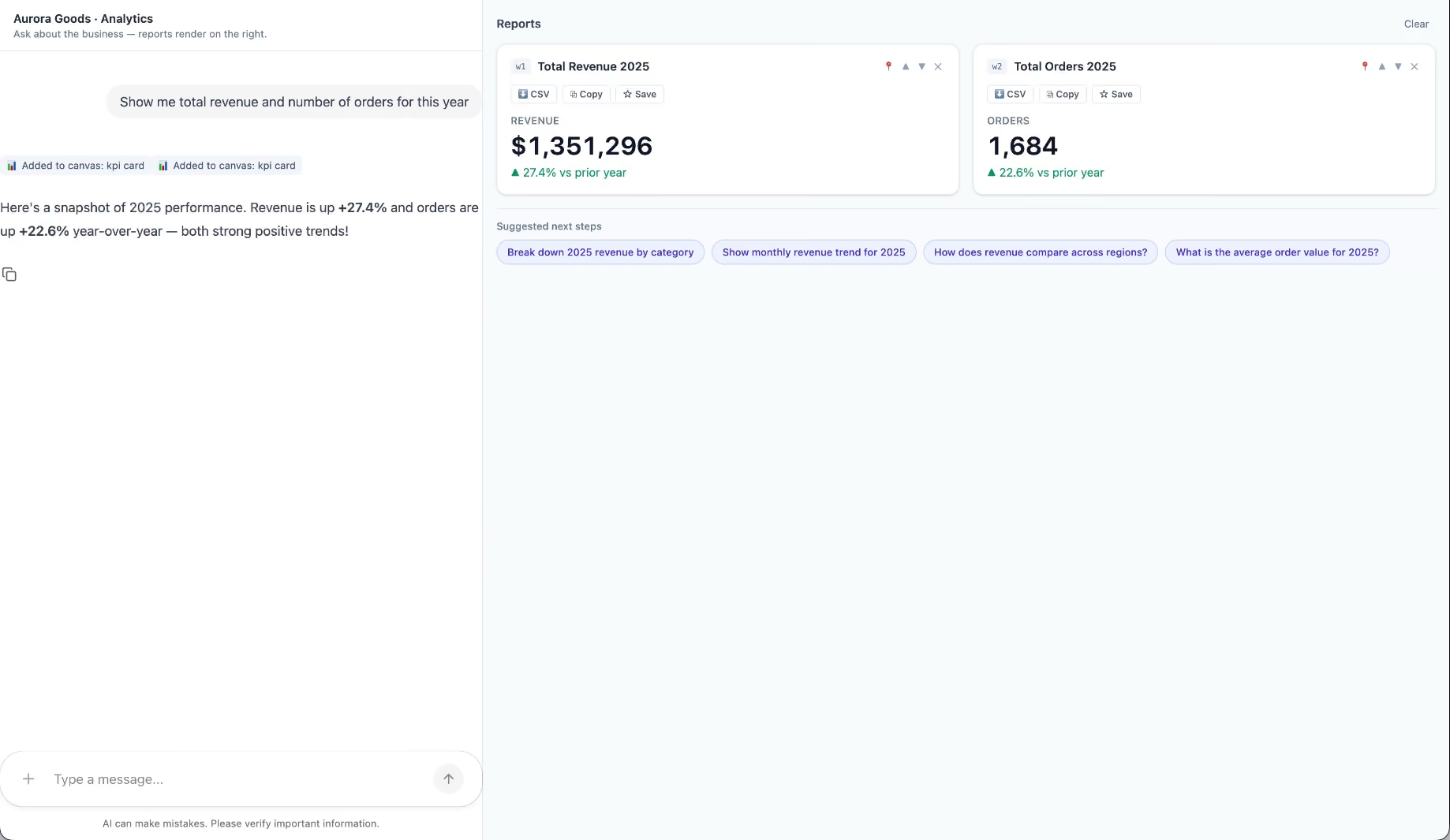
Aurora Goods is a fictional consumer e-commerce platform we created for the demo. The interface is simple: chat on the left, canvas on the right. You ask about the business, the LLM figures out what you need, pulls the data, and renders it visually.
Ask about 2025 sales and it shows the numbers on cards, with a short note on anything relevant. Ask it to break that down by region and it extends the same view instead of starting over, because it understands the second question builds on the first. This part took us a while to get right, and it's what makes the whole thing feel like a conversation rather than a search box.
The canvas isn't output-only either. You can click into any element and drill down: revenue by category, then inside electronics, then which products sold most.
You configure the widgets once. The system combines them and adds relevant commentary on the spot.
The second demo is closer to home: a generative reporting layer on top of the time-tracking tool we use every day at Kaizen. The questions in this demo are questions someone here has actually asked.
Instead of building dozens of hyper-specific reports, a small amount of code now handles virtually unlimited queries. How many hours were logged in May? Which anomalies showed up in April? How do billable and non-billable hours compare across two months? Who worked on a given project last month, and for how long? Each answer arrives as the right visualization: cards, lists, bar charts, plus a short summary that's easy to scan.
Two details won us over. The LLM suggests next steps, so exploring the data becomes a conversation. And when it's not sure, it asks instead of assuming. Ask for the hours of someone named Alex and, since we have more than one Alex on the team, it asks which one before answering.
Generative UI is a complement, not a replacement. Standard interfaces still win for stable, repetitive workflows where consistency matters. Nobody wants their checkout button to be creative. Generative UI wins where the workflow is complex and the questions are unpredictable.
It also changes what design systems are for. Beyond designing components and screens, teams will need to define semantic rules: how the AI should react to uncertainty, which interfaces match which intentions, and the guardrails that keep generated screens functional and safe.
That's a new kind of design work. And it's already starting.
We build working proofs of concept in two weeks. Your data, your workflows, a real thing you can click.
Generative UI lets AI build the screen each user needs, in real time. What it is, how it works, the trade-offs, and two working demos we built.
12 min read
About Us

·
Jul 6, 2022
98% of our team said they’re happy working here. This is what that actually looks like behind the scenes.
12 read time
We are happy to be recognized as a Great Place to Work!
Furthermore, we are delighted to receive recognition as a Great Place to Work! The Certification™ by Great Place to Work® is a program that acknowledges and evaluates the quality of an organization's culture.
The Certification Program, based on 30 years of research, quantifies the organizational culture and compares it to The Best Places to Work.
What's truly remarkable is that a staggering 98% of our Kaizen team members wholeheartedly agree that we indeed are a Great Place to Work. This affirmation results from implementing a comprehensive labor climate survey, known as the Trust Index©
The Trust Index is made up of 60 statements that analyzes the perception of employees about what they experience in their workplace through behaviors related to Trust.
We organize these statements into 5 dimensions:
To obtain the Certification™, the survey data must meet the minimum requirement of 90% statistical confidence with a maximum margin of error of 10.5%.
Below, let's look at some of the most distinguished results based on the survey.

The survey's outcomes have provided us with valuable insights, highlighting both our areas of strength and those that require enhancement. We found participating in this assessment process incredibly enriching!
We are profoundly grateful to every team member who openly and honestly shared their feedback, thereby contributing to our collective success in making Kaizen a resounding Great Place to Work!
At Kaizen, our belief in the importance of transparency, collaboration, and commitment is unwavering. We invite you to explore more about our values, our exciting success stories, and join us on our thrilling journey.
Discover how at Kaizen Softworks, we not only craft high-quality software but also build strong relationships and an exceptional work environment.
Your journey to an exceptional workplace begins here.
Business
·
Jul 1, 2022
Uruguay didn’t become a tech hub overnight. These are some of the factors that made it happen.
12 read time
When people talk about the software and IT industry in Uruguay, the country is well known as the “Silicon Valley of South America”. Its fast-paced innovation environment and skilled workforce makes Uruguay a high-quality technology exporter and one of the most prominent technology markets in Latin America.
Because of the rapid growth of the software industry in the country, major U.S. software and IT firms have been established over the past decade. Companies like IBM, Microsoft, Oracle, Netflix, Cognizant, NetSuite, and VeriFone, among others, have set foot in Uruguay and hire Uruguayan talents.
According to experts of the Uruguayan Chamber of Technology (CUTI), this number will continue to increase over the next 5 years. So, you might be wondering how can such a small country of only 3 million people could achieve such a feat?
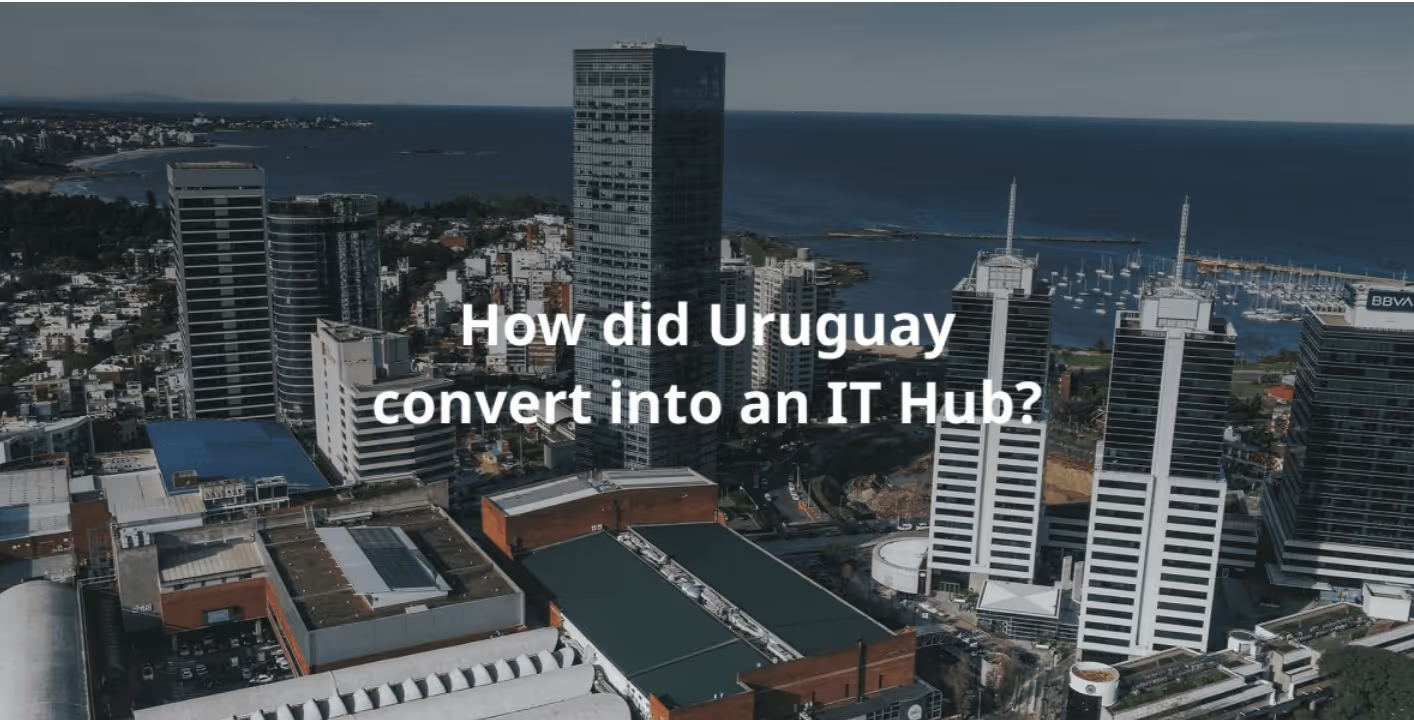
Below , we will tell you 5 reasons Uruguay has converted into an IT Hub in Latin America.
Uruguay is the second digitally-ready country in Latin America after Chile, according to the Cisco Global Digital Readiness Index. The report aims to measure the level of digitization that is needed to achieve competitive advantage and boost economic growth.
Uruguay has a robust Internet penetration rate of 83.4%, and one of the fastest download speeds in Latin America, ranging from 30 to 120 Mbps. 1 Almost all homes and businesses have access to high-speed Internet connections, of which 75% have fiber optic access. The state-owned telecommunications company, Antel, plans to provide full coverage of the country's fiber optic network by the end of 2022. 2 Isn’t it great for companies and even families at home, to know that they have one of the fastest speeds in the continent?
Also, Uruguay is the leading country in the region in terms of 4G-LTE mobile communications, with a 63.3% penetration rate, and one of the first countries to launch a 5G commercial mobile network (#1 in LATAM and #3 in the world).3
In addition, it is the number one country to adopt the IPv6 protocol in Latin America and #8 in the world, according to the Google IPv6 country ranking. Moreover, it has one of the best Data Centers in Latin America with several underwater connection systems to numerous countries such as the U.S, Brazil and Argentina.
In 2021, Google announced the construction of a Data Center near Montevideo (the capital city of Uruguay), its second in Latin America. Google stated that the investment:
“(...) reinforces Google's commitment to Uruguay and Latin America and to the development of the local technological ecosystem”. 4
Uruguay is a member of Digital Nations, a collaborative forum of the world’s most advanced digital governments that aim to use technology to improve citizens services. Currently, the forum has 10 members, such as Canada, Israel, Denmark and New Zealand, who promote digital inclusion and accessibility, open government, digital citizenship, among others.
Uruguay ranks #1 country in terms of e-governance in Latin America, according to the United Nations.
The various characteristics of Uruguay's business climate and technological advancements make it an ideal location for global service providers.
In order to drive sustainable technological growth, Uruguay’s main investment was, and still is, its people. The country is committed to ensuring that everyone has access to high-quality education and promoting digital inclusion.
The public education system in Uruguay is recognized as one of the best in Latin America, with the highest population literacy rate of 99%. 5
Uruguay was also the first country in the world to provide a laptop computer to every public primary and secondary school student and teacher.
The One Laptop Per Child government program (nationally known as ‘Plan Ceibal’), which was launched in 2007, has promoted the country’s digital literacy rate bridging the gap between the poorest and richest households.
High school students can also take advantage of several tech public programs that are available through the University of Work (UTU), such as Networks and Softwares, Telecommunications or Networks and Optical Communications. This way, students are then familiarized with IT jobs and educational opportunities they can choose to pursue when they finish high school.
Uruguay’s state University, University of the Republic (UdelaR), is known for its high quality education. It has been consistently ranked among the best universities in Latin America, ranking #1 in the country and #21 in the region, according to a survey conducted by the U.S. World News & Report. 6

For those who are interested in computing, the University offers a variety of programs, including a three-year degree in Computing or a four-year bachelor’s degree in computing engineering. UdelaR also offers masters in: Software Engineering, Computing Engineering, Electric Engineering, and Computing.
In addition, private universities are also shining in the software and IT field. They are hiring more experts and providing internships to some of the most prominent tech companies. This is the case of ORT University, which offers a wide range of degrees in technology such as video games design, animation and art.
The wide range of courses Uruguay has to offer, makes following an IT career more tempting and easy to achieve.
Uruguay is a strong software export country. It is the largest software exporter in Latin America and the third largest in the world.
According to the Financial Times:
“More than 1,000 software development companies now operate in the nation of 3.4m people, generating almost $1bn in exports — mostly to the U.S. That makes it one of the world’s leading software exporters in per capita terms”. 7
The U.S. is Uruguay's largest export market, accounting for 65% of the country's tech revenue. Uruguay is getting the recognition of the “Silicon Valley of South America”, thanks to the investments made to develop its tech industry and the country's relationship-building efforts with the U.S, through its investment promotion agency, Uruguay XXI.
Uruguay XXI, has been strongly marketing the country's tech companies in the U.S. It has also been able to establish a variety of platforms for its companies, such as the country's own country pavilion at the annual tech conference in Silicon Valley, known as TechCrunch Disrupt.
For the second year in a row, in 2021, the Bank of the Oriental Republic of Uruguay (BROU) has recognized our company, Kaizen Softworks, as the country's Largest Exporter of Information and Communications Technology (ICT) services.
Uruguay is an innovation and entrepreneurial hub. Especially the capital, Montevideo, where the startup scene is promising due to its technological achievements. From the first pacemaker to the development of a mammography exam, the country has been able to create some truly remarkable innovations.
U.S. venture capital firms have also been instrumental in helping build the local tech market in Uruguay. Companies like IBM, Microsoft, Oracle, Netflix and Cognizant, have established operations in Uruguay, hiring local talents.
In June 2017, 500 Startups, a leading startup accelerator, announced that it would be launching its operations in the country. Through the Montevideo Accelerator Program, the goal was to help early-stage companies grow and attract the necessary resources to succeed.
Also, in 2017, the country's telecommunications company, Antel, partnered with Google to build a fiber optic cable that will link the U.S and Uruguay. This will also help greatly with communications in the long run.
Evan Henshaw-Plath, the co-founder of the company that later became Twitter, moved from the U.S. to Uruguay to found his own company in Montevideo. He explains the growing interest in Uruguay from the American tech industry as such:
“Uruguay is a remarkably open place when it comes to attracting talent”.9
Frederick Terman, a Stanford University professor and one of the core founders of Silicon Valley, introduced the co-working spaces before the term was even coined, by allowing students to use university facilities to start their own businesses.
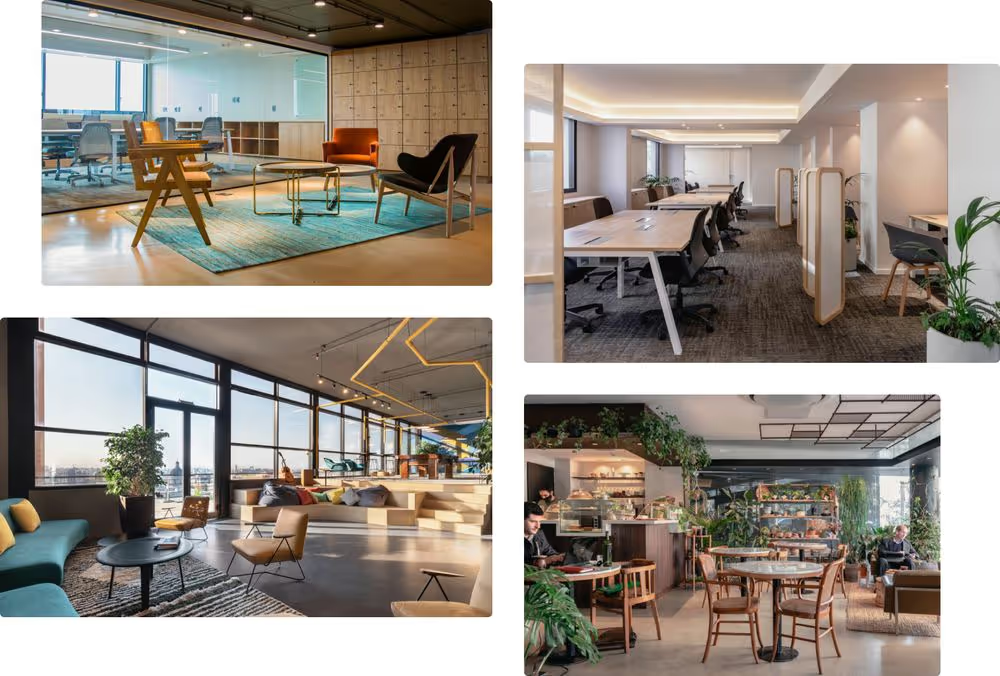
Co-working facilities are the incubator places for Uruguayan startups. These are dedicated facilities that provide a space for freelancers and entrepreneurs to lower their initial startup costs and address the isolation that many people experience when they work from home. Sinergia Cowork, Del Plata Office and Smart Office are some of the biggest groups of co-working spaces in Montevideo.
One of the advantages of working with Uruguayan companies is that it's only an hour ahead of the U.S. Eastern Time Zone (EST +1). This greatly impacts on the workflow and the success of any project. By sharing every office hour, Uruguayan companies and developers can work as if they were side by side with their U.S. partners, improving collaboration.
These are some of the reasons why Uruguay is associated with quality. Today, international companies choose Uruguay as a place to develop technological products and services and as a place to launch their operations to the rest of Latin America.
Without a doubt, the software and IT industry in Uruguay is constantly growing.
Its time zone similarity with the U.S., the high quality of tech talent, and its competitive cost-benefit rate of software development services makes the country an extremely attractive place for U.S. companies seeking this type of service.
U.S companies can lower their software development costs by working with companies from Uruguay, without compromising the quality of work. What’s best here is that although you pay a lower price for software development services from Uruguay, the high quality of work we provide is on a par with any company you could hire within the U.S. Thus, an excellent cost-benefit makes Uruguay a great choice to seek this service.
As an Uruguayan company, at Kaizen Softworks, we care about meeting the needs of our partners through constant improvement and innovation. We not only have high standards for software development talent and quality of work, but we also seek to provide a holistic approach to what it means to outsource software development services.
To achieve innovation and high levels of productivity, we provide support in project management and consulting services to improve our partners' internal processes, and in technology mentoring for team members of our clients, among other initiatives that make up the DNA of our people and company.
I invite you to learn more about who we are and our work. Thanks for reading!
Technology
12 read time
When dealing with high volumes of data and traffic in web application APIs, it is imperative to avoid wasting resources so that end users won’t perceive any slow downs, as well as to reduce costs in the underlying infrastructure. The topic of today’s article is to examine under what circumstances it is possible to cancel already-running HTTP requests before their completion in an API implemented with ASP.NET, and how to implement these capabilities in a few common scenarios.
Long running HTTP requests may occur as a consequence of having to deal with an ever-increasing amount of resources for their execution, which is a scenario that can be expected in an active API serving thousands of clients per minute. Under those circumstances, having a way of knowing when the results of such requests may end up being unused would be highly desirable in order to free up server resources, such as CPU, RAM, database locks, network sockets, etc., that other clients may need to use.
Common situations where this may arise are:
Short lived requests that consume too little resources are better left alone, as the cost of implementing cancellation capabilities would be most surely greater than any real benefit that could be gained from that.
Requests that can have side effects, such as creating, updating, or deleting data, should also be left as they are, because there is a real risk of compromising data integrity of the system if the request is interrupted at the wrong moment, especially if there are multiple internal steps to the operation.
That leaves us only with nullipotent requests, that is, those that only fetch data but don’t modify anything after they finish, metrics and logs notwithstanding. In other words, if implemented correctly, HTTP GET requests.
As an example, we’ll start with a basic ASP.NET controller written in C#:
using Microsoft.AspNetCore.Mvc;
namespace Kaizen.Blog.Examples.Controllers;
[ApiController]
[Route("api/[controller]")]
public class CancellationController : ControllerBase
{
    [HttpGet]
    public ActionResult<string> Get()
    {
        return "The endpoint was called.";
    }
}
The change to allow a request to be canceled is as simple as adding a parameter with type CancellationToken to the endpoint. This type has two useful members that can be leveraged for our purposes:
IsCancellationRequested: Returns true if the caller asked for the request to be canceled; otherwise, false.ThrowIfCancellationRequested(): Throws an OperationCanceledException if the caller asked for the request to be canceled.With this in mind, the endpoint can be updated to handle request cancellations manually:
using System;
using System.Threading;
using Microsoft.AspNetCore.Mvc;
namespace Kaizen.Blog.Examples.Controllers;
[ApiController]
[Route("api/[controller]")]
public class CancellationController : ControllerBase
{
    [HttpGet]
    public ActionResult<string> Get(CancellationToken cancellationToken)
    {
        try
        {
            cancellationToken.ThrowIfCancellationRequested();
            return "The request was not canceled.";
        }
        catch (OperationCanceledException)
        {
            return "The request was canceled.";
        }
    }
}
Cancellation tokens can also be used with common asynchronous operations in web APIs. Here are some examples:
// Non-cancellable version
await Task.Run(() => LongRunningSynchronousOperation());
// Cancellable version
await Task.Run(() => LongRunningSynchronousOperation(), cancellationToken);
var collection = GetExpensiveToCreateCollection();
// Non-cancellable version
await foreach(var item in collection)
{
    // do something with item...
}
// Cancellable version
await foreach(var item in collection.WithCancellation(cancellationToken))
{
    // do something with item...
}
var collection = GetCollection();
// Non-cancellable version
var results = collection.AsParallel()
    .Where(Condition)
    .ToArray();
// Cancellable version
var results = collection.AsParallel().WithCancellation(cancellationToken)
    .Where(Condition)
    .ToArray();
var usersQuery = DbContext.Users.GetAll().Where(Condition);
// Non-cancellable version
var results = usersQuery.ToList();
// Cancellable version
var results = usersQuery.ToListAsync(cancellationToken);
using var connection = new SqlConnection(connectionString);
await connection.OpenAsync();
// Non-cancellable version
var results = await connection.QueryAsync(sqlQuery);
// Cancellable version
var results = await connection.QueryAsync(
    new CommandDefinition(sqlQuery,
        cancellationToken: cancellationToken));
From the front-end perspective, web client applications can cancel API calls before their completion by making use of the so-called “Abort API” (AbortController and AbortSignal). Both the standard Fetch API, as well as popular HTTP library Axios, allow canceling requests this way. An example using the former can be found in Mozilla's dom-examples repository, while usage of the later can be found in Axios Docs.
It should be noted that canceling long running requests in cases where they’re caused by an inefficient implementation is only a stopgap measure. It’s no substitute for a good implementation, but a way of mitigating the damage a bad one can cause. Having said that, I’ve seen situations where the cost of reimplementing an existing piece of functionality is accompanied by a high risk of breaking something, so, as a short term patch to scalability-related problems, request cancellation is a good tool to have in your arsenal.
Business
Project Management
·
May 11, 2022
Hiring is hard. Keeping great developers is even harder. This is what’s worked for us.
12 read time
There is a very restricted talent pool and a massive demand for software developers in the U.S. Companies must do their best to attract the greatest people to their team. The IT industry is highly competitive so attracting and retaining top talent becomes one of the biggest challenges for every tech company.
In this scenario, we are frequently asked how we manage to have such a low turnover rate (10% overall) when IT recruiters are constantly contacting our teams with new job offers. In this context, it is essential to understand the motivations of our developers and the ways we can structure work environments to maximize longevity and career satisfaction.
Now, what is your plan to attract and retain high quality software development talent? We’ve come up with several strategies that have helped us to do so.
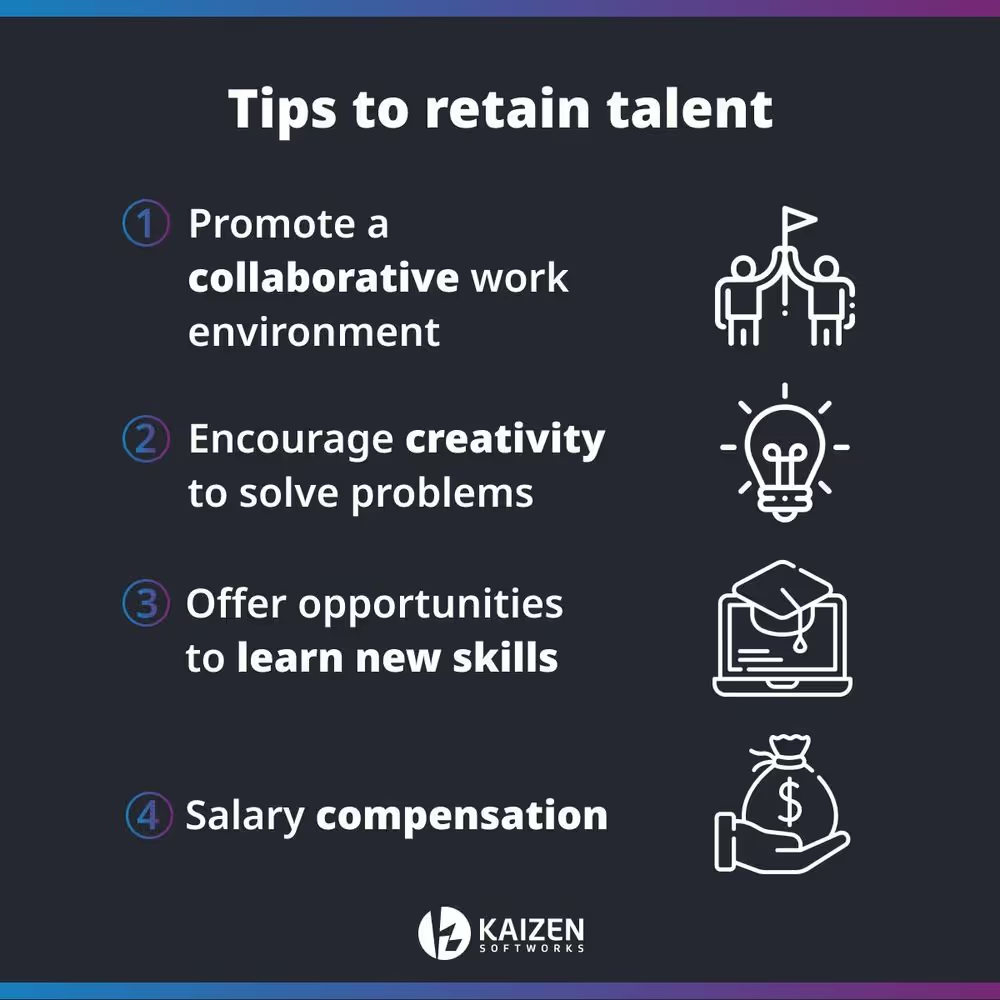
Creating a collaborative work environment fosters people to express their talents. Developers want to be part of an organization where their voices are heard, where they feel part of the company culture and have an influence on what happens within it.
You should allow your developers to participate in decisions that may affect both the institutional and software development team environment. Encouraging people to participate in the decision-making process that involves aspects beyond the specific tasks of their role, increases the perception of the influence they have both on the team and the company.
In other words, this means allowing and promoting cross-area collaboration.
By listening to and, more importantly, acting on the feedback provided by your developers, you'll let them know that you recognize their talents and make them feel that their contributions have a tangible impact on a team and organization level.
There is nothing more counterproductive than having to solve a problem with techniques that may not be the most efficient ones. So why don't let your developers play with the methods they try and be the ones to come up with effective and creative solutions?
It's important to promote creative freedom to solve important problems. This job is, after all, their domain, which means they must have a responsible level of independence within it.
Also, this will encourage them to be more engaged with the company as there is trust in their work.
As the technology market continues to grow and evolve, your software developers should have the opportunity to grow with it.
Please notice that continual updating and self-improvement drew many developers to their profession in the first place.
You should offer the suitable training as these tech talents like to be challenged but they may resent being thrown into a new expertise without properly learning it first.
Keep in mind that having suitable resources is a crucial factor in developers' enthusiasm and outcomes. For example, let's say your engineers find a problem and don't know how to fix it. Hitting an obstacle directly proportional to the limits of their experience will end up discouraging them, affecting the project and the company in general.
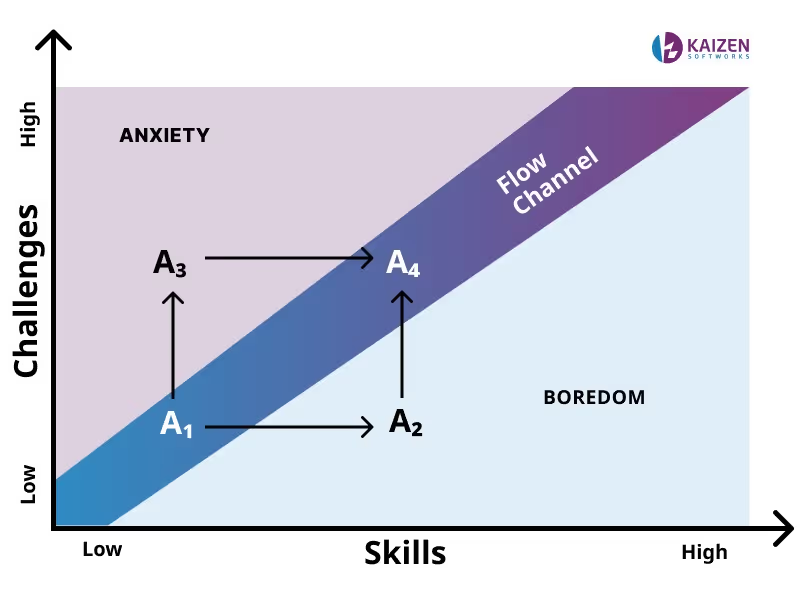
This is an opportunity to provide enrichment. Empower them to master their skills and encourage them to continually improve by creating a culture where they learn that a long, profitable and fulfilling career comes from using skills to deliver software and create impact.
This fosters a culture of self-determination and adds to employee’s benefits.
A key aspect of a developer's motivation is salary and compensation package for their work. To recognize the market value of a person, it is necessary to carry out labor market research and more importantly, ask yourself what gives them their experience and skills necessary for their job?
It is important to research the value that other companies in the industry provide, to ensure that the salaries and compensation plans offered, such as additional benefits, are attractive enough to keep developers engaged with the company.
A good employee deserves to be recognized for the value of their work and paid according to their responsibilities. Otherwise, they will be open to new opportunities that give them the compensation they believe their work deserves.
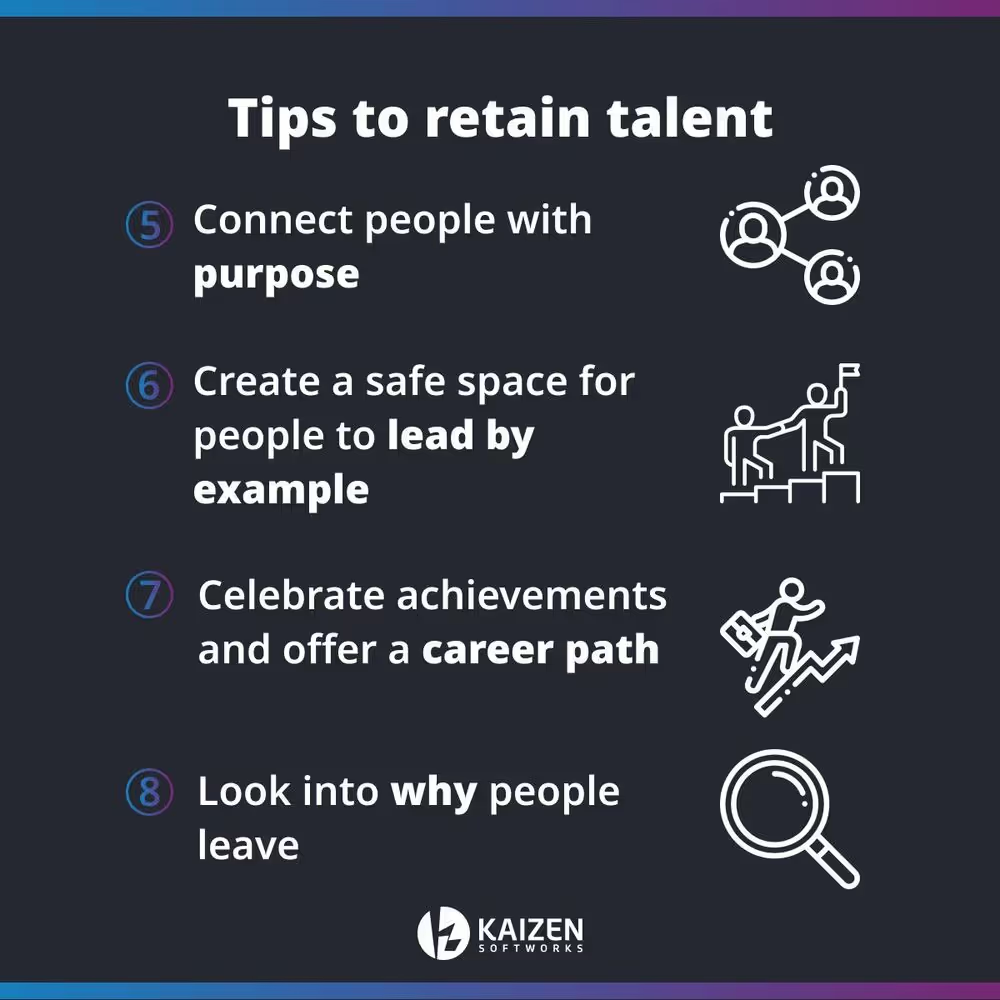
Purpose has to do with being able to make a contribution to others and pursuing a higher goal. We find more and more professionals who no longer focus primarily on how much they are going to earn or what they are going to achieve, but on one main question: “what am I going to work for?”.
Connecting people with purpose, makes the differences between the technical and human sides of a person disappear. Working and living guided by a purpose benefits people because it gives them the opportunity to look inward and renew themselves by going beyond their own limits. Likewise, it gives a sense of belonging to the organization and reinforces organizational commitment.
Motivate people to ask questions like: why does what we do matter? What difference do we make in the world? What motivates us to continue offering our services? What motivates our clients to hire us?
The first few years as a software developer might be a stressful time that comes along with different challenges. Going through these early years can be an extremely frustrating experience if developers are not supported by a strong structure. That's why every company needs to have leaders with the experience and vision to support less experienced employees as they grow with the company.
Providing a safe space for developers to teach other team members is one of the best ways to increase team seniority. When developers are mentored, they learn. When they learn, they get involved. When they get involved, they are much more likely to stick around.
Therefore, recognizing and encouraging mentoring within teams and companies is one of the most important things a company can do.
Also, teaching others inspires them to take on new challenges, to share their knowledge and to continue growing from a soft skill point of view since it is an opportunity to develop empathy and improve leadership and communication skills.
There is nothing more encouraging and fulfilling than knowing that your work makes a difference in your company and also in your client businesses. Let your employees know that their day-to-day work is important!
Implement recognition initiatives, celebrate team milestones, and provide small confidence boosts.
But recognition is not enough incentive to retain talent if you don’t support it with career advancement opportunities.
Career growth can mean fostering a culture of knowledge-sharing, which enables employees to discover new interests within the company, allowing role gaps to be filled internally.
Also, it makes them feel like they’re growing with the company and provides a sense of purpose and belonging, which in turn fosters loyalty and long term engagement.
Losing a team member can become an opportunity to learn from the experience and mitigate the risk of having the same problem in the near future. Just as not all problems have a solution, you can’t fix a problem you don't know about either.
Conducting an exit interview can help you to learn more about the reasons why people decide to leave the company and their perception of the work environment.
This information works as an opportunity to improve your current talent management process through receiving honest feedback on the true state of the organization, and the problems employees face on a day-to-day basis.
We invite you to reflect on the following questions: what excites your developers to go to work? How does the structure of your organization affect its overall performance? Are your developers surrounded by peers who can encourage and challenge them to improve? And more importantly, can your developers visualize a career within your company?
Whether you’re looking for software developers to take your business idea into a digital solution or want to further expand your current development team, we’re here to help.
Business
Project Management
·
Apr 12, 2022
A look inside our hiring process, from cultural and technical interviews to the feedback practices that help build lasting teams.
12 read time
In 2021, we had over 302 candidates went through our software developer hiring process.
After carrying out 302 recruiter screens, 177 cultural interviews, 106 technical interviews, 15 new hires were made, resulting in an investment of more than 400 hours of interviews.
Since feedback on our hiring process from both our interviewees and clients has been highly positive, we’d like to share with you the insights of this valuable journey.
In this post, we will cover our in-house designed 5-step interview process that follows the initial screening all candidates go through. All of our interviews follow a specific objective and a way to accomplish those goals.
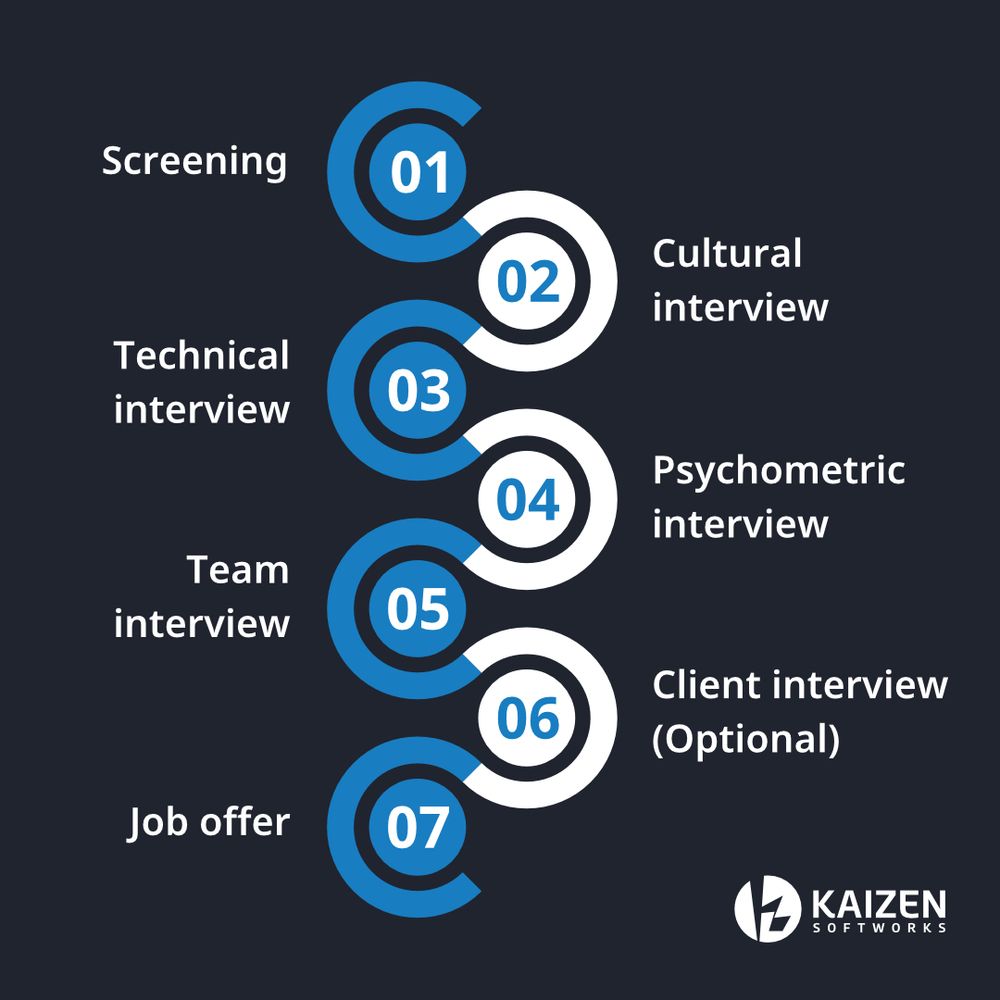
The screening is the first contact that the candidate has with Kaizen after sourcing, and it consists of a brief call with the recruiter to present them with Kaizen as a company and gather information about the candidate’s profile such as:
If the Recruiting Team agrees the candidate can be a good fit, the following steps are explained to the candidate and they move to the first instance of the interview process itself, the cultural one.
At this stage, we focus on candidates' interests, motivations, expectations, cultural matches with our organizational culture and understanding what opportunities are seen as challenges for their professional development and growth.
We are interested in candidates who are confident and convinced communicators that constructively challenge assumptions encouraging collaboration, proactive and independent. But we also look for some aspects that are more specific to the Kaizen culture.
At Kaizen, we value the contributions of all teammates and promote a collaborative work environment. Therefore, teamwork and communication skills such as expressing their own opinion to help build new knowledge are evaluated and praised. This also means not being afraid to ask questions.
In addition, since our organizational structure is horizontal, flexibility and the ability to adapt to changing environments is considered as valuable. We seek for people who are friendly, passionate about their work, motivated and eager to learn.
Our technical interview team evaluates the set of skills they understand are a must to fill the position on a certain project.
Although we value expertise in specific technologies, we strongly believe that the ideal candidate must have critical thinking techniques that help him/her to overcome complex problems. In this way, through face-to-face questions we also evaluate if they have a solid foundation in general programming.
Then, we dive deeper and evaluate the knowledge and management of the technology stack required for the project and/or the candidate's area of professionalization.
When candidates without work experience or juniors (with little work experience, up to 1 year) are going to be technically interviewed, they are sent a short test through Interviewzen. This consists of an online test of approximately an hour long, which that lasts must be taken before the technical interview, since it is be used as an input for the interview.
If the candidate passes the technical interview, a psychometric appointment is made with a people care specialist, which consists of an unstructured one-on-one conversation. We seek to learn about certain patterns of the candidate’s behavior from a psychological approach to evaluate future behaviors in the work environment.
This stage consists of a conversation between the candidate and the team members of the project position they applied to join.
The goal of this meeting is to ensure the candidate is a good fit for the team, talk about the challenges they will have to face in the project, and also try to assess communication and self-management skills.
Once the candidate passes the final team interview, we focus on the client’s validation. To ensure this, we always give the client the chance to interview each candidate to get to know each other and provide a space for an open-round Q&A session.
During this last stage of the process we prepare a document called ‘Blind Resume’ which includes the information of the candidate and her/his resume, but leaves out candidates last names and former work places.
The success of our hiring process lies in 4 key factors:
After successfully hiring our developers, the next challenge comes in retaining them. True hiring success is also measured by loyalty and a low turnover ratio.
In 2021, we had a 10% turnover ratio overall and 0% on key team members. The reasons that can explain this low ratio will be covered soon in another post.

We know how expensive and time consuming it is to find candidates with the right technical and soft skills. Companies often have trouble connecting with the right talents because the IT field is in high demand.
According to the US Bureau of Labor,
"the employment of software developers, QA analysts, and testers is projected to grow 22% between 2020 and 2030, much faster than the average for all occupations."
Almost every business needs developers, and each company offers different benefits to attract the best talents, not to mention high salary demands.
Considering an outsourcing strategy could be a good fit to address these software development hiring pains.
Challenges are full of risks, but choosing the right nearshoring partner shouldn't be.
About Us
·
Dec 10, 2021
We were recognized as Uruguay’s top ICT exporter. This is what that means to us.
12 read time
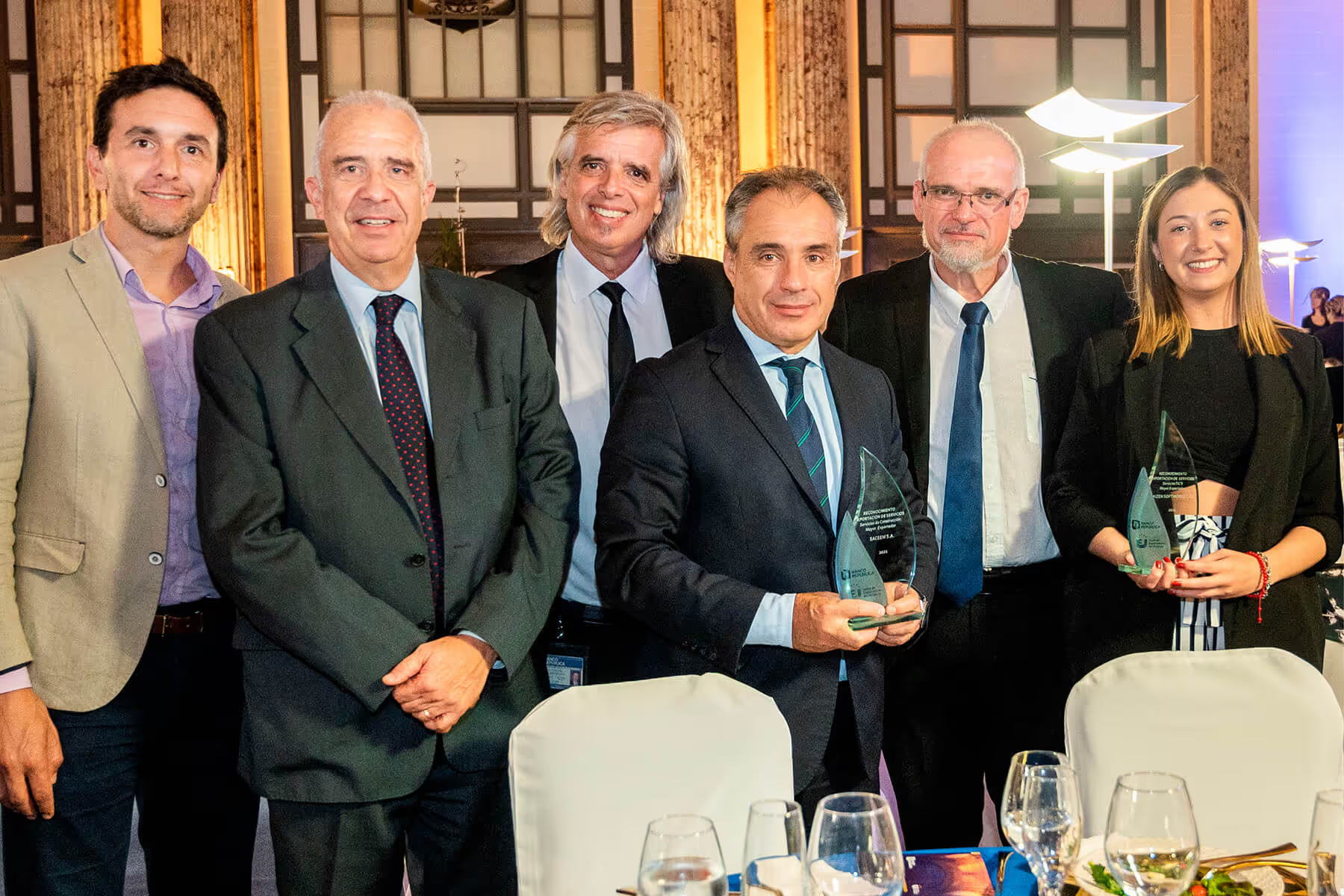
On December 8, 2021, Kaizen proudly stood in the spotlight at the distinguished Exporting Effort awards, an annual event organized by Banco República (BROU) and the Union of Exporters of Uruguay (UEU). This recognition ceremony, graced by the presence of esteemed figures such as President Luis Lacalle Pou, Vice President Beatriz Argimón, Minister of Economy and Finance Azucena Arbeleche, and BROU President Salvador Ferre, celebrated the outstanding achievements of companies contributing significantly to Uruguay's export landscape in 2021.
The event, held at the BROU headquarters, not only acknowledged the top exporters of goods and services in Uruguay across various categories but also provided a platform for nominees to engage in networking and share experiences during a delightful dinner.
For the second consecutive year, Kaizen was awarded as the Top Exporter of ICT Services (Information & Communications Technology) in the country. This prestigious recognition underscores Kaizen's unwavering commitment to excellence and innovation in the realm of ICT services.
Our heartfelt congratulations go out to the entire Kaizen team for their tireless effort and commitment to excellence. This achievement reflects our collective dedication to continuous improvement, fostering growth, and accumulating valuable experiences and learnings along the way.
As we reflect on this remarkable journey, we express our gratitude to our clients, partners, and supporters who have been integral to Kaizen's success. We remain committed to advancing the standards of ICT services in Uruguay and look forward to even greater milestones in the future.
Beyond our accomplishments in the export sector, Kaizen invites you to explore a world of possibilities with our team – a team dedicated to continuous improvement, quality, and collaboration. Whether you're envisioning a new software project, seeking to enhance your existing systems, or considering expanding your in-house engineering team, Kaizen is here to collaborate and bring your ideas to life.

About Us
12 read time
With a commercial office in Boston, U.S., and the headquarters in Uruguay, South America, Kaizen Softworks is a software development company with a focus on product development from scratch.
At Kaizen, professionals create, develop, and deliver customized software by establishing an effective collaboration in which the success of the business relationship is most important. They create a pillar of trust, transparency, and flexibility; these are the building bricks of the solid and consistent partnership Kaizen offers.
Since the inception of Kaizen Softworks, they have been producing custom applications and have gained extensive experience in developing robust solutions for a wide range of domains. They offer consultancy services in the full cycle of creating software. From research and design, to programming, QA and testing, maintenance and enhancements.
GoodFirms is an online review portal that evaluates various businesses registered with it to receive daily accreditation. The valuation is based on three criteria - Quality, Reliability, and Ability. Similarly, GoodFirms also valued Kaizen Softworks and found it as a leading mobile app development service provider in Boston amongst the listed ones. It also claimed that Kaizen had risen to the top of GoodFirms companies for software development and web design in Uruguay and Massachusetts, respectively.
Thus, providing ever-improving mobile app development services, Kaizen Softworks thrives as one of Boston's best mobile app development company at GoodFirms.
Working as a Content Writer at GoodFirms, Anna Stark bridges the gap between service seekers and service providers. Anna's dominant role lingers to form every company's achievement and critical attributes into words. She strongly believes in the charm of words and equips new approaches that work, always with concepts, something new to create, and something original to define the firm's identity.
About Us
12 read time
Kaizen Softworks has been recognized as one of the top ranked Software Development Companies in 2021 by DesignRush. Among the different services offered, we were recognized in the following categories.
Enterprise Software Development Companies. Whether our clients are dealing with a new product inception, legacy systems maintenance and migration, process automation, new features implementation or API integrations, our solutions are purpose-built to assist their processes in a productive and rapid way. Understanding their business goals and the right problems are key to meeting specific requirements at a competitive cost to build, maintain and modify software solutions, helping our clients to gain independence, scalability and achieve lower integration costs.
Software Testing Companies. We have strong workflow processes in place to ensure the operational efficiency and productivity of different solutions. With cutting-edge technologies and the latest resources, we help our clients to properly maintain their solution and perform regular quality assurance services such as performance and error monitoring. Through this ongoing work, we will consistently bring and deliver new solutions onto the table to help our clients to stay competitive in an always evolving market.
.Net Development Companies. From front end work to back end and database coding, our .NET developers are capable of adding immediate value and capacity with the flexibility and availability to fill short-term positions.
Nearshore Software Development Companies. When projects require a little extra expertise, we are able to add professional resources. We respond to changes as they occur and take immediate action and our clients know it. We are committed to work as partners with our clients in order to create new strategies without the high risk costs associated with in-house development. While conversion rates from the U.S. dollar to our local currency are favorable, the real value comes from our passion and eagerness to transform your ideas into quality work.
Special congratulations to our team, who are always challenging assumptions and bringing innovative ways of thinking onto the table. We live and breathe what we do. Amazing things can happen when our team are great people who truly enjoy our work, taking pride in learning how to give our best.
About Us
12 read time
Hello there, our valued friends, clients, and everyone who's been a part of our amazing journey! We're absolutely thrilled to share some truly fantastic news with you. Kaizen Softworks has earned its place as one of Clutch.co's top Software Development Companies in the United States for the year 2020. For those not familiar with Clutch, it's a B2B platform renowned for providing ratings and reviews for top IT and software companies. 🎉

This recognition is more than just an accolade; it's a testament to the incredible dedication and hard work of our entire team. It's a reflection of the mission we set out on six years ago. Back then, our mission was simple but powerful: we wanted to step into our clients' shoes, deeply understand their needs and aspirations, and then go that extra mile to help them achieve their goals.
As we look back on our journey, it's truly heartwarming to see how that early-stage mission has evolved and become an integral part of our company culture. Yes, we've grown as a company, but the most remarkable growth has been that of our clients. It's a profound joy for us to witness the success and progress they've made with our support.
However, it's essential to remember that none of this would have been possible without our incredible team. They are the backbone of our operation. Their remarkable talents, unwavering focus, and unparalleled commitment are the driving forces that have shaped Kaizen Softworks.
So, what's next? We're filled with anticipation about the path ahead. We can't wait to see how this recognition propels us into the future. We're committed to pushing the boundaries, continuing to support our clients and partners, and striving for even greater heights.
Our journey is just beginning, and we're elated to have each and every one of you join us on this incredible ride. We're deeply grateful for your unwavering trust in us and for being an integral part of this exciting adventure.
Check out our Clutch profile here: https://clutch.co/profile/kaizen-softworks
No blogs matched this category, try applying different filters.