



Generative UI: What it is, how it works, and when to use it
Generative UI lets AI build the screen each user needs, in real time. What it is, how it works, the trade-offs, and two working demos we built.

12 min read
Read more

Insights, stories, and experiments from our team.
AI
UX Design
Generative UI lets AI build the screen each user needs, in real time. What it is, how it works, the trade-offs, and two working demos we built.

Santiago Chiappa
·

Jul 17, 2026
·
12 min read

Generative UI is a full-stack architecture that lets AI create, modify, and render user interfaces in real time, based on what each user needs at that exact moment. Instead of static, predefined screens, the interface assembles itself on the fly: a bar chart, a table, a comparison card when you're comparing things.
We've been building proofs of concept with it for the past few weeks. Most of what's written about generative UI is either too abstract or too exciting, so this is our attempt at neither: what it is, how it works, where it helps, where it doesn't, and what we learned from two demos we built.
Generative UI is a full-stack architecture: the backend talks to the LLM, decides what the answer should look like, and picks the components, while the frontend renders them and handles how the user interacts with what’s on screen.
Compare that with how interfaces have always worked. A designer decides what goes on each screen, a developer builds it, and every user sees the same thing. Forever, or until the next redesign.
Generative UI flips that. The interface becomes dynamic and personal instead of static and universal. The AI doesn't just answer your question, it designs the screen that answers your question.
Dashboards and reporting are the most common use cases, but they're far from the only one. The same pattern works for dynamic forms, onboarding flows, and customer support, as it takes input just as easily as it presents output. It can even adjust font size, contrast, or layout for users with low vision, color blindness, or cognitive load.
There are three levels of generative UI, from most constrained to most open (Google Cloud, 2026):
Most production systems today use the declarative approach, and that's what this post assumes from here on. The AI isn't writing HTML or CSS freestyle. It selects components, fills in pre-designed widgets, and composes them into the right screen.
Generative UI works by turning a user request into structured data that describes an interface, then rendering that data as real components. The flow looks like this:
To the user, the result feels like magic. Behind the scenes, it's structured data flowing through a well-defined pipeline. We prefer the second description. It's the one you can build on.
Generative UI trades real personalization and faster development for added latency, inference costs, and less predictable layouts. That's the honest version. Here are the details.
None of these are dealbreakers. There are known techniques to mitigate each one.
We built two demos. One with fictional data, one on top of a tool we use every day.
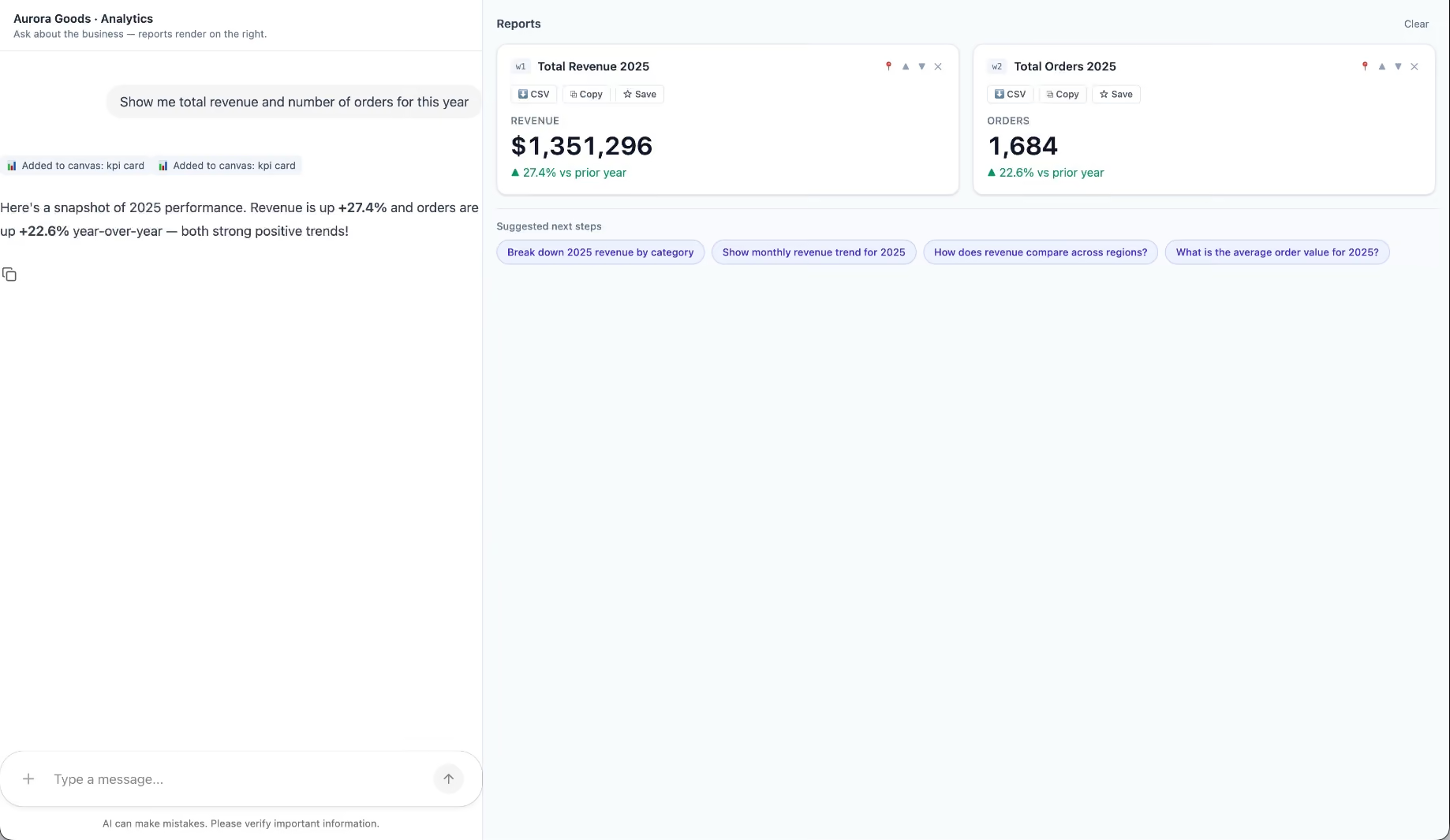
Aurora Goods is a fictional consumer e-commerce platform we created for the demo. The interface is simple: chat on the left, canvas on the right. You ask about the business, the LLM figures out what you need, pulls the data, and renders it visually.
Ask about 2025 sales and it shows the numbers on cards, with a short note on anything relevant. Ask it to break that down by region and it extends the same view instead of starting over, because it understands the second question builds on the first. This part took us a while to get right, and it's what makes the whole thing feel like a conversation rather than a search box.
The canvas isn't output-only either. You can click into any element and drill down: revenue by category, then inside electronics, then which products sold most.
You configure the widgets once. The system combines them and adds relevant commentary on the spot.
The second demo is closer to home: a generative reporting layer on top of the time-tracking tool we use every day at Kaizen. The questions in this demo are questions someone here has actually asked.
Instead of building dozens of hyper-specific reports, a small amount of code now handles virtually unlimited queries. How many hours were logged in May? Which anomalies showed up in April? How do billable and non-billable hours compare across two months? Who worked on a given project last month, and for how long? Each answer arrives as the right visualization: cards, lists, bar charts, plus a short summary that's easy to scan.
Two details won us over. The LLM suggests next steps, so exploring the data becomes a conversation. And when it's not sure, it asks instead of assuming. Ask for the hours of someone named Alex and, since we have more than one Alex on the team, it asks which one before answering.
Generative UI is a complement, not a replacement. Standard interfaces still win for stable, repetitive workflows where consistency matters. Nobody wants their checkout button to be creative. Generative UI wins where the workflow is complex and the questions are unpredictable.
It also changes what design systems are for. Beyond designing components and screens, teams will need to define semantic rules: how the AI should react to uncertainty, which interfaces match which intentions, and the guardrails that keep generated screens functional and safe.
That's a new kind of design work. And it's already starting.
We build working proofs of concept in two weeks. Your data, your workflows, a real thing you can click.
Generative UI lets AI build the screen each user needs, in real time. What it is, how it works, the trade-offs, and two working demos we built.
12 min read
.avif)
About Us

·
Jan 21, 2026
Code reviews aren’t just checks, they’re how we keep each other sharp.
12 read time
At Kaizen, we don’t believe software quality is enforced by a checklist or a single gatekeeper. It’s something we build together, day in and day out, as a team.
We’ve been working on this platform for years. What started with two developers has grown into a 30+ person team building a large-scale logistics system. And like any growing team, we faced a big question:
How do you keep quality high without turning into a slow, over-regulated machine?
We chose trust over set in stone rules. And in doing so, we learned something simple but powerful: Our strongest safety net isn’t a process. It’s each other.
When systems get complex, legacy code, multiple teams, tight deadlines, it’s tempting to respond with more rules. But heavy oversight kills initiative. Instead of building a team that takes ownership, you get one that’s just trying not to mess up.
We took a different approach. We built a system where quality doesn’t rest on one person, it’s shared, distributed, and reinforced by the people around you.
Code review is just one part of that system, but it’s where this mindset comes to life.
For us, code review isn’t about nitpicking, it’s a technical conversation between teammates.
When I open a PR, I’m not bracing for criticism. I’m inviting collaboration. Together, we’re asking: “Are we solving this clearly, cleanly, and in a way that makes life easier for the next person?”
Code reviews are done by other developers from the same sub-project. That means the person reviewing already has context, and because the reviewer role rotates, everyone gets to both give and receive feedback. It’s collaborative by design, and part of how we grow as a unit.
We review with a few key principles in mind:
We refer to our internal Wiki often, not as a rulebook, but as a shared language.
One of our core beliefs:
“Ownership starts with the person who says it’s done, but quality is everyone’s job.”
We say it often: “The ownership falls mainly on the person who tests it and says it’s okay.”
It’s not about blame. It’s about trusting each dev to be accountable, knowing the team has their back. That shared responsibility creates a culture where people step up, not out of fear, but because they’re supported.
Let’s be honest: we’re human. Not every issue gets caught in review. But that doesn’t break our system, it proves why it works.
Because someone else will catch it later. And when they do, they won’t ignore it, they’ll flag it, fix it, and keep moving.
We log cleanup tasks in our tech debt backlog. It’s not a black hole, it’s a to-do list for continuous improvement. A way to keep tightening the net.
In our team, code review it’s where learning happens.
New devs get real-time, contextual feedback. Seniors reflect on their habits. We share ideas, challenge each other, and improve as a unit. It’s ongoing, hands-on knowledge transfer, baked into the flow of work.
We don’t trust the code because it’s perfect. We trust it because of how it’s built:
by a team that shows up, collaborates, and looks out for each other.
Our confidence doesn’t come from tools or top-down rules. It comes from people who care. People who ask questions, challenge decisions, and leave the codebase better than they found it.
The team is the system. The team is the process. The team is the safety net.
And when that’s in place, you can scale without fear.
.avif)
AI

·
Dec 1, 2025
We asked a developer what it’s really like using AI tools daily: the good, the bad, and what no one talks about.
12 read time
"Stack Overflow on steroids." That’s the best way to describe it. But is AI the ultimate productivity hack, or just a faster way to create complex code? From parsing tricky regex in seconds to figuring out how much context to feed the bot, integrating these tools is a skill we are all learning in real-time.
I sat down (virtually) to discuss the art of prompt engineering and the nuances of relying on generated solutions. We dive into why using AI effectively isn't just about getting answers, it's about knowing how to ask the right questions to build better, sustainable software.
*Note: This interview with Dan was conducted by Claude, an AI assistant. Yes, the irony of using AI to discuss using AI is not lost on us.*
"Stack Overflow on steroids" - honestly, that's what it is for me. It's like having that incredibly knowledgeable senior developer available 24/7, but you need to know how to talk to them.
For quick, isolated problems, it's incredible. Need to parse a tricky regex? Convert between date formats? Understand an error message? Just ask. No context needed, instant answer. These small, specific queries are where AI shines brightest with minimal effort.
The big challenge is context, especially for larger projects. That's where things get interesting - and harder.
My initial approach was exhausting. I'd dump everything into the prompt: "Here's my entire file structure, here's the relevant code, here's what I'm trying to do..." I'd spend 10 minutes crafting a prompt, constantly worried I'd forget some crucial detail. It worked, but it was draining.
A fellow developer showed me a completely different approach: let the AI build its own context through questions. Instead of front-loading everything, you start with something simple like "I need to add authentication to my Express app," and the AI asks what it needs to know - what auth strategy, existing middleware, whatever. The conversation naturally builds the needed context. You only provide what's actually relevant.
Honestly? I'm still figuring it out. The truth is, I still struggle with prompt engineering. For larger features or refactors, I haven't found the perfect workflow. Sometimes the "let AI ask questions" approach works great. Other times, I need to provide upfront context. It really depends on the complexity and how well I can articulate what I need.
Because it's not about getting complete solutions - it's about changing how I problem-solve. It's like having a knowledgeable pair programmer who's always available. The skill isn't in knowing everything anymore; it's in knowing what questions to ask and when to ask them.
It's wild, honestly. I've seen colleagues build entire projects from scratch in just days, even hours. I've also seen someone migrate a whole Angular project to a newer technology without writing a single line of code themselves. It sounds amazing, right?
But here's the catch - if you don't review what AI generates carefully, you can accumulate massive technical debt. The code works, sure, but it might not follow your team's patterns, might have hidden performance issues, or make architectural decisions that don't fit your specific needs. AI can move fast, but someone still needs to be the critical reviewer.
I'm still learning, we all are. The tools are evolving, and so is my approach to using them. But one thing's clear: understanding how to interact with AI is becoming as important as understanding the code itself. It's a skill we're all developing in real-time.
.avif)
About Us
·
Dec 1, 2025
As the team grows, keeping quality high gets harder. This is how code reviews help us do it.
12 read time
I’ve been on this project for years. I was here when "the team" was just two developers in a room, and I'm here now as part of a 30+ person force building a critical logistics platform for our client.
Most stories about scaling a dev team are war stories. They’re all about shipping fast, racking up technical debt, and eventually having to rewrite the whole thing from scratch. Ours is different. It’s about how a deliberate (some might say stubborn) commitment to code quality from day one helped us grow without burning ourselves later.
When Kaizen joined this project, we weren't starting with a blank slate. We were tasked with merging and modernizing several legacy systems into one cohesive platform. The codebase had layers, each with its own quirks and logic. In that kind of environment, the “move fast and fix later” approach would’ve been a disaster.
We knew that if we wanted to build something scalable and sane to work with long-term, quality couldn’t be optional. It had to be baked in.
So from day one, we made it a rule: every single line of code gets reviewed. Whether it’s a new feature or a legacy refactor, it goes through a second pair of eyes.
We framed this to our client not as a slowdown, but as an investment. Spending an extra hour reviewing a PR, especially one touching old code, saves days (sometimes weeks) of tracking down weird bugs later. It was the only way to build a modern, maintainable codebase.
Fortunately, our client’s technical. They got it. And that trust? It became one of the most valuable things in our partnership. It gave us room to do things right, not just fast.
We needed a process, a way to keep standards high, share knowledge, and catch issues early. So we built a structured code review system, grounded in Kaizen’s core principle: continuous improvement.
This wasn’t about nitpicking or finger-pointing. It was about creating a feedback loop and turning every review into a learning opportunity.
Here’s what that looks like today:
Going from 2 to 30 devs is one thing. Scaling a culture of quality across all of them? Way harder.
Our code review process became the backbone of both onboarding and team growth.
Was this a quick win? No. It took time and buy-in. But the impact has been huge.
“I remember a case where we brought a function’s execution time down from 10 seconds to under three. The client was thrilled,” one of our devs shared. “That’s when it clicks. This isn’t just about ‘clean code’, it’s about delivering real value.”
Some of the benefits we’ve seen:
And yeah, we still have technical debt. We even have a “tech debt bucket” in Jira. But it’s not this ominous, growing monster anymore. It’s a manageable list. A conscious decision, not a side effect of bad habits.
Code reviews aren’t magic. They won’t solve everything. But done right, they can become the heartbeat of a team that cares about quality, about learning, and about building something that lasts.
That’s how we did it. That’s how we’re still doing it.
AI

·
Nov 20, 2025
There’s a lot of AI noise out there. These 4 books are the ones that actually helped us understand what matters.
12 read time
AI is evolving fast, and it's easy to get lost in the sea of online hype and conflicting advice. To help you cut through the noise and start building solid foundational knowledge, our Innovation Hub has curated a list of four essential books. Each one tackles a different but interconnected layer of the AI stack, offering the practical knowledge you need to stay ahead of the curve.
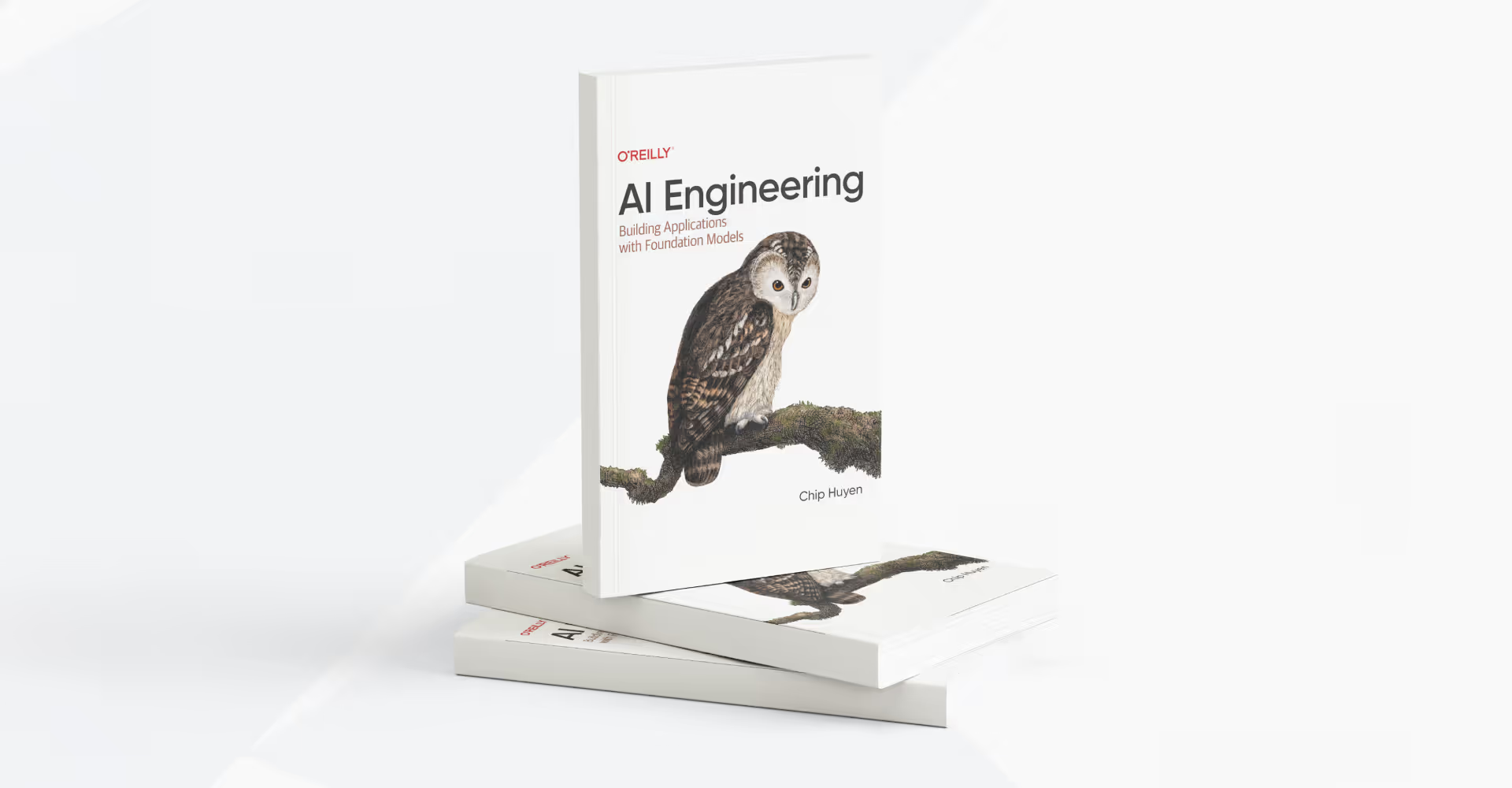
Get a complete guide to "AI Engineering," the new discipline of building powerful applications with readily available foundation models, and understand how it differs from traditional ML engineering.
This book teaches you how to:
Jay Alammar moves past abstract theory and superficial prompts to teach you how to build modern, end-to-end AI applications. His famous visual style makes complex architectures and cutting-edge techniques easy to understand and implement.
This book teaches you how to:
This book takes you to the next level of AI development. It goes beyond simple chatbots to teach you how to build and orchestrate fully autonomous, production-ready AI agents. Micheal Lanham’s guide focuses on creating trustworthy systems capable of handling complex, real-world tasks like high-stakes negotiations.
This book teaches you how to:
Get a practical, example-rich guide that bridges the gap between a promising concept and a successful, scalable product, focusing squarely on the MLOps strategies needed for real-world deployment.
This book teaches you how to:
The world of AI won't be slowing down. Getting grounded in the fundamentals is the best investment you can make in your career. We hope this list of AI books for developers gives you a clear starting point to take these concepts, experiment with them, and start creating
Events
Business

·
Nov 7, 2025
TIA Technovations 2025 showed that AI is now the cost of entry in logistics, but custom tech is where real differentiation starts.
12 read time
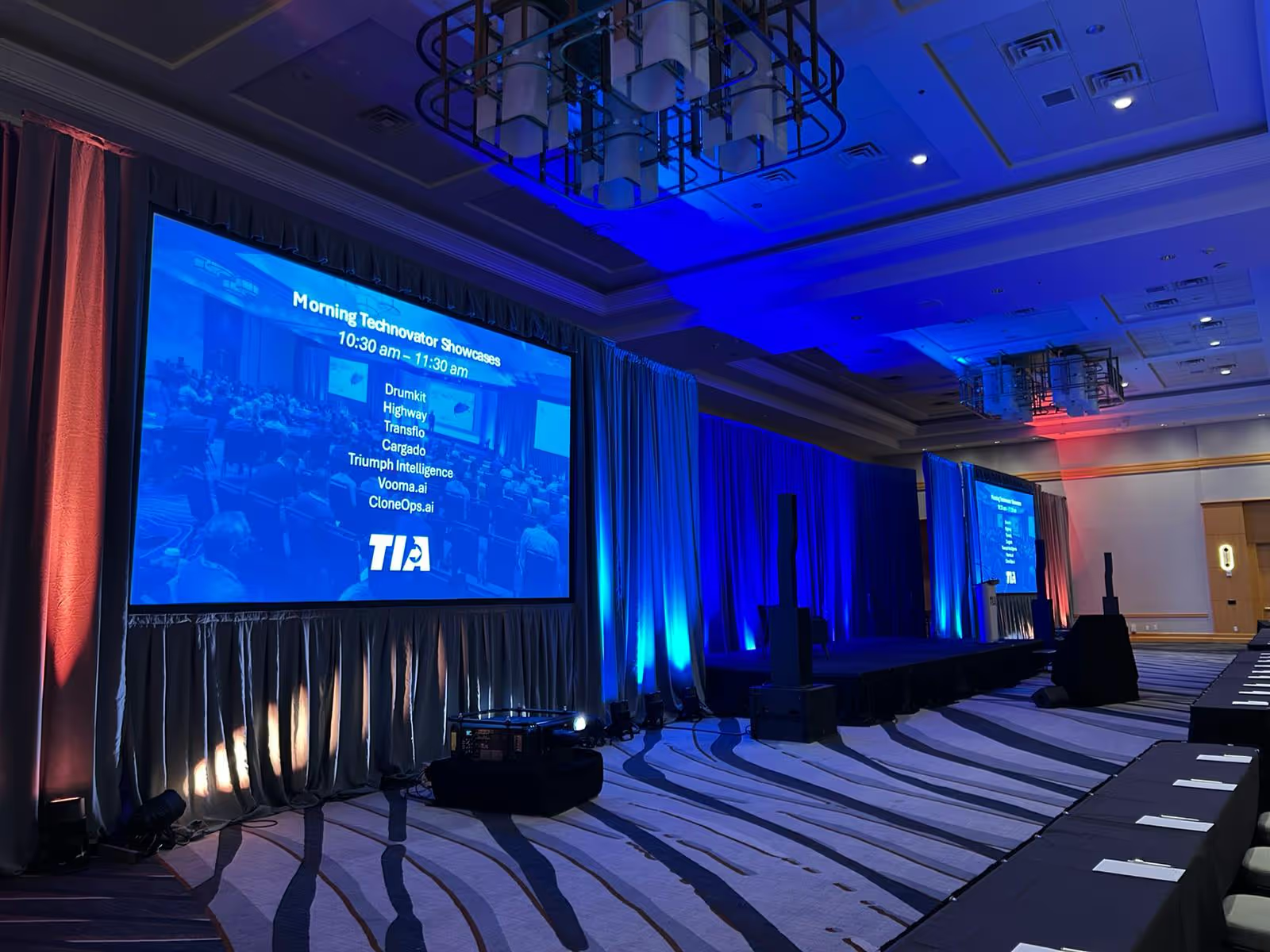
The Transportation Intermediaries Association (TIA) Technovations 2025 Conference in Phoenix, AZ, was a highly focused and valuable event. Held at the JW Marriott Phoenix Desert Ridge Resort & Spa, this gathering, while smaller and intimate with an estimate of 200 attendees, was a powerful showcase for the best of logistics technology.
The central theme was clear: Automation and AI are driving the industry forward, and the sheer volume of high-quality, off-the-shelf software available is impressive.
The conference structure was engineered for engagement, primarily through product-focused interaction:
The consensus across the keynotes and educational sessions was clear: AI and automation are the cost of entry for survival and scaling.
While the product ecosystem is robust, our conversations with leaders across the industry revealed a clear, unmet need:
This is the true next step for growth: building proprietary technology that hard-codes a competitive edge directly into the business model.
At Kaizen Softworks, we partner with logistics leaders to:
TIA Technovations 2025 confirmed that the logistics industry is healthy and focused on innovation. We look forward to working alongside our peers to help freight leaders build the tailored solutions necessary to thrive in the complex, digital landscape ahead.
UX Design

·
Oct 31, 2025
Giving feedback on design isn’t always easy. This is how we approach it as a team.
12 read time
At Kaizen, design critiques began as a simple idea for peer learning, but quickly became the most valuable part of our UX culture. Our philosophy is to build by co-building. Feedback isn’t something we fear; it’s something we train for. We prefer to face tough input at the right time rather than too late.
We use design critiques to connect, exchange perspectives, and train our critical eye. It's not about one UXer working alone; it’s about bringing diverse viewpoints together to strengthen ideas early, before they go live. We hold these sessions weekly across all projects, from small features to large redesigns.
A design critique is a structured, collaborative review where peers evaluate a design, prototype, or concept. Its main objective is to gather constructive feedback to identify strengths and weaknesses, leading to significant product improvements.
Our sessions last one hour. One person moderates while others present their work. Each presentation is about 15 minutes, split evenly between context and feedback.
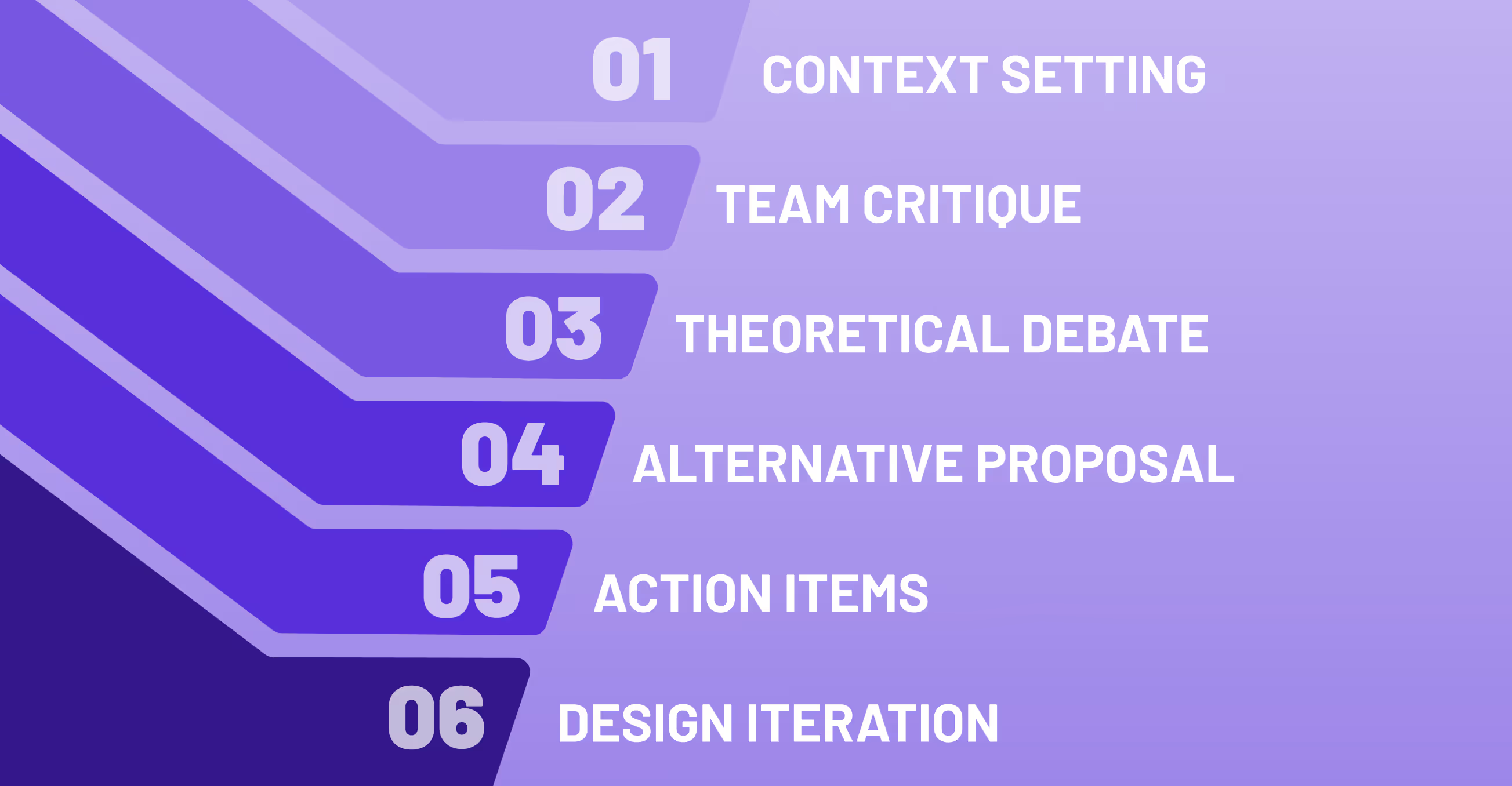
Every UX design critique follows a three-part structure. The core rule is that feedback must be objective analysis (e.g., based on user needs and UX principles) and never personal judgment:
What makes the Kaizen design critique process unique is the dual purpose it serves:
Our golden rule for giving a design critique remains simple: “Critique, explain, propose.” It’s how we stay grounded, theoretical, and solution-oriented at once.
When the critique ends, the feedback doesn't vanish, it's immediately actionable:
Every session becomes part of our collective learning system, building a repository of UX design best practices.
For us, design critiques are not mere meetings; they are a ritual of learning. They remind us that good design doesn't happen in isolation, and that growth comes from openness, respect, and shared curiosity.
When asked how Kaizen’s UX team achieves consistent quality, we point to this practice: a warm group of people, united by listening deeply, questioning respectfully, and building better designs together.
AI
Technology

·
Oct 28, 2025
We tried going from prompt to prototype with Windsurf. Here’s how that actually played out.
12 read time
Working with AI in its default state is a manual loop: you prompt, get a result, tweak it, and repeat. The core problem is that this approach has no memory or system. A lesson learned in one prompt is forgotten by the next.
This inevitably ends in frustrating loops, where the AI goes beyond what is asked and gets stuck solving the wrong problem while we waste time and energy trying to prompt it back on track.
We learned that the agent's effectiveness skyrocketed when we stopped treating it like a single-use tool and started building a system around it by:
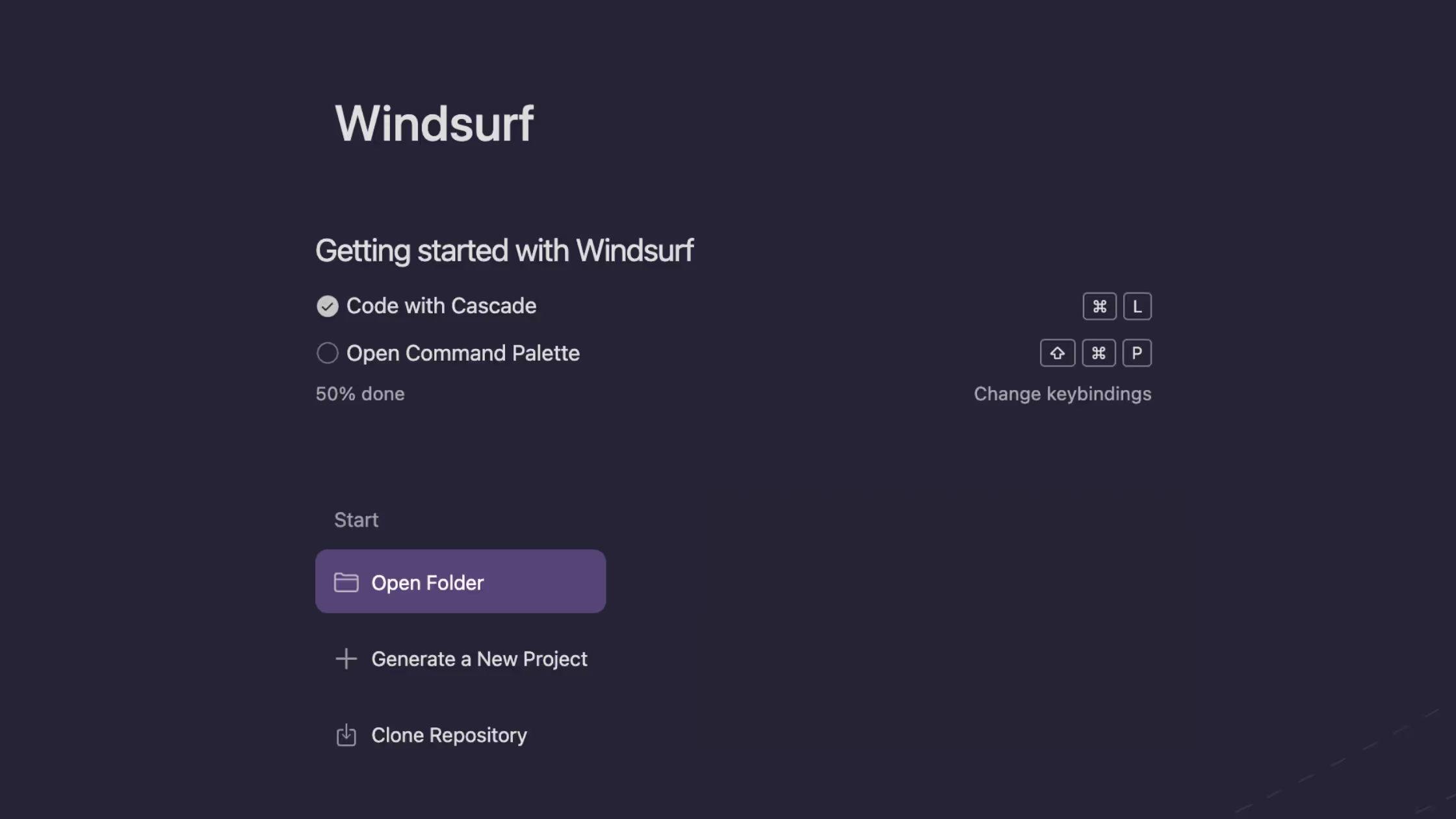
Initially, each developer solved this in their own way, creating custom prompts and conventions. It worked, but it didn't scale. The solution was to systematize this knowledge and turn it into shared workflows and rules using the Windsurf Editor.
Our Innovation Hub created a repository that functions as an additional workspace, providing a set of workflows and rules that standardize how we interact with the AI on development projects.
Building a workflow in Windsurf is like creating a smart recipe for your AI assistant. You're giving it the ingredients, the rules, and the step-by-step instructions separately so it can deliver a perfect result every time.
Location: .windsurf/workflows/ These are executed with slash commands and orchestrate the entire flow of a task:
Location: .windsurf/rules/
This is where you enforce quality and consistency. You create "rules" that act as non-negotiable guardrails for the AI's output.
Guidelines for architecture, TypeScript conventions, use of Tailwind + shadcn/ui, testing, performance, error handling, and the assistant's expected behavior (e.g., do not assume or invent libraries).
This file tells the AI "where" to work. It defines that process tracking and documentation are centralized in docs/development/current-task.md within the devsuite. This maintains order and traceability.
You can explore all the DevSuite guidelines and workflows directly on our GitHub repository here.
Consistency → The same rules applied across all projects.
Standardization → Clear steps and documented outcomes in each workflow.
Traceability → All decisions recorded in a single location.
Productivity → Less friction; the assistant knows what to do at each stage.
Today, we are in the middle of the adoption phase: each team at Kaizen is incorporating the workflow set into their daily routine while we gather feedback to improve it. The goal is for these workflows to evolve with use:
We want this to become a common and living foundation that empowers every dev, regardless of their seniority, and facilitates collaboration between teams.
We went from "fighting with the AI to make it understand what we want" to having a structured and reliable process where the assistant works with focus, within a common framework, and without endless prompt loops.
With Windsurf + devsuite, AI has stopped being an isolated experiment and has become a real pillar of our daily operations.
Business

·
Oct 23, 2025
Find where your logistics operation stands today and what tech steps can help you move from daily firefighting to smarter growth.
12 read time
Is your logistics operation running smoothly, or does it sometimes feel like a daily firefight? Do you make decisions based on real-time data, or do you rely on gut feelings and the expertise of a few key employees?
Every company is on a unique journey. For many, the challenges come from patchworks of disconnected systems, manual workarounds, or processes that haven’t yet scaled with growth. This isn’t a failure, it’s simply where you are today. The important thing is recognizing opportunities to grow stronger, more efficient, and better connected.
This framework is designed to help you quickly assess where you are today and what opportunities exist to unlock your next stage of growth.
You may be here if:
Opportunities to Grow: Reduce inefficiency, errors, and stress by introducing simple, repeatable processes and basic technology tools.
You may be here if:
Opportunities to Grow: Focus on connecting systems and sharing data to improve collaboration and visibility across teams.
You may be here if:
Opportunities to Grow: Build efficiency, scalability, and consistency by leveraging integrated systems and measurable results.
You may be here if:
Opportunities to Grow: Use collaboration and data insights to strengthen partnerships, anticipate challenges, and improve customer experience.
You may be here if:
Opportunities to Grow: Turn technology into a true strategic advantage by moving from reactive problem-solving to proactive, optimized decision-making.
No matter where you are currently, staying stagnant can hold back your growth. Every disconnected process, data-entry error, and missed insight make it harder to compete.
Your Competitors Are Advancing: Companies at later stages are moving faster and more efficiently.
Inefficiency Eats Profit: Manual processes and disconnected systems act like a hidden tax on your margins.
Blind Spots Limit Strategy: Without integrated data, decisions remain educated guesses.
The question isn’t if you should progress, it’s how and when. And the best time to start is now.
Let’s work together to assess your current systems and design a roadmap that fits your business goals.

About Us
·
Oct 22, 2025
See how we built a transparent salary policy around fairness, market data, purchasing power, and shared decision-making.
12 read time
A transparent, decentralized, and human approach to compensation
Let’s face it, salary decisions in most companies feel like a black box. You work hard, get good feedback… and still wonder: Am I being paid fairly? Who decides that, anyway?
At Kaizen, we decided to do things differently.
We built a transparent and collaborative salary policy, one that doesn't rely on negotiations behind closed doors, or a single person pulling the strings. Instead, it's a decentralized, data-informed system that values fairness, context, and sustainability.
Here’s how our salary policy actually works, and why we believe it reflects the culture we’re building every day at Kaizen.
In the early days, our CEO, Bruno, handled all salary reviews. His intentions were fair and well-meaning, but the process just wasn’t scalable. Reviews took time, data was hard to update, and decisions were largely centralized.
So a few Kaizeners decided to change that.
Martin (our Agile Coach), along with Nacho and Eduardo (two of our tech leads), proposed a change. They started codifying the values and principles Bruno used to make decisions and turned them into a transparent, repeatable process the whole company could see.
They focused on four main goals:
We based our salary policy on four clear, concrete pillars. Each one helps us make decisions that are fair, sustainable, and rooted in reality.
We subscribe to trusted market surveys (CPA Ferrere and Búsquedas IT) and build salary bands by role and experience.
Instead of guessing or benchmarking against vague “industry averages,” we aim to land between the 20th and 80th percentile of real-world salaries. This gives us flexibility to reward growth while staying competitive across roles.
A salary isn’t just a number, it’s what it can actually buy.
That’s why we track inflation, currency fluctuations, and cost of living. We don’t just raise salaries because it’s time; we raise them when people’s actual purchasing power is impacted. It’s about making sure people can live well, not just look good on paper.
This principle of real-world stability also applies to when you get paid. We pay salaries on the first day of each month. If that day is a holiday or weekend, you get paid on the last business day of the previous month.
We’re transparent about the fact that salaries are a big investment, and we need to manage them responsibly.
We track our Gross Margin (revenue minus direct project costs), and aim to keep it around 50% to stay healthy. Every proposed salary adjustment gets run through simulations to see if it keeps us on track.
It’s a way of saying: yes, we care about people, and we also care about keeping this company strong for the long haul.
Similar work should mean similar pay across different departments, with room to recognize impact.
We use years of experience as our starting point (it’s a reliable guide about 80% of the time), and then enrich that with input from team leads and principals. This helps us identify people who are growing fast and contributing at a higher level, even if they’re earlier in their careers.
Anyone at Kaizen can request a salary review, for themselves or a colleague. But we also run company-wide reviews twice a year (around March and September), and on every Kaizener’s yearly anniversary.
Here’s what the process looks like:
Our salary policy isn’t perfect. But it’s transparent, thoughtful, and built by the people who live it every day.
It reflects who we are as a company: collaborative, transparent, and constantly evolving. And because we value that long-term commitment, we have other ways of showing it. For example, after three years at Kaizen, your personal laptop bought with an allowance benefit, is 100% yours to keep.
So if you’re someone who values honesty, ownership, and real context behind how things work, you might feel right at home here.
Curious to learn more about life at Kaizen or how we work?
Check out our open roles or reach out to [email protected], we’re always happy to talk.
No blogs matched this category, try applying different filters.