








How We Make Decisions Without Managers
We don’t have traditional managers. This is how we make decisions and keep things moving.

12 min read
Read more

![Illustration of expert content creation for the [Your Company Name] blog, featuring articles on software development and technology insights.](https://cdn.prod.website-files.com/6846d4fc5449e72dcdad7d99/6883e43726396202465e6dce_IMG.svg)

No blogs matched this category, try applying different filters.

Insights, stories, and experiments from our team.

About Us
We don’t have traditional managers. This is how we make decisions and keep things moving.

·

Mar 13, 2026
·
12 min read

There's a myth that in flat organizations, everyone decides on everything.
That's not how it works. At least not at Kaizen.
When people hear "no managers," they often picture one of two extremes: either total chaos where nobody is accountable, or endless meetings where 80 people vote on which coffee to buy. The reality is neither.
Not everyone decides on everything. Not everyone votes. What we do have is a clear set of decision-making methods that we choose based on context.
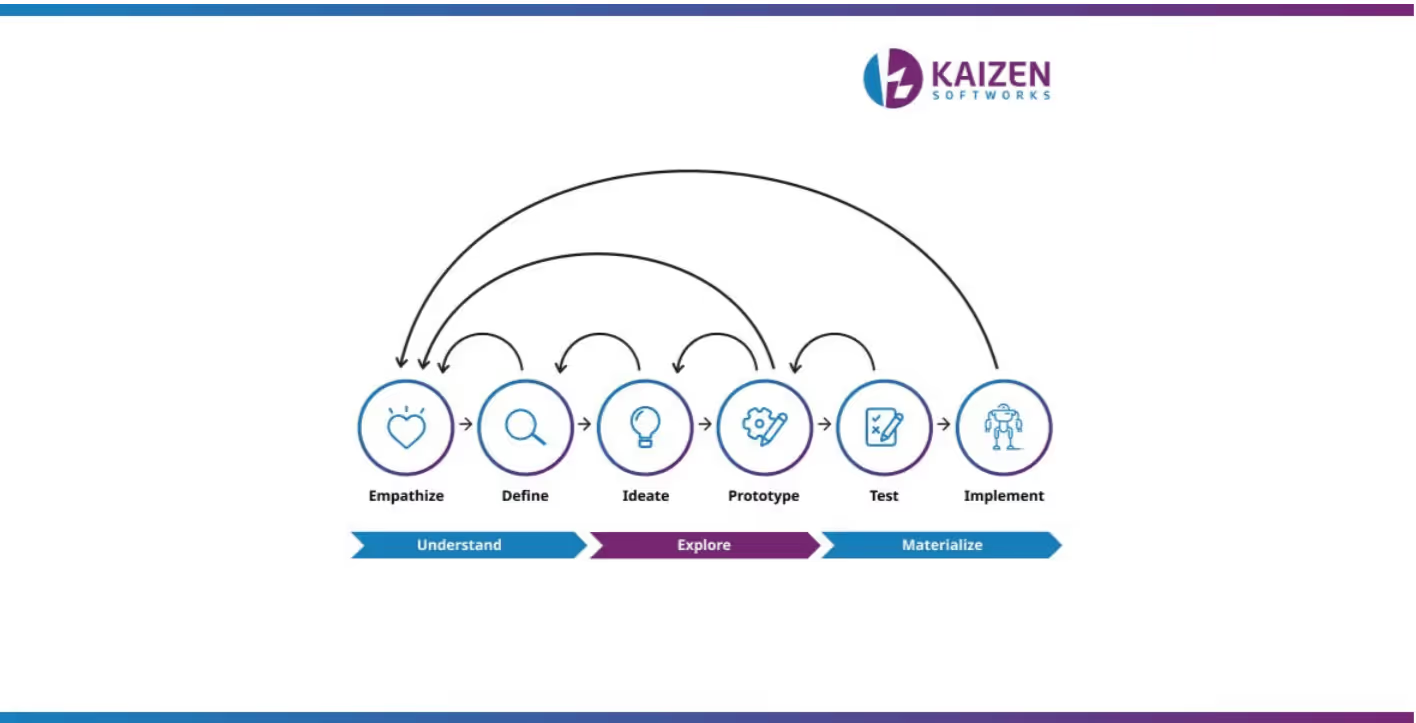
Before choosing how to decide, we ask ourselves a few questions:
These dimensions help us pick the right method. Not every decision deserves the same process.
Over the years, we've landed on a few methods that we use depending on the situation:
Some decisions belong to a specific role. If someone owns a responsibility, say, office logistics or hiring for a team, they decide within that domain. No committee needed. The key is that roles are transparent: everyone knows who owns what, and the scope of each role's authority is clear.
When a decision doesn't clearly belong to one role, or when it crosses boundaries, we use the advice process. Here's how it works:
The decision-maker is not a committee. It's one person (or a small group) who takes responsibility. But they don't decide in isolation, they bring in the perspectives that matter.
We sometimes call this "Team Advice" when a working group forms around an issue that doesn't naturally fall into anyone's area, and "Area Advice" when a team opens up a topic that exceeds their own scope.
Consent is not "everyone agrees." Consent means "no one has a strong enough objection to block this." We do use a poll, but not to count votes — we use a 1-to-5 scale to measure the level of agreement and surface objections, not to let the majority rule.
We use it in two flavors:
Not everything needs participation. When a decision has already been made through a legitimate process, the right move is to inform, not to fake-consult. One of the fastest ways to kill self-management is to ask for feedback and then ignore it. If you're not going to change course based on input, don't ask for it, just be transparent about the decision and the reasons behind it.
We didn't adopt these methods because they're trendy. We adopted them because they solve real problems:
Transparency is the foundation. Every method we use, from role-based decisions to high-participation consent, works because information flows openly. People know what's being decided, who's deciding it, and how they can participate.
Horizontal doesn't mean structureless. It means fewer hierarchical levels, clearer roles, and intentional decision-making processes that match the weight of each decision.
Not everyone decides on everything. But everyone knows how things get decided.
About Us
We don’t have traditional managers. This is how we make decisions and keep things moving.
12 min read

About Us
12 read time
In the ever-evolving landscape of international trade, staying ahead of the curve is not just a competitive advantage; it's a necessity. SmartBorder, a leading logistics compliance software, understands this all too well.
To ensure they continue to meet the needs of their diverse customer base, they have made an exciting announcement. SmartBorder is partnering with Kaizen Softworks, a renowned Uruguayan software development company. Agreements are in place with programming set to begin in Q1 2017.
Launched in 2001, the SmartBorder line of U.S. Customs compliance software was designed from the ground up to increase productivity for customs brokers, carriers, and self-directed importers. With new guidelines and regulations being implemented at an ever-increasing pace, SmartBorder has proven its adaptability by constantly offering solutions that are extremely flexible, exceedingly reliable and most importantly increase the productivity of their client’s workforce.

SmartBorder's decision to collaborate with Kaizen Softworks is driven by their quest for innovation. With Kaizen's expertise in web development, particularly in Google's Angular framework, SmartBorder aims to usher in a new era of efficiency and functionality. Ron Barone, Director of Technology at SmartBorder, expressed his enthusiasm, stating: 'We are excited to partner with Kaizen Softworks to use Google’s Angular – one of the fastest web technologies available. It will be able to easily handle our large data entry requirements in the enterprise environment.'
The choice of Google's Angular framework is not arbitrary. It offers a host of advantages that are particularly crucial in the international trade industry. Angular allows for increased productivity, scalability, and flexibility in application development. In an environment where new regulations and compliance requirements are perpetually emerging, having cutting-edge technology is a game-changer for SmartBorder's customers, which include customs brokers, importers, and carriers.
Accuracy of the modules is key; as urgent shipments can be delayed or penalties issued if information is not transmitted correctly or timely to the appropriate government agencies. Partnering with a company that has in-depth experience in web development will create a better platform going forward, making it easier to release new functionality with fewer bugs.
In addition to new features and increased efficiency, SmartBorder customers can look forward to more capacity to automate and customize the new application for their needs. As organizations are increasingly moving towards software being built around their unique business, SmartBorder knows that the flexibility of this technology will be extremely beneficial to its customers.
No blogs matched this category, try applying different filters.