






How We Make Decisions Without Managers
We don’t have traditional managers. This is how we make decisions and keep things moving.

12 min read
Read more

![Illustration of expert content creation for the [Your Company Name] blog, featuring articles on software development and technology insights.](https://cdn.prod.website-files.com/6846d4fc5449e72dcdad7d99/6883e43726396202465e6dce_IMG.svg)

No blogs matched this category, try applying different filters.

Insights, stories, and experiments from our team.

About Us
We don’t have traditional managers. This is how we make decisions and keep things moving.

·

Mar 13, 2026
·
12 min read

There's a myth that in flat organizations, everyone decides on everything.
That's not how it works. At least not at Kaizen.
When people hear "no managers," they often picture one of two extremes: either total chaos where nobody is accountable, or endless meetings where 80 people vote on which coffee to buy. The reality is neither.
Not everyone decides on everything. Not everyone votes. What we do have is a clear set of decision-making methods that we choose based on context.
Before choosing how to decide, we ask ourselves a few questions:
These dimensions help us pick the right method. Not every decision deserves the same process.
Over the years, we've landed on a few methods that we use depending on the situation:
Some decisions belong to a specific role. If someone owns a responsibility, say, office logistics or hiring for a team, they decide within that domain. No committee needed. The key is that roles are transparent: everyone knows who owns what, and the scope of each role's authority is clear.
When a decision doesn't clearly belong to one role, or when it crosses boundaries, we use the advice process. Here's how it works:
The decision-maker is not a committee. It's one person (or a small group) who takes responsibility. But they don't decide in isolation, they bring in the perspectives that matter.
We sometimes call this "Team Advice" when a working group forms around an issue that doesn't naturally fall into anyone's area, and "Area Advice" when a team opens up a topic that exceeds their own scope.
Consent is not "everyone agrees." Consent means "no one has a strong enough objection to block this." We do use a poll, but not to count votes — we use a 1-to-5 scale to measure the level of agreement and surface objections, not to let the majority rule.
We use it in two flavors:
Not everything needs participation. When a decision has already been made through a legitimate process, the right move is to inform, not to fake-consult. One of the fastest ways to kill self-management is to ask for feedback and then ignore it. If you're not going to change course based on input, don't ask for it, just be transparent about the decision and the reasons behind it.
We didn't adopt these methods because they're trendy. We adopted them because they solve real problems:
Transparency is the foundation. Every method we use, from role-based decisions to high-participation consent, works because information flows openly. People know what's being decided, who's deciding it, and how they can participate.
Horizontal doesn't mean structureless. It means fewer hierarchical levels, clearer roles, and intentional decision-making processes that match the weight of each decision.
Not everyone decides on everything. But everyone knows how things get decided.
About Us
We don’t have traditional managers. This is how we make decisions and keep things moving.
12 min read

About Us

·
Dec 30, 2019
We’re entering a new chapter. Here’s who’s leading it and where we’re heading.
12 read time
The times they are a-changin' at Kaizen Softworks. We have a new CEO at our company: Bruno Bologna. Bruno brings more than 10 years of experience in the IT industry, having roles under his belt from client support, sales, business analysis, process improvement, to a software developer, technical leader, and software architect.Since his incorporation to our company in December 2015, he has been playing a key role in the direction of Kaizen. He is a member of the Board since then and has been involved with several projects. Starting his career at Kaizen as Software Developer, with roles of Architect and Tech Leader, he has evolved during the last 3 years to a role where he is more actively engaged in the general direction of the company. With a great interest in people & process, he has been a key player in suggesting, implementing, and developing new and better ways of running the firm, in line with our continuous improvement motto.
The decision of passing the direction to a new CEO comes from both of our founders, Fabian Fernandez (former CEO), and Rolando Larrainci (former CTO), who will be leaving their executive roles in January 2020, engaging only at the Board Member level to collaborate with Bruno with the strategic vision and direction of the company. This movement will allow our founders to focus more on the general picture and not in the daily operations of the company, gaining time to develop new ventures and pursue new dreams.The change is bringing great news to everyone involved as the reorganization is generating new roles and allowing people to grow in their career paths taking new and more challenging responsibilities as the ones executed once by Fabian and Rolando are being appropriately delegated into our new CEO, Bruno, and new roles like Account Managers, People Care, Client Care, and Sales Manager, among others.
2019 has been a great year of growth at Kaizen along with several hours of continuous work on how to best proceed with the transition to our new CEO. He will have a challenging 2020 where one of the main objectives is to implement OKRs (Objectives and Key Results) at the company and team levels. Bruno has been studying OKRs all along 2019, thinking about how to best implement this process at Kaizen. Together with our founders, they have come to the following company-wide OKRs.
Company-wide objective: Mature and grow in this new stage, promoting our values in the process.Objectives:
Here's John Doerr on OKRs: https://youtu.be/L4N1q4RNi9IWe look forward to the success of Bruno as CEO at Kaizen and to keep the continuous improvement our founders have promoted since day one. Cheers! You can get in touch with Bruno on LinkedIn if you want to continue the conversation.
About Us
12 read time
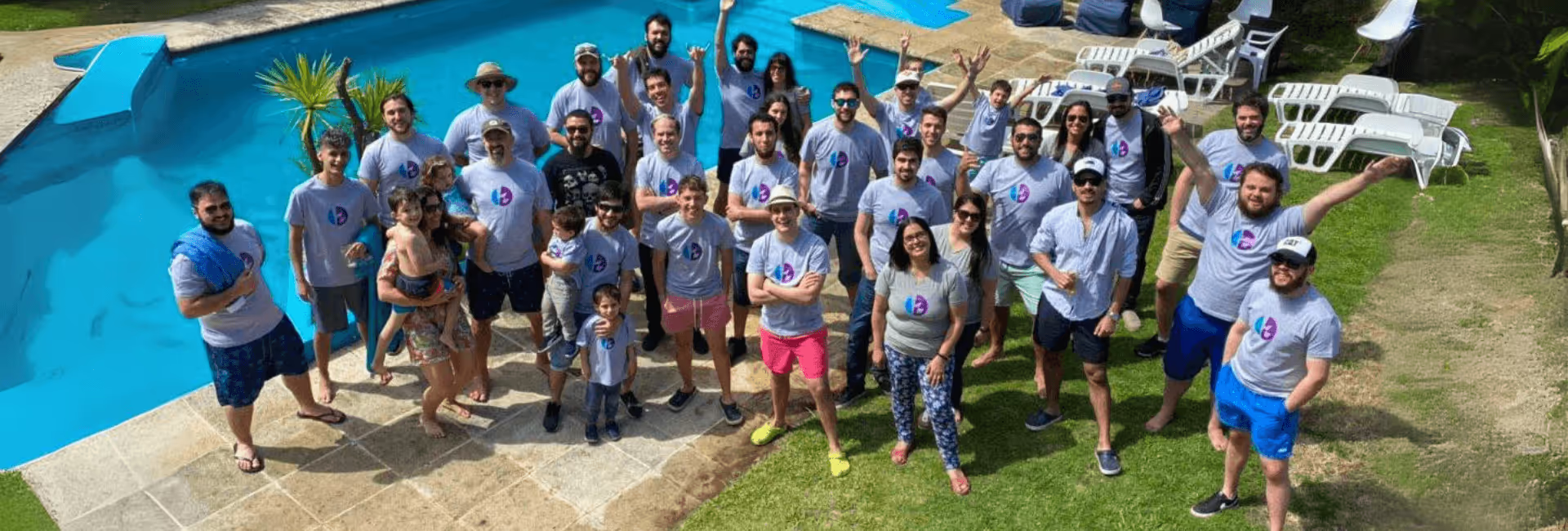
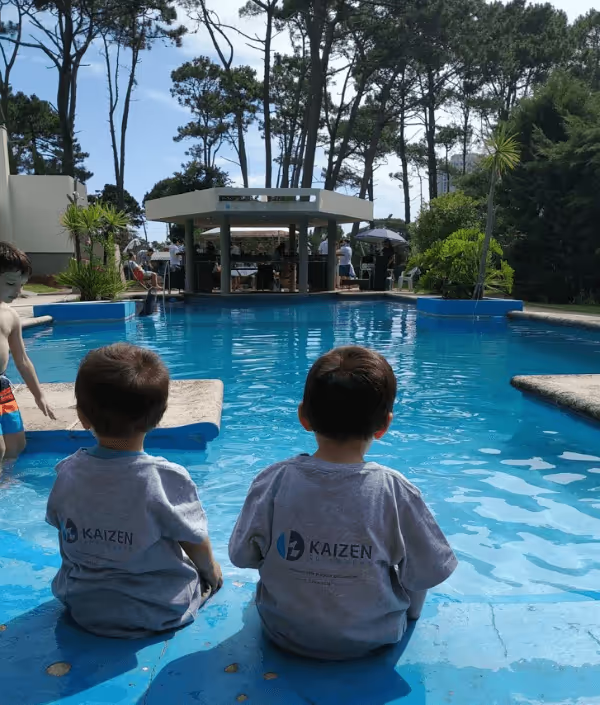
It's December 1st and Kaizen is 5 years old now since it all started back in 2014. As every year, we celebrate by engaging with the whole team and their families renting a big house with a pool and bar for a full week. Check how much fun we had in this post!
During December of 2019, we rented a house in Punta del Este, one of the most beautiful tourist spots in Uruguay, especially during Summer. It was a great week where part of the team spent the weekdays at the house working and having fun. Then by the weekend, the whole team gathered at the house to spend all day Saturday having an asado, drinking and laughing.
As every year, we had the "Kaizen Awards", a fun way of celebrating the things that happened in our company during the year.
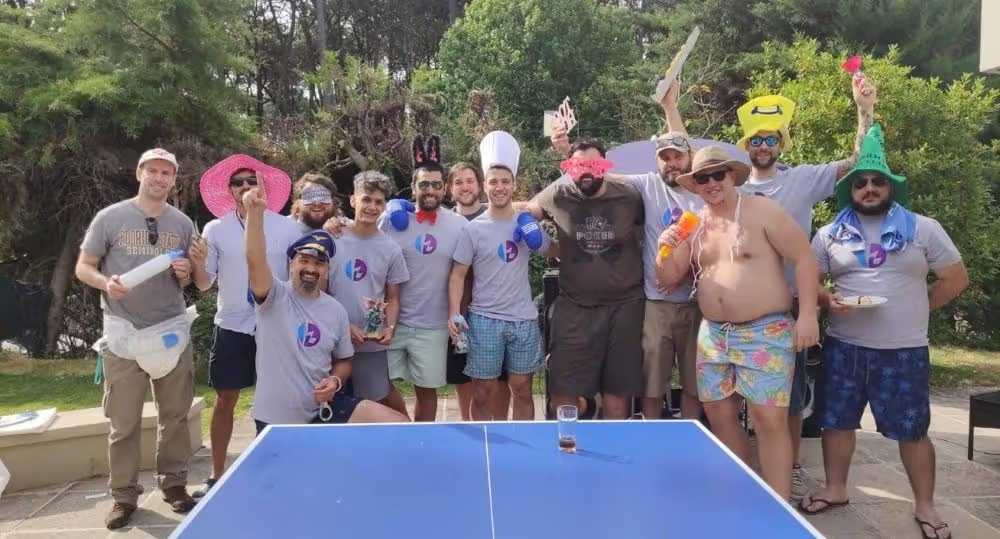
While eating and drinking with our family and friends, we had a ton of fun playing ping-pong, playing board games, tennis-football, and swimming in the pool!
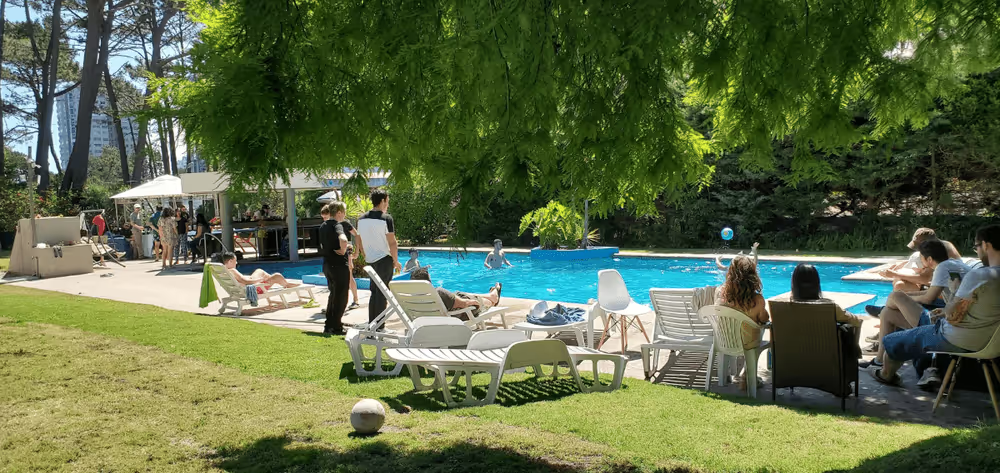
See you next year!

About Us
·
Sep 2, 2019
12 read time
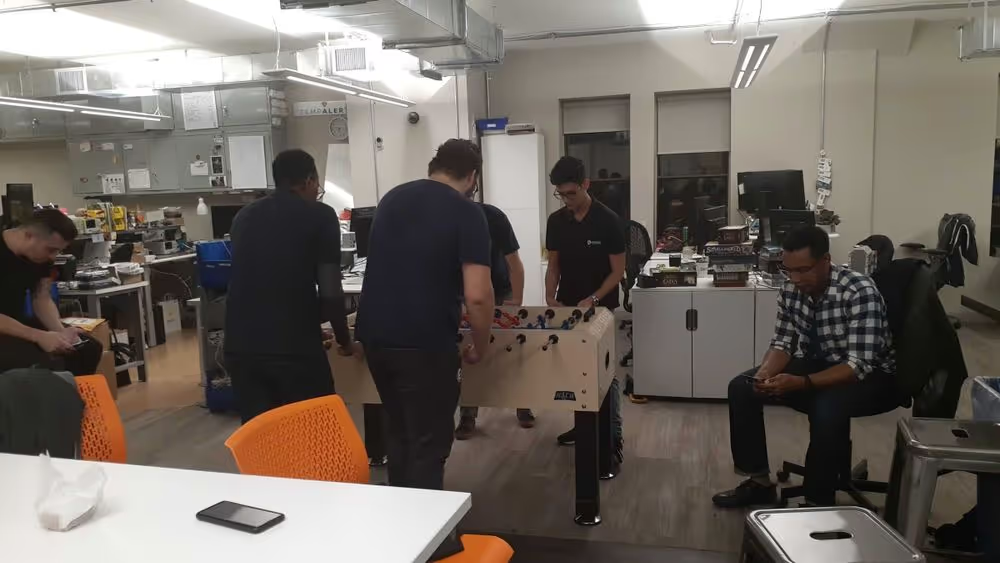
Team collaboration is key to develop quality software. While we work most of the time from our Delivery Center to deliver software applying agile methodologies, having the chance to meet in person with our clients to collaborate, work on details, and reduce ramp-up time, usually at the beginning of the project, is highly valuable for everyone involved.
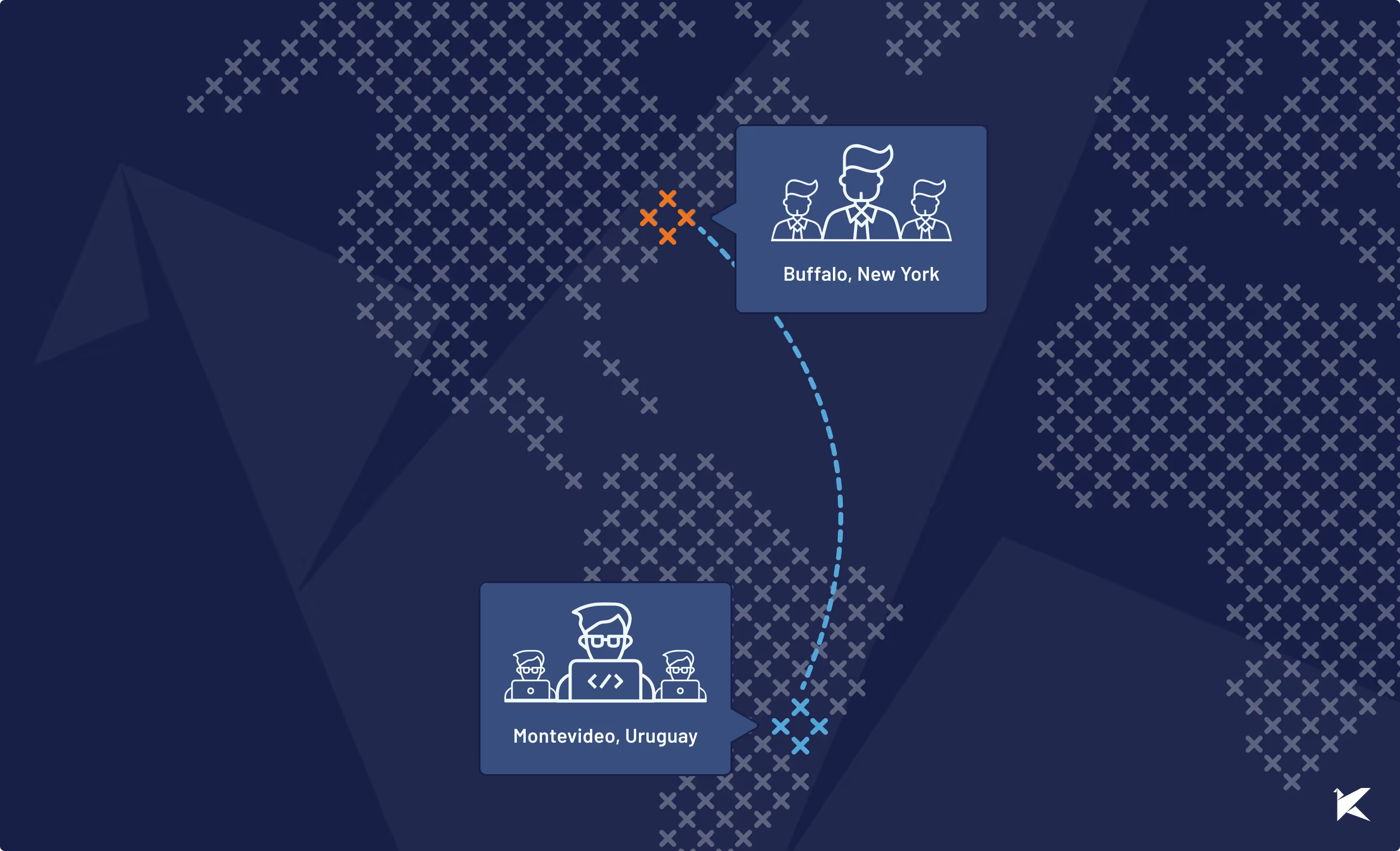
During 2019 our team traveled 4 times to meet with customers based in Boston, MA and Buffalo, NY. SmartBorder, Blueport, and SmartSense are some of them. You can learn about their feedback in our success cases section.
Usually, these trips take 1 week where we visit the client, have several meetings, work side by side, adjust details, and of course have some fun outside the office to build a great and trusting relationship.




About Us
12 read time
For small to mid-size companies, hiring a software development firm to help with your IT needs is essential to its success today. There are more than 500,000 software development and IT services companies in the U.S. alone, so how do you know who to hire?
For the firms that have entrusted us with this responsibility, we are grateful for them and proud of the success they have achieved using our services.
Our clients recently left us great feedback on Clutch, a ratings and reviews platform headquartered in Washington, D.C. This has allowed us to be named amongst the top software developers.
We recently worked with a Learning Solutions company to update its education platform, building its eighth and most recent version. We integrated it with email notifications and dashboard plugins, and we continue to provide maintenance.
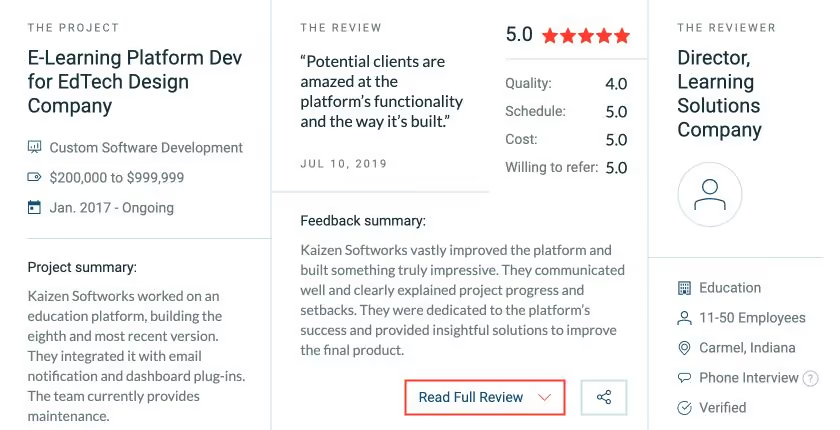
In the 5-star review, the Director said:
“Potential clients are amazed at the platform’s functionality and the way it’s built.”
This is something that all of our clients can expect if they choose to work with us. Client satisfaction and feedback are very important to us.
Another example of a satisfied client is SmartBorder, an import/export software company in Buffalo, New York. We worked on a multi-year project, upgrading and developing its main platform. The SmartBorder Director of Technology, Ron Barone, in this 5-star review, said:
“They’re hungry programmers that do a really good job.”
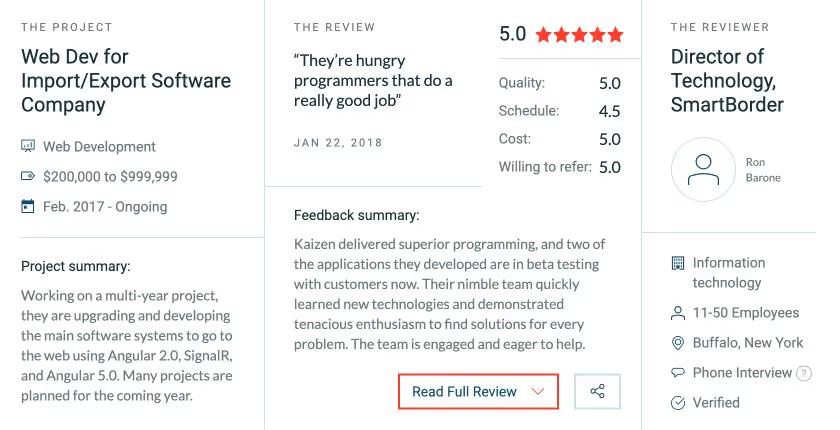
You can expect this type of commitment in terms of quality and quantity if you choose to partner with KAIZEN Softworks for your next project.
“Customer feedback is very important to Kaizen Softworks. It's one of the main tools that allows our company to continually improve and provide better services for our customers. Services like Clutch help us gather this feedback, and it has been a great source of validation for potential customers, too.” – Kaizen Softworks former CEO and Co-Founder Fabian Fernandez

About Us
12 read time
In a dynamic world driven by mobile technology, the demand for exceptional mobile app developers has never been higher. In this context, Kaizen Softworks has been recognized as top mobile app developers in the United States during Clutch's 2018 research.
Clutch's research team, led by Business Analyst Sara Philibotte, scoured the mobile app development landscape to uncover the industry's top talents. The rigorous selection process took into account a myriad of factors, including the quality of client feedback, the range of service offerings, the richness of the portfolio, and the overall market presence of the contenders.
Out of a pool of more than 640 companies, Kaizen Softworks stood out as a true mobile app development powerhouse.
Sara Philibotte, the Business Analyst behind the research, emphasized the exceptional qualities that set Kaizen Softworks apart from the competition. She noted: 'These app developers have risen to the top of our research rankings due to their phenomenal dedication to their clients and their mobile app development prowess'.
This recognition serves as an inspiration to aspiring developers and a testament to the tremendous potential of the Nearshore mobile app development industry.
Our dedication to providing exceptional services, tailored to meet our partners' specific needs, is to none. The Clutch recognition is not just a culmination of our efforts; it's a harbinger of even greater achievements on the horizon.
As we continue to set new standards in the industry, we anticipate an even brighter future for our exceptional mobile app developers.

About Us
·
Sep 26, 2018
We were named a top B2B provider in LATAM. Here’s what’s behind that.
12 read time
Headquartered in the heart of Washington, D.C., Clutch is a leading B2B research, ratings, and reviews firm dedicated to connecting small and medium businesses with the perfect agencies, software solutions, or consultants for their specific needs. By applying a meticulous methodology that considers verified client reviews, available services, work quality, and market presence, Clutch assists businesses in tackling their challenges with confidence and finds the ideal partners to collaborate with.

We're delighted to announce that Kaizen Softworks has once again secured its place in the spotlight, earning recognition as a Top-Rated B2B Service Provider in Latin America for 2018. This prestigious acknowledgment comes from Clutch, a reputable B2B research, ratings, and reviews company headquartered in Washington, D.C.
Clutch's 2018 rankings represent a careful evaluation of all the companies listed, focusing on critical aspects such as client reviews, service quality, the range of services offered, and the overall presence in the market.
Ricardo Real, the Senior Analyst responsible for the extensive research, pointed out some compelling reasons why nearshoring services in Latin America are such an attractive option for businesses, particularly those based in the United States. Nearshoring refers to the practice of outsourcing specific business operations or services to a nearby country or region.
'The highlighted agencies are top performers in their countries and the region (...) “Nearshoring the development, design, and marketing of a digital product to Latin America is a smart option for companies based in the U.S. The leading B2B companies featured in this year’s report share convenient time zones with major U.S. cities and have qualified talent, aligned working cultures, great English communication, and competitive rates, so clients get the best value for their money', Real said.
Latin America's allure as an outsourcing hub lies in its advantageous time zone compatibility with major U.S. cities, enabling real-time communication and efficient collaboration. The region also boasts a pool of highly skilled and qualified professionals who bring their expertise to the table. This remarkable talent pool is complemented by aligned working cultures, facilitating seamless cooperation between clients and service providers.
Furthermore, Latin America has seen remarkable growth in its English proficiency, ensuring effective communication between businesses from different corners of the world. Clutch's evaluation recognized the competitive pricing offered by Latin American service providers, ensuring that clients receive excellent value for their investments.

Technology

·
Sep 5, 2018
12 read time
Welcome to the first installment of our series dedicated to streamlining web development and boosting your productivity.
If you've ever found yourself drowning in repetitive CSS tasks, this post is your lifeline. In this post, we'll delve into the basics of Sass, paving the way for a more efficient and enjoyable web development journey. Say hello to cleaner, more maintainable code, and wave goodbye to CSS monotony.
The scenario is simple, you're developing a website or web app, and for sure you want it to look as good as you can, which is obviously accomplished by using CSS. Then you find yourself repeating tag names, properties, colors, and having a gigantic main.css file (or maybe a lot of <src rel="stylesheet"> tags in your HTML header?).
And what if you want to change something as the main color of your website? Dozens of lines changed just because #7a19a8 seemed slightly better than #7211a0.

Is there even a difference?
Well, to solve all of this and more, in 2006 the Syntactically awesome style sheets were created, Sass for the friends. Sass is a preprocessor scripting language that is interpreted or compiled into simple CSS. What all of this means is that Sass extends the CSS syntax, using a similar structure, with a lot more fuctionality.
All installation steps are covered in Sass' official install guide. In this post, I'm going to show you some basic syntax so you can make your CSS better since day one.
Variables are a core part of Sass, the premise is that you declare any data in the form of a valid data type in Sass, and you can use it all along your stylesheet. Here is the syntax:
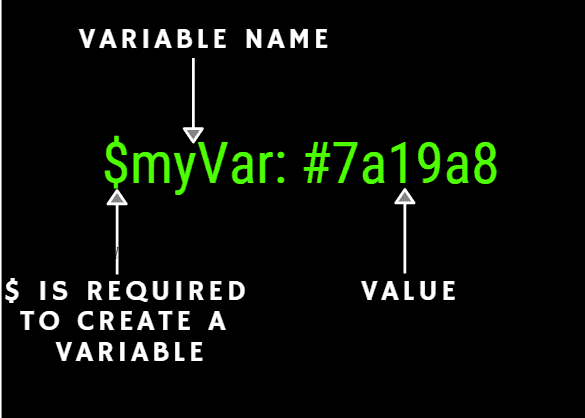
With Sass Selector nesting we can transform this:
div {
  // Some properties for a div
}
div span {
  // Some properties for a span tag inside a div
}
div p {
  // Some properties for a p tag inside a div
}
Into:
div {
  // Some div properties
    span {
      // Some properties of a span tag inside a div
    }
    p {
      // Some properties of a p tag inside a div
    }
}
Basically, you can nest selectors within selectors to avoid repeating tags each time you may need to go deeper in order to win specificity.
You can also add pseudo elements and modify parent selectors inside themselves with the & symbol, this way:
div {
  // div properties
  &.steve {
    // properties of a div with steve class
  }
}
A mixin is a Sass feature that allows you to define reusable pieces of code, and even allows parameters, just as functions, in order to modify its behavior without having to draw upon semantic classes as .margin-box-size-1. Let's see them:
@mixin box-size($size: 1em) {
    margin: $size;
    padding: $size;
}
You define a mixin by using @mixin, then you name it, in this case is box-size and write down the parameters it will receive, if any. In this case we also have a default parameter $size: 1em. The variables will be replaced with their value at build time, and everything inside the mixin will be placed wherever is used across the stylesheet. You call the mixin function by using @include followed by the mixin name.
div {
    @include box-size(3em);
}
// Will be replaced by
div {
    margin: 3em;
    padding: 3em;
}
With Sass we can bring common programming sentences into stylesheets, with control directives as @if, @for, @each and @while, we can sort out, repeat and take from a map or list any piece of code. Lets take a brief look over each syntax.
@ifThe @if directive takes any SassScript truthy or false expression and executes whichever code sections applies:
@if (true) {
    // This code will always run
} @else {
    // this code will never run
}
@forThe @for directive is pretty straight forward, it runs the code inside the braces for a determined amount of times. The syntax is as follows:
// We declare a variable $i for the iterator, which starts at [from] and ends in [trough] values
@for $i from 1 through 6 {
    margin: $i+px;
}
@whileThe @while directive works pretty much as the @for directive, with the difference that the condition of the loop to execute is entirely on us, and not only an incremental operator.
$execute: true;
@while ($execute) {
    @debug($execute);
}
@debug() will print out any value to the console while building, as its name says, its awesome for debugging!
@eachLast but not least, @each works slightly different from the other directives, as it goes trough a collection such a map or a list instead of simply a condition, and exposes the current value for you to use.
$colors: red green blue;
@each $color in $colors {
    background: $color
}
And that's it! With this easy tool you can start to write cleaner and more maintainable CSS from now on.
If you have any doubts you can find me on twitter as @stiv_ml. I will be more than pleased to answer any question!

Project Management
·
Jun 15, 2018
At some point, every developer needs to level up. This is how we think about that shift.
12 read time
I've been working as a developer for around 1 year, I'm currently studying CS and always loved the idea of making things work as I want by writing code. My current stack at work is mostly JS (Angular 2+, Node), and have worked with C# (.NET).As a young developer being in the industry since so early, I've been really curious about how we developers define ourselves by 'Ranks'.When do you become a senior developer? How do you do it? What should you do/know? I still don't have answers to those questions, but I realized there's a key factor that influences every developer career, no matter how much time and experience they have...
When I was just starting, I had to fight with the overwhelming amount of things that seemed necessary to learn in order to call myself even a developer, let alone working as one. This takes us to the first point:
Nobody knows everything, and this is specially true in programming. No matter how many years of experience or how many languages a developer claims to know, what really matters is how he/she approaches learning new things. This is an attitude that will open you a huge amount of opportunities.Don't be afraid of spending hours on a problem that might seem the simplest of them all, just because you don't know how does X thing work, as long as they are spent researching and actively working on understanding it. In the end, you might have learned more than what you were first looking for.It's also important to have in mind that ...
As every other discipline, being proficient as a developer will take time, understanding some things will take time, and making things work will take time, but you should always look forward to complete what you're doing, because stress and fatigue may come, but will always pay off in the long run.You will be a better developer, and may be able to complete any similar task in a better faster and cleaner way sometime in the future.
And I can't stress this enough. Asking other developers when you're new into programming is one of the best and most enriching things you can do, because most of the time people will be eager to help you and you may learn a whole lot of things in a way it's really hard to reproduce any other way.Most experienced developers also make questions all the time. Not knowing something doesn't make you less of a developer.
What else would you add to this list? When did you stopped feeling as a junior? Leave it in the comments!
About Us
12 read time
Corporate Vision Magazine's Technology Innovator Awards have honored us with the title of "Best SME Technology Consultancy in South America" for 2018.
In recent years, the digital transformation has led to an increased demand for technology services across various industries. Businesses are relying on technology to foster their growth and stay competitive. To meet these evolving needs, technology companies must be at the forefront of innovation.
Corporate Vision Magazine (CV Magazine) is dedicated to acknowledging technology firms that lead the way in innovation and outshine the competition.
We are proud to be recognized for our innovative technology services in a rapidly evolving digital landscape.
We extend our gratitude to our valued customers for their trust in our ability to deliver significant value to their companies while staying at the forefront of technology trends.
No blogs matched this category, try applying different filters.