
·
Nov 4, 2026
SmartSense Live 2026 | Food Safety Summit
SmartSense LIVE26 recap: SmartSense ONE’s launch, the Disruptive Technologies acquisition, AI assistant KAI, and what it means for food safety and compliance teams.

4
min read
Read more
Kaizen Teams


·
5
min

·
September 30, 2026

·
November 13, 2026



Martin Mato
AI
AI
AI
Technology
Technology
Technology
·
November 13, 2026
·
November 13, 2026
·
5
min read
Martin Mato
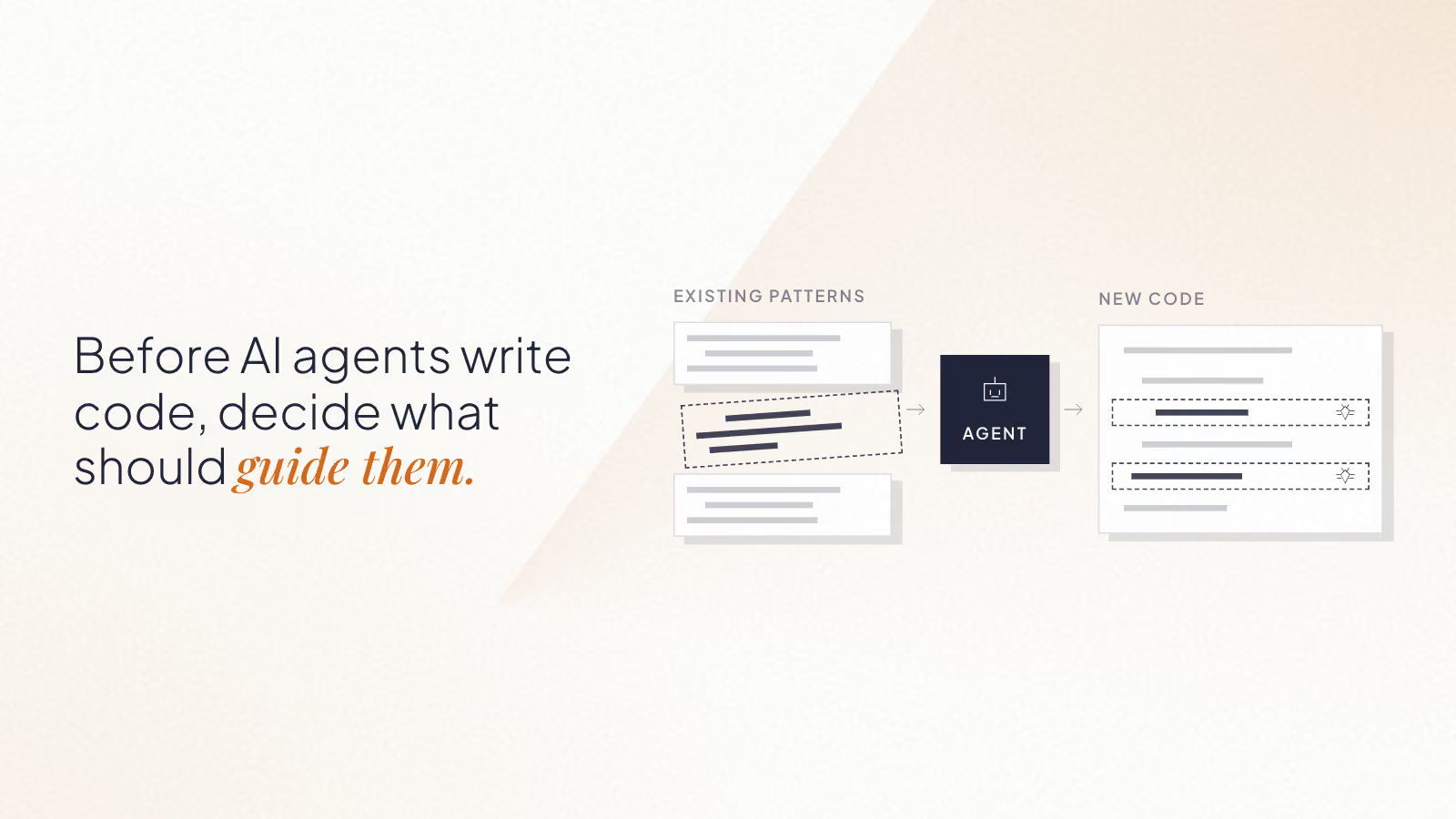
An AI coding agent works with the context your team gives it: existing code, documented decisions, instructions, and reference examples. If that context contains inconsistent patterns, the agent can repeat them.
Before implementation starts, engineering leaders need to define how agents should work and how the team will check their output. Choosing a coding assistant does not make those decisions for you.
For greenfield projects, where the team is building a new codebase, our approach starts with Sprint 0. This is when the team sets the architecture, coding conventions, agent guidance, and verification process.
The setup has two parts: guidance that shapes the agent's work before it starts, and checks that catch problems afterward. With both in place, agents can take on more implementation while engineers stay responsible for how the software is built.
The codebase is part of an agent's instructions. Its structure and existing implementations show the agent which patterns to follow.
A well-structured starting point gives the agent better direction than an empty repository or inconsistent boilerplate. That makes the team's early decisions important because those decisions become context for future work.
Sprint 0 makes that direction explicit through four elements:
The team also needs to decide what agents can access and do. That includes which files and systems they can see, which tools they can use, what they can change, and which reviews they must pass.
Without enough context, agents have to infer what the team wants. Weak constraints can lead to inconsistent implementations.
Setting those boundaries is part of the engineering work that should happen before agents start building.
Guidance shapes the work, but the team still needs to check what the agent produces.
That process can include:
Engineering leaders need to define and maintain these checks. Stronger verification gives the team more confidence to delegate implementation work because problems are easier to detect before they reach production.
As agents take on more implementation, engineers can spend more time on architecture, review, and improving the guidance the agents work from.
Implementation needs the same clarity: a description of what the team is building.
In this model, Product explores an idea in a separate environment and validates it with customers. Once the idea is ready for construction, Engineering receives:
The experimental code stays in the exploration environment.
We cover that handoff in When PMs can ship code, what changes for Engineering?, including what Product should provide after testing an idea.
During construction, the specification defines the behavior the implementation needs to meet, including edge cases and failure modes. Engineering decides how to implement that behavior within the agreed architecture.
This gives the agent a defined target and gives the developer a clear basis for reviewing the implementation.
Sprint 0 prepares the environment, but engineers continue making decisions throughout implementation.
The developer chooses the architecture and reviews the agent's execution plan, including which files it will change and which risks it has identified.
During implementation, the developer supervises the work. Before sign-off, the changes go through manual review, automated checks, and security review.
If the work stops matching the specification or architecture, the developer should stop and reset the cycle.
The guidance from Sprint 0 also needs to evolve. As the team builds, engineers can add new rules and examples, update existing ones, and remove documentation that no longer reflects the codebase.
Maintaining the context agents use becomes part of the development process.
This approach is easiest to establish on a greenfield project because the team can set the architecture, conventions, and verification process from the start.
Existing codebases are different. Their previous decisions and inconsistencies are already part of the context an agent sees.
Teams can still introduce the same kinds of guidance and checks. Reaching consistent agent output can therefore take more work.
For a new project, Sprint 0 gives the team a chance to make those choices before implementation begins. Define the architecture, give agents clear guidance, put verification in place, and keep engineers responsible for architectural decisions and release approval.
Then keep that foundation current as the codebase grows.
If your team is starting a new project with AI coding agents, we can help you define the architecture, repository guidance, and verification process before implementation starts.
No. The construction cycle can work with different architectures, including monorepos, microfrontends, and serverless systems.
No. Exploration needs different boundaries from production development.
In this model, PMs work in a separate preview environment with sanitized data, no direct access to the production database, and no path for changes to reach production automatically.
That gives PMs room to build, test, and discard ideas without putting the live application at risk.
The design system, maintained by UX, gives agents and PMs design tokens and component conventions to work from.
That lets Product explore ideas within an established visual language without redefining shared patterns on every iteration. Designers can also join during ideation or provide detailed prototypes when a feature needs more design input.


Events
·
Nov 4, 2026
SmartSense LIVE26 recap: SmartSense ONE’s launch, the Disruptive Technologies acquisition, AI assistant KAI, and what it means for food safety and compliance teams.
4
min read
AI
UX Design

·
Oct 23, 2026
How a design system lets Marketing and Product teams use AI to build on-brand prototypes, based on Kaizen’s own experience and turnaround numbers.
6
min read