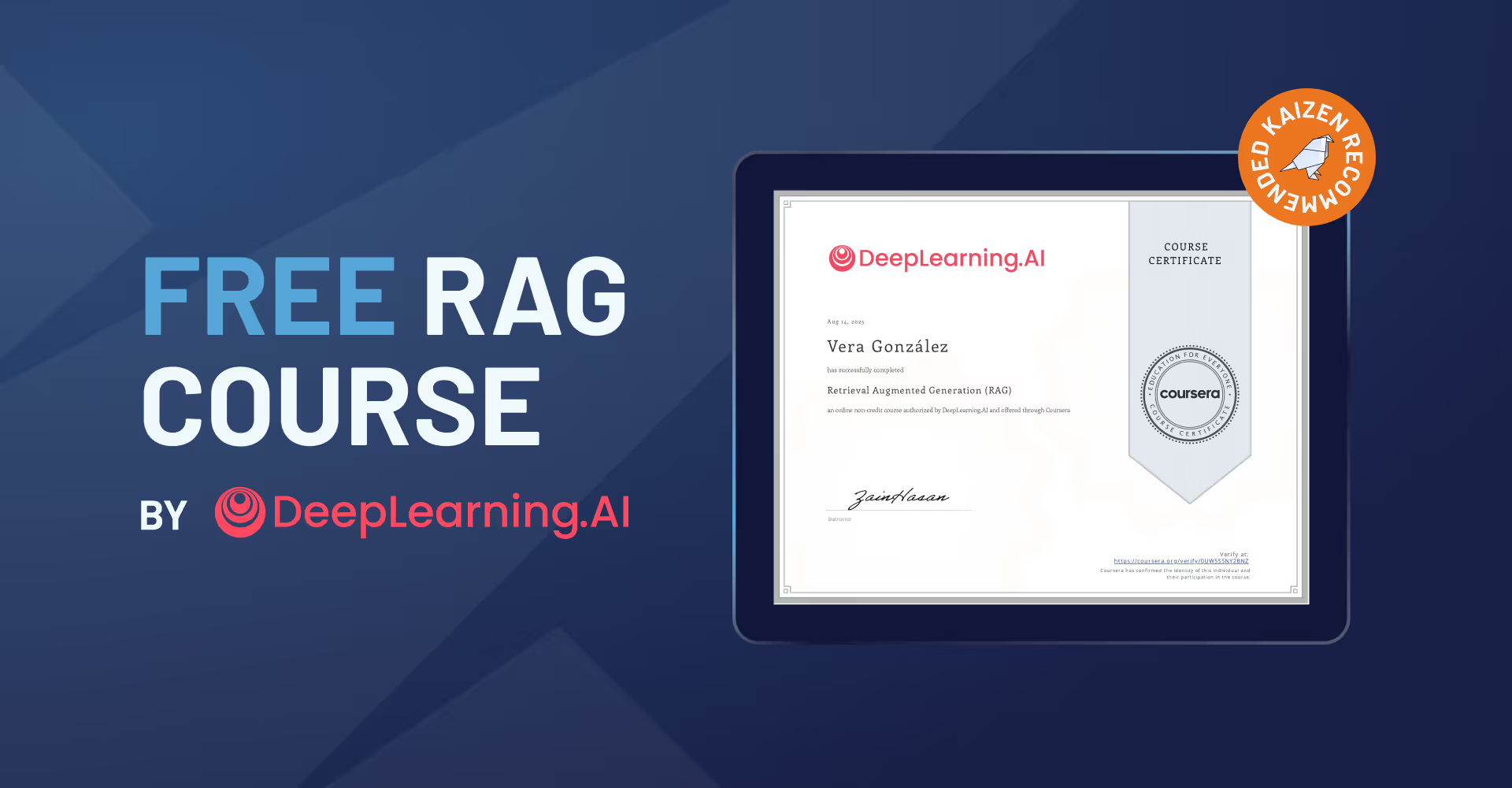
I just finished a course that I have to tell you about, especially if you’re building with LLMs. You know the drill, you build something cool, but the model starts making things up (“hallucinating”) or its knowledge is stuck in 2023.
We’ve all been there. But there’s a practical fix called Retrieval Augmented Generation (RAG), and the team at DeepLearning.ai has released a course to master it, and it’s 100% free to learn.
What is RAG, and Why Should You Actually Care?
LLMs are incredible, but they come with well-known limitations. They can make up facts, and their knowledge is limited to their training data (which is always out of date).
RAG is the elegant solution to these problems.
Instead of just using the LLM’s static knowledge, a RAG system first retrieves relevant, up-to-date information from a reliable source, like your company’s wiki, a live database, or any other source you trust. It then augments the prompt with this information, giving the LLM the exact context it needs to give a smart, accurate answer.
Long story short: it’s how you give context to an LLM to stop making stuff up and start using real, up-to-date information.
So, What’s This DeepLearning.AI Course All About?
This course it’s built to take you from “What’s RAG?” to build production-ready applications. The knowledge is completely free. If you want a certificate to pop on your LinkedIn, that’ll run you about $49, but it’s totally optional.
Who is This Course For?
This is definitely for engineers who already have some Python skills under their belt. You’ll be in good shape if you have:
- Intermediate Python skills.
- A basic grasp of what generative AI is.
- High school–level math (nothing too crazy).
Here’s a Look at What You’ll Learn
The course is self-paced and broken into five chunks. They estimate it takes about a month if you put in around 5 hours a week.
Here’s a quick rundown of the good stuff:
- Build a Full RAG Pipeline: You’ll learn how to actually connect an LLM to an external knowledge base from the ground up.
- Master Modern Search: Go beyond basic searches with techniques like semantic and hybrid search, using things like vector databases.
- Data Handling: Dive into essential concepts like chunking and query parsing for optimal retrieval.
- Handle Real-World Data: Learn the essentials of chunking and parsing documents so the retrieval part actually works well.
- Evaluate and Deploy: Figure out if your RAG system is actually any good, learn how to spot hallucinations, and get it ready for prime time.
My Take: Is This RAG Course Worth Your Time?
Absolutely. RAG is quickly moving from a “nice-to-have” to a “must-have” skill for anyone serious about building practical AI applications.
What I love about this course is that it pushes you past the simple “hello world” examples and into the stuff that matters for real-world deployment, like evaluation and optimization.
For me, this is the most direct path to leveling up your AI skills and building applications that are genuinely more reliable and powerful. It’s a skill that will absolutely make you a more valuable developer.
The Quick-Hit FAQ
I figured you might have a few questions, so here are the quick answers.
Is the DeepLearning.AI RAG course really free?
Yes. All the videos and labs are totally free. You only pay (about $49) if you want the official certificate at the end.
How long does the course take to complete?
It’s self-paced, but plan for about 5 hours a week for a month to get through everything comfortably.
Do I need to be an AI expert to take it?
Not at all. As long as you’re solid with Python and know the basics of AI, you’ll be fine.
Ready to Start Building Smarter AI?
If you’re tired of the limitations of off-the-shelf LLMs, this is your next step. Stop letting your models guess and start giving them the facts.
Check out the free Retrieval Augmented Generation (RAG) course on DeepLearning.AI